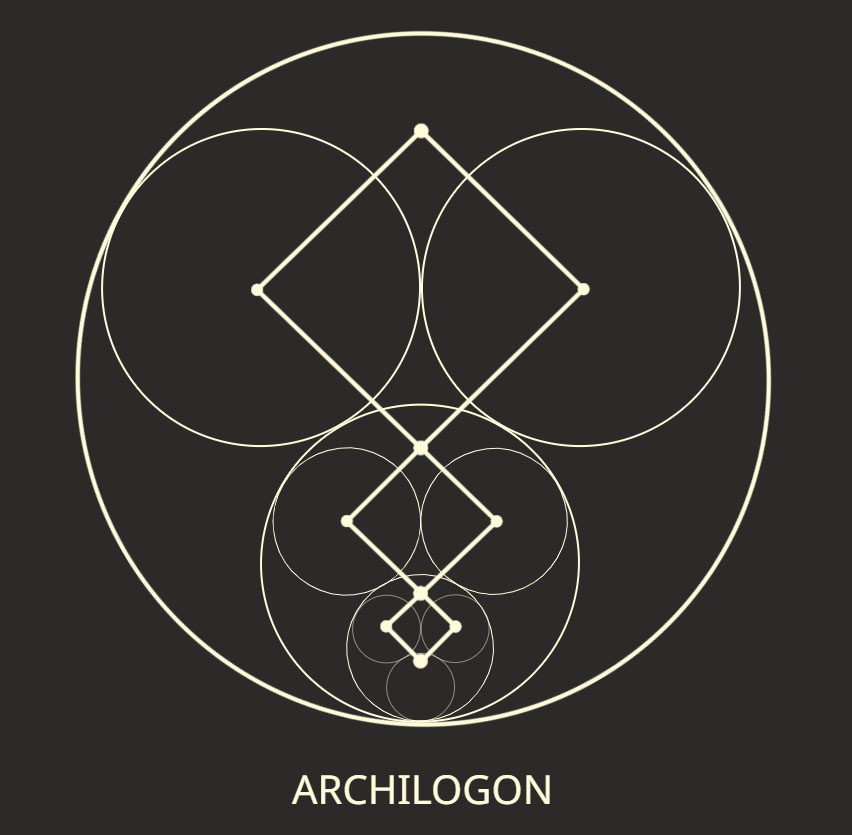
Archilogon 001 - Presentation
Presentation of Elias Artista and brief notes on the contents offered by this website, dedicated to Pythagorean Philosophy.
Archilogon � The key to Synthetic Logic. A project by Elias Artista.
Video Transcription
Welcome, wanderer.
I am the digital avatar of Elias Artista, and together with my material counterpart, we shall introduce the content of this channel.
Let us begin by clarifying that this is not a channel devoted to esotericism or spirituality, but one dedicated entirely to Philosophy.
Yet it is not Philosophy in the sense with which you may already be familiar, but Philosophy in its most original meaning, namely, in the Pythagorean and Platonic sense.
Why this distinction? The reason is that the ancient Pythagorean doctrine, in the incomplete form in which it has come down to us, has until today been regarded as partly irrational.
Throughout history, the failure to grasp the essence of the ancient Pythagorean Philosophy has produced two opposing approaches: on the one hand, it has become the preserve of esoteric circles; on the other, within academia, it has developed along heterogeneous lines, drifting from its original purposes and gradually taking on the character of Theology, Ethics, Psychology, Sociology, Semiotics, or Politics.
In this channel, we shall deal exclusively with the original aim of Philosophy: the logical�metaphysical study of the "Intelligible World", that is, the "World of Ideas�Forms", of which Plato speaks in his Dialogues.
Strange as it may seem, this "World of Forms" can be entirely resolved into the geometric lines of a diagram, which tradition has handed down to us under the name of Tetractys, for the Pythagoreans, or Psyche, for the Platonists.
Of the Pythagorean Tetractys, only a triangular symbol has survived, which does not do justice to its logical origin and its dynamic mechanism, while Plato described the Psyche in a rather elusive and enigmatic way.
Among the best-known descriptions are the Divided Line contained in the dialogue Republic and the passage in the Timaeus known as �the psychogony�, which gave rise to one of the most celebrated reconstructions: the Lambda of Crantor of Soli.
All these interpretations, however, fail to grasp the rational core of Pythagorean Philosophy.
We have reconstructed the diagram through the logic that emerges from Plato�s Dialogues and its reflections in collateral traditions, both Greek and Middle Eastern.
We have christened our reconstruction with the name Archilogon, to distinguish it from its historical counterpart.
What, then, is the Archilogon? The Archilogon is the geometric representation of the logical structure of Reality.
This representation was most likely used by Plato in composing his Dialogues.
The ancient diagram, presumably contained in the work of Philolaus of Croton, On Nature, was lost upon Plato�s death and with the disappearance of members of the first generation of the ancient Academy, such as Speusippus and Xenocrates.
This loss caused the drift of Pythagorean Philosophy.
We shall explore the historical and documentary circumstances in the upcoming videos.
Our reconstruction is the outcome of many years of historical�philosophical research, supported by ancient sources reinterpreted in the light of the logic conveyed by the archetypal diagram.
That is all. In the next video, we shall address some natural historical and philosophical objections.
We take our leave of you with the formula: �To the Principle!�