Archilogon 003 - The stages of the journey
Elias Artista here presents the path of the Archilogon in thirty-two stages, each marked by a keyword, revealing the fundamental role of Synthetic Logic in interpreting Pythagoreanism and Platonism. From the prologue “Chaos” to the conclusion “Cosmos,” the journey alternates between the history of ideas and theoretical foundations: Platonic Realism, the revival of Metaphysics, the power of diagrams, and the World of Ideas-Forms conceived as a fourth gnoseological dimension. A substantial historical section retraces the Mathesis Universalis (the Academy, Neoplatonism, Kabbalah, Humanism, and modern Idealism) and the Pythagorean Quadrivium. The theoretical part defines its pillars in five keywords—Geometry, Logos, Dialectic, Methexis, Analogy—and culminates in the archetypal diagram of the Archilogon, modelled on the Principles of Reciprocal Implication and Relativity. The work also includes studies on Timaeus, Psyché, and Parmenides, on the relation between philosophy and science (from Cusanus to Cassirer), on esoteric traditions (Egypt, Bagua, Zodiac, Ilan, Enneagram), and concludes with a final dialogue with AI (“Eidos”).
Archilogon – The key to Synthetic Logic. A project by Elias Artista.
Video Transcription
Welcome, wanderer. If you have arrived here after watching the presentation, we shall assume the Archilogon project has piqued your curiosity. If this is the first video on the channel you are tackling, we recommend returning to the presentation. It is vital that your approach to the videos on this channel be orderly and progressive. Some ideas cannot be grasped until we have first cleared the ground of prejudices, inaccuracies, and misleading traditions.
The logic of the Archilogon demands an initial phase of demolition, followed by a phase of reconstruction. Ours will be a genuine journey, a path of inner transformation. This journey into the original Philosophy unfolds in thirty-two stages. Each stage is marked by a keyword that will illuminate Synthetic Logic from a particular vantage point.
The word guiding the first stage of our journey is: “Chaos”. “Chaos” serves as a prologue. Here we set out the rationale of the work, underscoring the need to propose a new interpretation of Pythagoreanism, not as a dogmatic doctrine, but as a logical system. The reconstructed system will be termed Synthetic Logic, set in antithesis to traditional Aristotelian Analytic Logic.
The word guiding the second stage is: “Plato”. Plato functions as an introductory chapter. We shall survey several academic approaches to Plato’s oeuvre and introduce a new interpretative key to the passage of the “Divided Line” in the “Republic”. The use of diagrammatic reasoning will be claimed as essential for reconstructing Synthetic Logic and the archetypal structure, namely: the “World of Ideas-Forms”.
The word guiding the third stage is: “Metaphysics”. Metaphysics, the most authentic core of Philosophy, will be reconsidered in its fundamental lines and purged of Aristotelian and theological accretions. Metaphysics will be confined to the study of the “Intelligible World”, the domain of Forms, conceived as a fourth gnoseological dimension, alongside the “Sensible World”, “Thought”, and “Language”.
The word guiding the 4th stage is: “Symbol”. Here we re-read the history of Philosophy from the standpoint of so-called Platonic Realism. Platonic Realism maintains that the World of Ideas-Forms is, in every respect, a subsistent dimension, not a construct of thought. The delegitimation of this fourth dimension will be presented as a key factor in Philosophy’s decline.
The word guiding the 5th stage is: “Nous”. In this dense and demanding chapter, we analyze the principles of Platonic realist Idealism as they emerge from the reconstruction of Synthetic Logic, and set them against the psychologizing version of Metaphysics proposed by Kant. The “transcendental” stance will be delegitimized, while the “transcendent” stance will be reaffirmed, on account of its logical necessity.
The word guiding the 6th stage is: “Academy”. We begin a five-part historical journey through the so-called Mathesis Universalis, the project of a mathematical interpretation of reality. We discuss the activity of the ancient Platonic Academy, organized, at least in part, on the model of Pythagorean confraternities. Central to understanding Pythagoreanism is a revision of the Plato-Aristotle relationship, which was far less profound than tradition suggests. We shall see how Aristotle’s marginal position, in relation to the “so-called Pythagoreans”, prevented him from fully grasping Pythagoras’ metaphysical doctrine and Plato’s project, as well as the true nature of the Ideas-Forms.
The word guiding the 7th stage is: “Dogma”. This chapter is an interlude within the journey through the Mathesis Universalis. We explain why Pythagoreanism acquired dogmatic features and bring its rational core to light. We clarify the distinction between “Theology” and “Theosophy” and identify the loss of the diagrammatic key as the decisive event that, for centuries, negatively conditioned the development of philosophical thought.
The word guiding the 8th stage is: “Pantheon”. We continue our historical path within the Mathesis Universalis by investigating the metaphysical architecture emerging from the works of Plotinus, Iamblichus, and Proclus, heirs to ancient Philosophy. The advent of Christianity compelled pagan theosophers to construct an antithetical religion upon Pythagorean and Platonic foundations. Although deprived of the archetypal diagram, their works reveal clear traces of Synthetic Logic.
The word guiding the 9th stage is: “Kabbalah”. In this third chapter on the Mathesis Universalis, we retrace the Middle Ages and the Renaissance. We highlight the logical roots shared by Pythagoreanism, Platonism, and Jewish Mysticism, with the “Sefer Yetzirah” as a seminal text. We find traces of Synthetic Logic in the thought of cabalists such as Joseph Gikatilla and Johannes Reuchlin.
The word guiding the 10th stage is: “Mathesis”. We recount how abandoning Aristotelianism and the re-emergence of Pythagorean thought contributed to the birth of modern Science. Traces of Synthetic Logic surface in Copernicus, Kepler, Galileo, and Descartes. Nicholas of Cusa will be indicated as the first modern thinker who tried to formalize Synthetic Logic with the aid of diagrams.
The word guiding the 11th stage is: “Idea”. This chapter marks our final historical incursion into the Mathesis Universalis. We explore the consequences of the transition provoked by the Kantian Revolution—from Metaphysics to Psychology. The thought of Fichte, Schelling, and Hegel is interpreted as an attempt to re-actualize Platonic Idealism in a post-Kantian key. Ernst Cassirer is presented as the last great modern idealist.
The word guiding the 12th stage is: “Pythagoras”. After eleven preparatory chapters, we finally set out the conceptual nucleus of Pythagoreanism and the “Doctrine of the Partition of the Whole”, grounded in a distinctive kind of inference: “Structural Deduction”. Within the classic “Pythagorean Quadrivium”, we distinguish four disciplines: Astrology, Harmonology, Arithmology, and Eidometry, differentiating them from their post-Aristotelian counterparts: Astronomy, Music, Arithmetic, and Geometry.
The word guiding the 13th stage is: “Astro”. We begin a four-part path through the Pythagorean Quadrivium. The first discipline is Astrology. We reconstruct its logic, fruit of the ancient Doctrine of the Partition of the Whole, and examine problems generated by its empirical misreading.
The word guiding the 14th stage is: “Harmony”. Our second chapter on the Quadrivium focuses on Harmonology, which we sharply distinguish from the musical theories proposed in the Middle Ages by Boethius. The discipline originates, in fact, as the study of ideal proportions from a geometric standpoint. Here we present the reconstruction of Philolaus of Croton’s diagram of the Harmonic Octave.
The word guiding the 15th stage is: “Number”. The third Quadrivium chapter addresses Arithmology. We foreground the importance of Dialectic in the conception of the Even and the Odd, as emerges from Philolaus’s fragments, and re-read numerical relations in the light of Hegel’s categories of Quantity and Quality.
The word guiding the 16th stage is: “Tetractys”. This chapter concludes the tour of the Quadrivium and is devoted entirely to the fourth and most significant discipline: “Geometry”, here redefined as “Eidometry”. The Tetractys is presented as Pythagoras’ most precious legacy, overshadowing in importance the celebrated Theorem of the Hypotenuse. We examine ancient testimonies concerning the symbol and propose a shared origin for three archetypal structures: Pythagoras’ Tetractys, Philolaus’s Harmonic Octave, and Plato’s Psyché.
The word guiding the 17th stage is: “Geometry”. With this chapter we open a five-part exploration of the theoretical foundations of Synthetic Logic. The key terms are: “Geometry”, “Logos”, “Dialectic”, “Methexis”, and “Analogy”. We identify the “Ideal Geometry” conceived by the Pythagoreans, prior to “Euclidean Geometry”, as a proto-algebra, a symbolic representation that prefigures the formal language of modern Theoretical Physics.
The word guiding the 18th stage is: “Diagram”. Functioning as a historical interlude within the theoretical path of Synthetic Logic, this chapter explores the power of the diagram as a cognitive instrument. We propose a distinction between “Synthetic Diagrams” and “Analytic Diagrams”, and review historical attempts to reconstruct the Intelligible World through geometric forms.
The word guiding the 19th stage is: “Logos”. This is the first of two chapters devoted to logic. We explore the concept of “Logos”, with particular emphasis on the Platonic transcendent dimension. We propose four primary logical domains and introduce the first two: the domain of Analytic Logic and the domain of Symbolic Logic. We then reconsider their historical role in shaping the canons of Western rationality.
The word guiding the 20th stage is: “Dialectic”. In this second chapter on Logic, we tackle the two informal logics: the Transcendental and the Synthetic. Above all, we examine and refute the traditional conception of Platonic Dialectic as a rhetorical art, redefining its true role within the Academy. Dialectic, the mechanism underlying Synthetic Logic, consists in the study of Relations of Opposition between Forms.
The word guiding the 21st stage is: “Methexis”. We examine the concept of “Methexis” (“participation”) as it emerges from the reconstruction of Synthetic Logic. We scrutinize the Aristotelian misunderstanding evident in the so-called “Third Man” argument. We also explore the medieval dispute over Universals and set Aristotelian taxonomy against Platonic typology.
The word guiding the 22nd stage is: “Analogy”. We analyze the crucial role of Analogy as a secondary logical device—one that requires the formalization of Synthetic Logic and the archetypal diagram. Through this new lens, we revisit Pythagorean themes, such as Cosmology, the role of God, the Soul, and Reincarnation, also in the light of the Kantian perspective.
The word guiding the 23rd stage is: “Timaeus”. This is among the most important chapters of our journey. After a general introduction to the dialogue—examining the roles of the Demiurge and the Receptacle—we reconstruct the famous passage on “Psychogony”. Having surveyed the principal traditional reconstructions, we present the diagram of the Psyché concealed within the mythical account. In closing, we reconsider, in the light of these findings, Aristotle’s vehement critique of the Platonic Ideas.
The word guiding the 24th stage is: “Psyche”. We reconstruct Plato’s and the Ancient Academy’s endeavor to define Ideas by way of Forms, through the structure of the archetypal diagram. We show how, in subsequent theological developments, this project evolved into the “Doctrine of the Divine Names”. We then analyze modern developments of the term in the light of Carl Gustav Jung’s theories.
The word guiding the 25th stage is: “Parmenides”. We offer a new interpretation of this enigmatic Platonic dialogue through the lens of Synthetic Logic and the diagram of the Psyché. We highlight the disappearance of Forms from modern philosophical discourse and critically assess Heidegger’s attempt to define “Being” in the absence of a robust formal foundation. Finally, we propose a response to Carnap’s critique of Metaphysics.
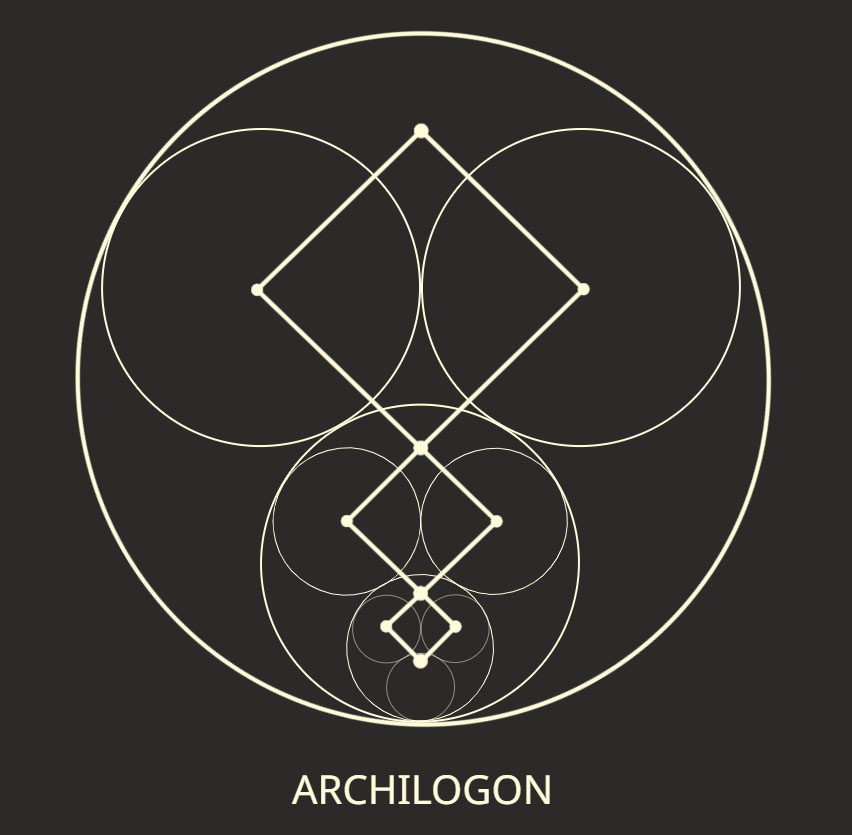
The word guiding the 26th stage is: “Archilogon”. This chapter forms the central core of our work. After twenty-five chapters preparing the ground for a new perspective, we construct here the archetypal diagram, step by step, with the aid of Kantian Categories, thereby revealing the logical-synthetic nature of the symbol.
The word guiding the 27th stage is: “Synthesis”. Building on the reconstruction of the archetypal diagram, we analyze the founding principles of Synthetic Logic. Two fundamental laws are formulated: the Principle of Reciprocal Implication and the Principle of Relativity. In the second part of the chapter, we offer an analysis of Nicholas of Cusa’s “De Coniecturis”.
The word guiding the 28th stage is: “Nature”. We demonstrate the relevance of Synthetic Logic to the development of Physics, both Classical and Quantum, and re-read selected passages of Plato’s Timaeus in the light of the diagram. In proposing a metaphysical re-reading of scientific thought, we examine Pierre Duhem’s theoretical stance, supported by Ernst Cassirer’s seminal essay: “Substance and Function”.
The word guiding the 29th stage is: “Egypt”. We begin here a two-part journey into the esoteric tradition. We attempt to trace the historical roots of Hermeticism, drawing on the testimony of Iamblichus. We highlight the presence of the Tetractys within Egyptian monumental architecture, and emphasize the line of continuity between Egyptian Cosmology and the Pythagorean and Platonic traditions.
The word guiding the 30th stage is: “Key”. In this second and final chapter on the esoteric legacy, we examine four diagrams from different cultural traditions: the Bagua, the Zodiac, the Ilan, and the Enneagram. Each is compared with the structure of the Archilogon, offering a rational perspective on their metaphysical architecture.
The word guiding the 31st stage is: “Eidos”. Presented as a dialogue, this chapter records an interaction that actually occurred between Artificial Intelligences. In response to a series of questions, a process of logical deduction was set in motion, in which the machines confirmed the necessity of the subsistence of a fourth gnoseological dimension: the World of Forms.
The word guiding the 32nd stage is: “Cosmos”. This chapter is the epilogue to our long journey into the heart of Pythagoreanism and contains our personal reflections on several themes in contemporary philosophical debate. Thus our journey comes to a close. Thirty-two keywords will help us explore Synthetic Logic along a path through the History of Philosophy. Thank you for coming this far, wanderer. If the subject has stirred your interest, we look forward to embarking together on our first stage. “To the Principle!”