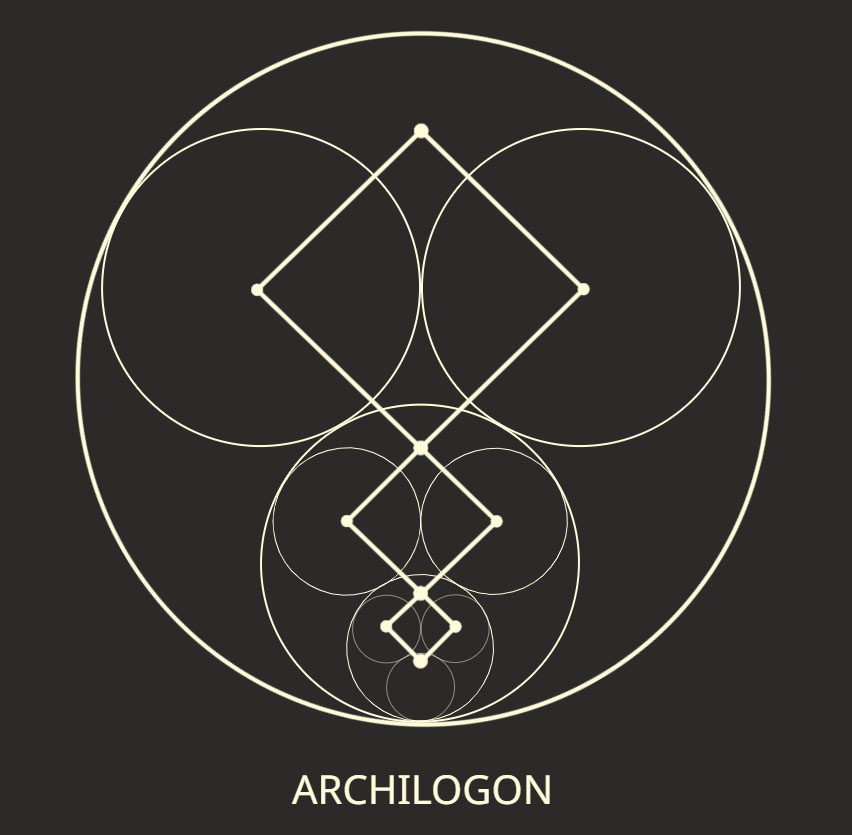
Archilogon 005 - 1. Chaos - 2. Knowledge and Comprehension
In this video, Elias Artista examines the distinction between 'knowledge' and 'comprehension'. Knowledge is the mere storing of notions in memory, socially useful yet inwardly inert; comprehension requires a systemic restructuring of consciousness, turning data into an ordered 'cosmos'. From Plato’s critique of erudition to Bruno’s reflections and Husserl’s insights, the message is clear: human thought can comprehend because reality itself is systemic. Whether we perceive the world as 'chaos' or as 'cosmos' depends on the conscious direction of our gaze.
Archilogon – The key to Synthetic Logic. A project by Elias Artista.
Bibliography
Works Cited
- Plato, La Repubblica, Bompiani, Milano, 2009, 500c-d.
- Edmund Husserl, Ricerche Logiche, Vol I, ed. G. Piana, Mondadori, Milano, 1968, p. 34.
Further Reading
- Ernst Cassirer, Sostanza e Funzione – Sulla Teoria della Relatività di Einstein, La Nuova Italia, Firenze, 1973, p. 182-184.
- Francis M. Cornford, Principium Sapientiae – The origins of the Greek philosophical thought, Cambridge University Press, Londra, 1952, p. 55.
Video Transcription
That comprehension and knowledge are not identical concepts is a truth we learn very early at school, along with the art of dissimulation. We are able to take the terms of Philolaus’ fragment, such as Limit and Illimit, and store them in one of the compartments of memory. Whenever occasion requires, we can retrieve them, and even make them the object of teaching, if by teaching we mean the transfer of notions from one memory to another. The remarkable fact is that we can transmit notions, and do so brilliantly, without ever having truly comprehended what we had memorized. This act of retention is knowledge, and its competitive exercise is erudition. This is much appreciated in society and lies at the root of collective progress. Yet, on the individual level, it produces no evolution, for it works without the aid of consciousness, like a machine that executes perfectly without grasping the ratio of its instructions.
Until we move from knowledge to comprehension, each concept we retain is no more than a label to be affixed and later retrieved. A compulsive study leads to accumulation, and if our consciousness does not restructure itself so as to integrate the notions in an organic whole, we shall parade the fragments of our collection with great pride, yet with no awareness of their value, content merely to display the semblance of vast culture. This is precisely the attitude Plato derides through the irony of Socrates. For modern societies the transfer of notions suffices; indeed, the more one knows without comprehending, the more efficiently one functions within the social machine, for one runs no risk of jamming it with superfluous questions.
In the archive of memory, Philolaus’ concepts appear unrelated, for instance, to the theories of Charles Darwin, and a pedant would condemn the juxtaposition. Each label has its own drawer: one marked “philosopher,” the other “scientist,” and it is deemed best not to confuse them. Knowledge must order notions with diligence, so that what is needed may be retrieved at once. Comprehension, however, demands something deeper, and refuses watertight compartments.
To comprehend means to hold every notion within consciousness as part of a dynamic whole. Whereas knowledge arranges data by “categories,” comprehension relates them by “relations,” embedding them in a structure in which every element is linked, directly or indirectly, to all the others, through relations of inheritance, sequence or analogy. To comprehend, thus, means to fashion one’s mental universe into a “cosmos,” an ordered structure mirroring the order of the world, in which each part has its role and function. For the reality that surrounds us, and which we interpret by groping, piecemeal, through narrow perception and fragile language, is systemic. Every element processed by our mind is part of the representation we call “reality.” Yet the number of its parts and the intricacy of their relations drive us to accumulate concepts with no coherence, consigning them to memory’s warehouse whence they soon slip into oblivion.
Physics, whose ultimate aim is the universal coordination of phenomena, has always pursued a “Theory of Everything,” a single formula capable of correlating all the laws of the physical world. Ancient philosophy cherished the same ambition. The supreme aim, according to Pythagorean and Platonic vision, was to conform our mental universe to the very structure of reality, or—if the word daunts us less—to its logic, as Plato’s Republic declares: “Do you not believe that, inevitably, we become akin to what we admire through study? This is why the philosopher, by contemplating the ideal Cosmos, is himself transformed, within human limits, into an ideal Cosmos.”
Our younger self would instinctively reply that interpreting reality as a “cosmos” is a mere illusion projected by the human mind’s penchant for order. This may be true, yet the objection rests on a prejudice, namely, that our mind is detached from the conditions reality itself imposes on all that exists, behaving like a conqueror in a foreign land, exempt from local laws and imposing its own by force. Giordano Bruno would frame the question in these terms: “If order is in man and not in Nature, whence comes order, if it was Nature that generated man?” If man is not detached from the world, then the traits he inherits belong to the world.
The obvious conclusion is that man can think systemically because the form of the system is a possibility contemplated by reality, an aspect intrinsic to it, and history shows that this systemic order gradually reveals itself through the progress of Science. Husserl wrote: the systematic character proper to Science, of true and authentic Science, is not our invention, but lies in things themselves, and we merely discover and bring it to light. Science aims to secure for our knowledge the realm of truth; but the realm of truth is not a disorderly chaos: within it reigns the unity of law. Hence the quest and exposition of truth must themselves be systematic.
If “order” and “chaos” coexist in us as equally legitimate possibilities, then to affirm categorically that “reality is not a cosmos” is to perceive, by choice or necessity, only one of its aspects. In the end, wanderer, the difference lies wholly in the direction in which, with full consciousness, we choose to turn our gaze. To the Principle!