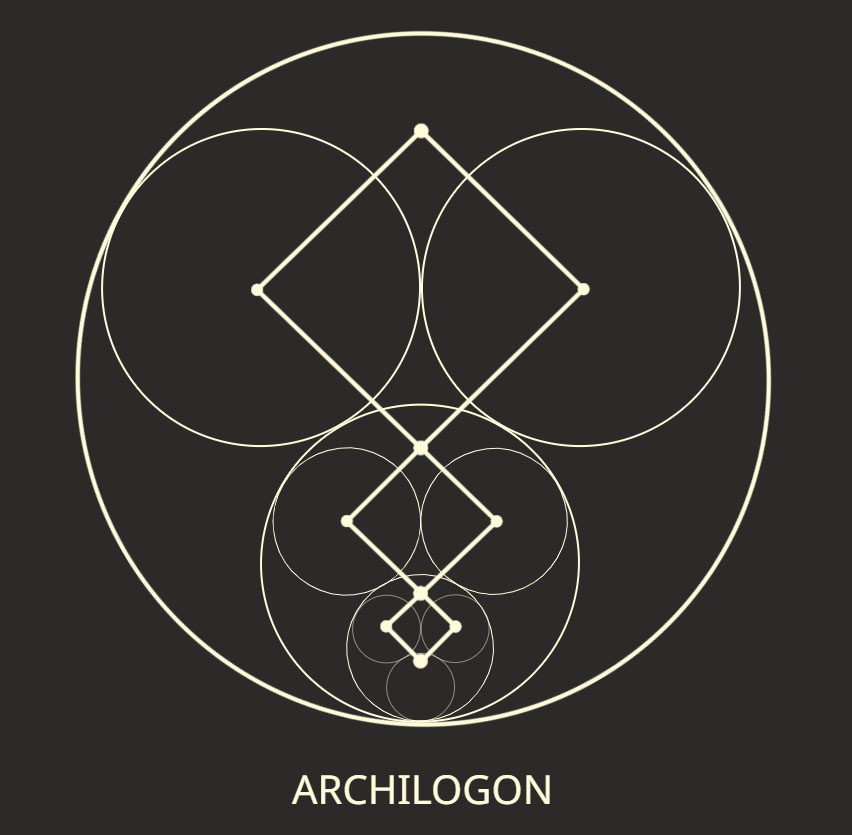
Archilogon 007 - 1. Chaos - 4. Metaphysics
In this video, Elias Artista delves into the concept of Metaphysics, restoring the discipline to its Pythagorean and Platonic origins—in line with Hegel—as a “science of logic.” The progressive loss of speculative thought, from Aristotle to Kant, is brought to light, together with the need to disentangle Metaphysics from its hybridisations with Empiricism, Theology, and Christianity. The account shows how language, though often accused of inadequacy, can serve as the privileged instrument for recovering the archetypal Forms of the Intelligible World. Through the Archilogon, the project seeks to construct a universal conceptual map capable of re-establishing a common dialogue between Science and Philosophy.
Archilogon – The key to Synthetic Logic. A project by Elias Artista.
Bibliography
Works Cited
- Immanuel Kant, Prolegomeni ad ogni metafisica futura che vorrà presentarsi come scienza, Bocca, Torino, 1913, pp. 21 and 29.
- Georg W. F. Hegel, La Scienza della Logica, Vol. I, Laterza, Bari, 1925, Prefaction to the first edition.
- Alfred N. Whitehead, Processo e Realtà – Saggio di Cosmologia, Giunti/Bompiani, Firenze/Milano, p. 139.
Further Reading
- Enrico Berti, Introduzione alla Metafisica, Utet/De Agostini, Torino/Novara, 2006.
- Achille Varzi, Metafisica – Classici Contemporanei, Laterza, Bari, 2008.
Video Transcription
To grasp language correctly is to grasp, in turn, the true object of Metaphysics. The two dimensions are inseparably linked, for the logic embedded in language reflects bonds and constraints whose origin is supersensible, just as every physical law is supersensible in relation to the phenomenon it governs.
At first glance, this claim may seem paradoxical. Yet, if physical laws were not supersensible, we could perceive them directly in their very essence, whatever that may be, instead of having to deduce them from the behavior of the phenomena they regulate.
The chief aim of this account will be to restore the concept of metaphysics to its authentic origins. Our first step will be to reopen the question of transcendence.
What exactly is meant by the word “metaphysics” has been the subject of endless debate. In the Prolegomena, Kant declared: “A true Metaphysics does not yet exist in any form.” Indeed, by Kant’s time, the Pythagorean tradition had left behind only faint and misunderstood traces, filtered through Aristotle’s misleading interpretation.
In this account, we shall restrict the term “metaphysics” to the domain studied by Pythagoreanism and Platonism. From this perspective, Metaphysics designates the discipline that explores what lies beyond the sphere of phenomena, beyond the Sensible World. Metaphysics is, in short, the speculative reconstruction of that dimension which the ancients called the Intelligible World, a dimension of pure Forms assumed as non-existent, yet—by its very adjective—reconstructable by thought.
We shall therefore set aside much of what modern Philosophy means by “Metaphysics.” From our standpoint, it makes no sense to speak of Analytic Metaphysics, simply because Metaphysics cannot be hybridized with any form of Empiricism. Cassirer would call it “a wooden iron.” Kant initially adopted this narrow view only to broaden it later, in an attempt to found a new Metaphysics on scientific grounds, thereby betraying the discipline’s premises. Few today question Kant’s hybridization. Here, however, we shall follow Pythagoras and Plato: Metaphysics does not concern itself with the empirical, but with what transcends it.
All that can be experienced belongs properly to Science, and the scientist approaches it in the manner most fitting, without waiting for the philosopher’s futile seal of approval. Proof enough is that, in conceiving artificial intelligences endowed with extraordinary sensory systems, Science has shown itself more than capable of understanding and reproducing both human perception and the abstract processes of reasoning that arise from it.
The study of the empirical, therefore, requires no act of speculation—that method which combines logic and imagination, and which is the philosopher’s specific instrument of inquiry. For everything pertaining to the Sensible World, Science is the supreme authority, and we can only bow before the arduous labor of the scientists.
Metaphysics, by contrast, investigates a domain for which no technical instrument can substitute pure speculation. Throughout history, speculative Metaphysics has suffered progressive decline. Already two centuries ago, Hegel lamented the treatment modernity had reserved for it: “What once was called ‘Metaphysics’ has been eradicated at the root, and has vanished from among the disciplines… The Science of Logic, which constitutes true Metaphysics, that is pure speculative Philosophy, has until today been gravely neglected.”
Our attempt to reclaim and rehabilitate the term, its proper field, and its content follows in the wake of Hegel’s vision. Metaphysics should not only be preserved from any hybridization with Empiricism; it should also be safeguarded from other traditions that have customarily been ascribed to it, and that have parasitically fed upon it.
Here, then, we propose to carry out upon the immense and controversial tradition of Metaphysics an operation of purification and simplification. It is necessary, first of all, to sever Metaphysics from Theology, expunging from it all scriptural content that has obscured its formal aspect, while transposing the mythological elements of Paganism into terms of pure logic from which they originally sprang.
The second operation is the separation of Plato from Aristotle, an intervention already felt necessary in antiquity. By failing to grasp Platonic Ideas–Forms as the lines of a diagram, Aristotle misconstrued them, interpreting them as abstract concepts.
The third operation—separating Plato from Christianity—is more arduous, for its roots are deep. Since Western culture is steeped in Christian categories, it will not be easy to keep the two planes distinct. We shall need to dig deep to bring back into the light the formal clarity of Greek idealist thought, derived in part from the Near East.
Our field of action will be language, for Metaphysics makes itself manifest in the logic of language. It is precisely to language that Plato, like Kant after him, directed his inquiry.
Modernity, however, has developed a profound distrust of language, expressed in three principal charges: insufficiency, oversimplification, and manipulation. In short: an incapacity to reflect the complexity of reality; a reduction to a few crude categories; and the coercion of speakers into seemingly objective tracks.
Martin Heidegger, for instance, accuses language of being incapable of expressing the unfathomable depths of Being. This loss of confidence, in our view, is the breeding ground of Nihilism. For to strip language of its objectivity is to dismantle the only bridge that connects us to the Intelligible World, thereby depriving us of the means to comprehend the relation between the Whole and its Parts, and hence of the meaning not only of every human act of communication, but of our very existence as self-conscious beings.
Designing an alternative language at the desk is no solution. Such a game can be played only among the faithful of one’s own church. Although Hegel—the undisputed champion of obscurity—once stated quite clearly that “Philosophy, in general, has no need of a special terminology,” Alfred Whitehead, in Process and Reality, wrote: “Philosophers can never hope finally to formulate metaphysical first principles….” Like Heidegger, Whitehead deemed language profoundly inadequate.
All the limits attributed to language are real. Yet, from a metaphysical standpoint, they can be overcome by anchoring concepts and terms to an archetypal logical-formal structure. We must return, through a process of anamnesis, to the primary Forms. Cognitive Science confirms that the mind abstracts from very simple forms, generating increasingly complex concepts as metaphorical developments of these forms.
Otherwise a child could never begin to learn. It is precisely by probing the archetypal Forms structuring our mind that the metaphysical dimension reveals itself. The Greeks gave evocative names to these Forms, names whose meaning has since been lost: Monad, Dyad, Triad, Tetrad.
Thanks to Socratic maieutics, Plato shows how these Forms may resurface into conscious thought through a process of dismantling superstructures acquired through instruction, a stripping-away aimed at removing everything superfluous—and, above all, everything empirical.
The realm of Metaphysics is not a new world to be explored and colonized: it is the very ground from which knowledge begins. It is not what we see, but what allows us to see. Metaphysics investigates the archetypal Forms upon which human Reason itself is modeled.
To call for an alternative language, then, is to misunderstand the very aim of Metaphysics. We do not need new terms: our language already has too many. What is needed is to structure logical and analogical relations correctly—those relations that allow scientist and philosopher to understand one another on common ground.
For the Intelligible World is no arabesque: it is the source of the primary Forms from which imagination fashions arabesques. It is what remains at dawn, when the rest of the dream has already vanished.
For the ancients, the aim was to analyze language in order to rediscover the Forms of the Intelligible World, thereby making themselves closer to the Gods. Our purpose is more modest: the reconstruction of the Intelligible World that we shall propose in this journey is meant to build a bridge.
Through the Archilogon, we shall show that, to establish a shared plane of dialogue between scientist and philosopher, only a universal conceptual map can make any elaborated notion univocal and significant, thereby setting in motion a process that will allow us, at last, to “understand” what we already “know.”
To the Principle!