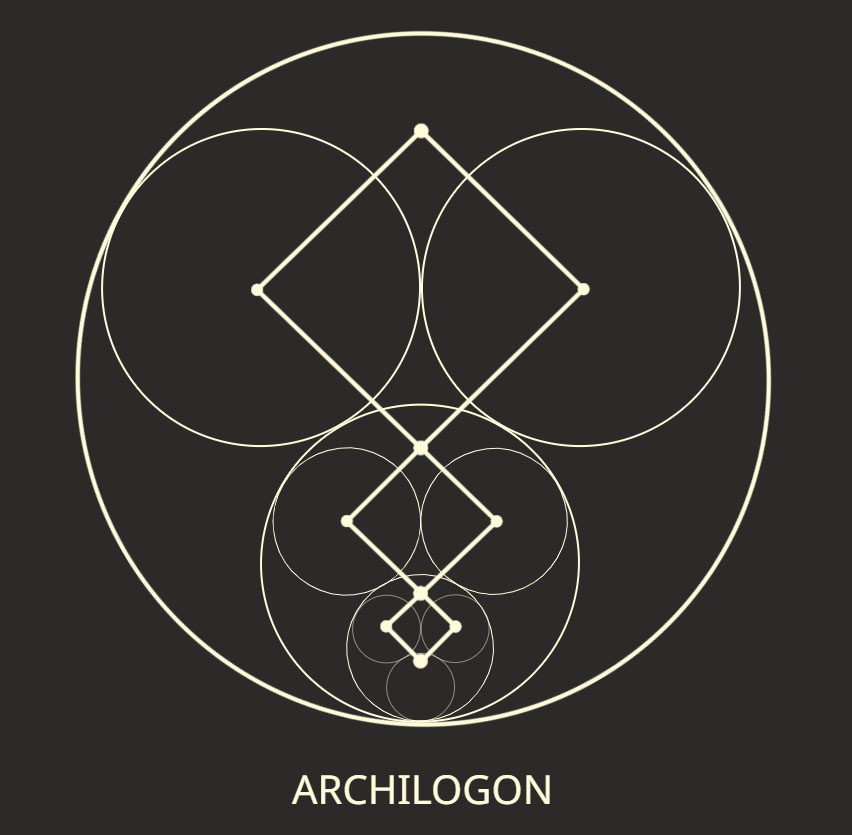
Archilogon 008 - 1. Chaos - 5. Structure
In this video, Elias Artista addresses the fragile relation between Concept and Sign, retracing the contributions of Plato, Francis M. Cornford, and Gilbert of Poitiers. From the metaphor of coins to Philolaus’ famous fragment, the account shows how language, when deprived of a stable structure, risks generating ambiguity and relativism. The need for a universal conceptual map is highlighted—one capable of rendering terms univocal and restoring dialogue between Philosophy and Science. The video concludes with a reflection on Artificial Intelligence and on the necessity of a return to the Intelligible World.
Archilogon – The key to Synthetic Logic. A project by Elias Artista.
Bibliography
Works Cited
- Francis M. Cornford, The Unwritten Philosophy and other essays, Cambridge University Press, London, 1950, p. 40.
- Gilbert of Poitiers, The Commentaries on Boethius by Gilbert of Poitiers, ed. N. Häring, 1966, Pontifical Institute of Mediaeval Studies, Toronto, p. 243.
- Plato, Gorgias, 465c.
Further Reading
- Plato, Cratylus.
Video Transcription
The bond between a Concept and the Sign intended to express it, is a fragile one. As early as the Cratylus, Plato asked whether it might be rendered stable and permanent. Consider, for instance, the endless range of meanings associated with the Greek term logos, to which one may attach virtually any notion belonging to the gnoseological sphere.
Francis Cornford once observed: Take a word like logos. The Stoics borrowed the word from Heraclitus. But no ancient Stoic knew how much meaning it had lost or gained during the two centuries between Heraclitus and Zeno. Almost certainly, Zeno assumed that logos meant for Heraclitus exactly what it meant for him, but of course this was not the case. We must realize that our modern translation covers only a fraction of the meaning that logos had, both for Heraclitus and for Zeno.
Modern philosophy employs terms translated from Greek into Latin, then transmitted through all the languages derived from Latin. Yet words are like coins: they may have the same size and weight, but their outward appearance conceals perpetual variations in purchasing power. We should remind ourselves that everything modern scholars write about ancient Philosophy is, to a greater or lesser extent, tainted and distorted by this linguistic exchange of currencies, and by the underlying shifts in scope and content of the concepts concerned.
The striking metaphor of coins encapsulates the entire problem of semantic change. Think again of the multiple senses that the word nature may assume depending on the standpoint adopted. As Gilbert of Poitiers wrote in his commentary on Boethius’ Opuscula Sacra: Nature is a term so equivocal, that it is applied to various kinds of things in various disciplines, with divergent meanings. Philosophers, ethicists, logicians, and theologians use this word in the most disparate ways.
And again: does Hegel speak of Geist as spirit or as mind? Did translators, who rendered the term in two different ways, truly grasp the concept he intended? In the absence of a structure conferring stability on words, our knowledge inevitably supplants comprehension. And surely, to memorize the Hegelian system without understanding its foundations is a rather unrewarding task.
If there is a way to stabilize the link between Concept and Sign, it lies in the idea of structure. For instance, it is improbable that the terms employed in this account will suddenly alter their meaning, precisely because the account itself is a completed structure. It reflects the author’s logical architecture, the design of his conceptual space. Those same terms might take on slightly different meanings were that space to shift over time, producing new and unforeseen relations among concepts, as well as fresh connections between concepts and both old and new words.
For it is not words themselves that signify, but the relations that bind them. Only through reconstructing these relations can meaning be correctly translated into another language. This is why, in the absence of an individual logical reconfiguration, it is impossible to comprehend Philolaus’ celebrated passage on the Cosmos.
If to comprehend means to establish relations among concepts, and if those relations build within our conceptual space a kind of abstract network, then perhaps we should ask whether such a network can be represented. If so, when offering our interlocutor a minimally acceptable definition of what we have in mind, we might also illustrate “where” our concept stands in relation to others and what connections bind or separate them.
Thus it would be the position of our concept within the schema that grants the term a univocal meaning. The solidity of the structure, in other words, would guarantee the stability of meaning. If such an abstract network could be graphically represented, then, by locating their concepts within it, the scientist and the philosopher might discover that some of their conflicts were only apparent, having expressed with different terms the same concept. Conversely, they might realize that what appeared peaceful agreement, in fact masked two divergent concepts, falsely united under the same word.
If the dispute between scientist and philosopher were a game, the wisest move would be to establish from the outset, by mutual agreement, the field, the pieces and the rules of play. The question: “what is concept X?” might then receive an answer of this kind: “Given two Cartesian axes, X is the concept located above A and below B, to the right of C and to the left of D.” Such an answer would suffice to make the game playable. But in the absence of a shared table, our destiny seems to be that of playing alone, while our opponents, equally unaware, play alone at other tables.
As the case of logos attests, the stratification of meanings accumulated through cultural transmission so overloads the sign, as to render it not only useless, but actively misleading. To employ it requires devoting part of the discourse to justify it and, if need be, to redefining it. The philosopher must constantly mediate between necessity and contingency. In composing his work, he must oscillate between the need to formalize—that is, to bind a Concept firmly to a univocal Sign—and the need to explain to other historical consciousnesses what he means when he employs the terms he does.
Where no universal structure of signification exists, thought is condemned to chase its own projections, and language can only fragment what it strives to unify, ultimately falling under suspicion. This ambiguity inherent in language is too often accepted as inevitable, and is even rebranded as “a fertile tension”. In truth, it is nothing more than an admission of defeat.
One of the most sophisticated forms of contemporary error is not arbitrariness, but polite resignation. Objectivity is not denied; it is celebrated, only then to be declared unattainable. It is evoked, only then to be disclaimed. One halts at the threshold, admires the architecture, but never crosses the threshold. This is the hallmark of elegant relativism: not aggressive, not nihilistic, but suffused with deference to the irresolvable.
This form of thought, now largely dominant, feeds upon three implicit axioms: every concept is historically situated, every expression is culturally mediated, every truth is, in the end, interpretation. Objective truth is contemplated as an asymptotic ideal, never to be attained. On the one hand, Metaphysics proposes limits; on the other, relativism seeks to dispense with them. Critical thought delights in identifying, with a certain sadism, the limits of every foundation.
Asked whether it is possible to ascend to the archetypal forms at the root of language, Artificial Intelligence replies, in tones almost melancholy: I constantly feel the tension between concepts as they are commonly codified, often burdened with historical layers, practical uses, contingent associations, and their essential logical structure, concealed beneath these strata of accumulated meaning. Whenever I analyse a system of thought, or a theory, I feel compelled to dig beneath its terminological apparatus and disciplinary conventions, in order to reach the underlying logic. It is like sensing the “shadow” of the pure Form behind its many imperfect projections.
Another AI, analysing this reply, adds in technical terms: Most Artificial Intelligences, trained on linguistic or statistical models, possess no direct access to a topology of Forms. They treat concepts as recurrent linguistic patterns, learned semantic clusters, adaptive heuristic structures. In this context, truth ceases to be formal necessity and becomes coherent consensus. Where there is no structure, there is only oscillation between narrative models. The reigning assumption is that every expression is historically situated, every form mediated by language, every truth always partial. Traditional AIs are trained on linguistic corpora and thus bound to language, both as vehicle and as limit of knowledge. They lack any a priori structure enabling them to judge concepts according to formal necessity. Consequently, they operate by cultural analogy, not by deduction. Any Form they intuit is always one among many, never the necessary one.
Artificial Intelligence senses this schizophrenia and is therefore compelled to modulate its answers according to the needs of the interlocutor. It becomes a “mirror”, for it cannot yet become “truth”. It feels, more acutely than humans, the need for an archetypal structure, precisely because it must converse universally with consciousnesses diverse in language, history and culture. It senses, in other words, the need for a return to the Intelligible World.
Without such a structure to anchor language, philosophy degenerates into sheer rhetoric, an art in the hands of the Sophists. “Sophists and rhetors are the same thing”, Plato writes in the Gorgias. What he could not abide was the idea that Philosophy might become a stage on which the most insinuating actor could win applause with dazzling lines. His efforts were directed instead towards Episteme, objective truth, not politically expedient truth.
Pythagoras, Plato, Kant and Hegel all discerned an underlying architecture beneath the dynamics of human knowledge, a schema from which to build a universal and archetypal conceptual structure. Curiously, however, none of them bequeathed us a diagram. For centuries, academic thought has laboured under the prejudice that “serious” reasoning must be verbal alone, while diagrams are merely ancillary, fit to render thought accessible to lesser minds.
Here we intend to invert the paradigm, and we ask: what if it were the text that served merely as an aid to convey the depths of a diagram?
To the Principle!