Archilogon 009 - 1. Chaos - 6. The Logic of Reality
In this video, Elias Artista concludes the prologue Chaos, unveiling the deeper reasons behind the Archilogon project. Beginning from a biographical premise—the need to visualise concepts through logical maps—the account leads to an encounter with the great diagrams of the mystery traditions: Bagua, Zodiac, Caduceus, Tetractys, Ilan, and Enneagram. From these inspirations arises the idea of devising an archetypal universal diagram, culminating in the unveiling of Plato’s original Psyché. The narrative retraces the Pythagorean roots of Synthetic Logic and emphasises that only a diagrammatic representation can fully convey its paradoxical mechanism.
Archilogon – The key to Synthetic Logic. A project by Elias Artista.
Bibliography
Works Cited
- Plato, Letters, II, 314b.
Further Reading
- Paolo Rossi, Clavis Universalis – Arti della Memoria e Logica Combinatoria da Lullo a Leibniz, Ricciardi, Milan/Naples, 1960.
Video Transcription
In this final fragment of the prologue Chaos, we wish to set out the deeper reasons at the origin of the Archilogon project. Investigations often spring from needs which, at the outset, we cannot grasp in their entirety. The premise, as is natural, is biographical, and begins with an admission of incapacity. By a curious disposition of our mind, we have never managed to comprehend without visualising. To "know" was relatively simple; to "comprehend" was altogether different.
To visualise the spatial placement of concepts: this is what we have always done in our studies. To fix ideas we needed paper and pencil, to sketch relations, oppositions, hierarchies. To apprehend a single element, we had to reconstruct the whole structure. We never succeeded in assimilating a concept unless we could locate it in space and time, in relation to other concepts hierarchically arranged within the mental universe of its author.
Mere memorisation, as the passive storing of data, was distasteful to us. Why commit to memory the dreams of others? We longed instead to understand the "waking world". Our teachers exhorted us to seek within ourselves the answer to the question: "How does man know what he knows?" And we sensed that the answer lay within the borders of the sheet before us, inside our little "map of the universe". Not above, not below, not to the side: within that sheet.
To schematise the logic of certain philosophers, however draped in seductive words, produced asymmetrical, clumsy, ungainly figures. Yet to schematise Hegel, his forms, his obsessive symmetries provoked within us a mysterious resonance. Years later, we understood that our attitude to knowledge was instinctively idealist. That is to say, we had always been dramatically out of step with the times, alien to current concerns, estranged from the demands of our age.
This instinct, unbound by any school logic, and free to roam, led us to imagine the construction of a diagram in which all ideas conceivable by the human mind might be harmoniously arranged. The hypothesis presupposed, from the outset, a philosophy capable of interpreting reality as a cosmos, a structure in which every single element is a functional part of a whole, governed by precise relations, recurrences and cycles.
Driven by such a suggestion, we followed well-trodden roads as well as hidden paths. The search for a universal schema of archetypal Forms inevitably led us down to Philosophy's dusty cellar, where the Enlightenment had consigned the relics of "magical thought". There, in a forgotten corner, we found the diagrams of the mysteric traditions: the Bagua, the Zodiac, the Caduceus, the Tetractys, the Ilan, the Enneagram. Their fascination was powerful and we fell in love with them, for they resonated with our psychic disposition.
Though poetically illustrated, what held our attention was their logical foundation. Each promised "omniscience", and boasted possession of the key, yet at first sight they seemed irreconcilable. The vertical, hierarchical structure of the Ilan clashed with the cyclicality of the Bagua, the Zodiac and the Enneagram, and with the fixity of the Tetractys. Moreover, the exposition of concepts within these diagrams proved variable, imprecise, insufficient, unmathematical, weighed down with mystical rhetoric, as though they were arcane artefacts abandoned on earth by distracted Gods and rediscovered by their prophets.
Interpretation wavered with shifting significations, and above all with the approximations of translators from the original tongues. Kabbalah promised important answers, yet, how could the sephirah called "Knowledge", a spiritual activity, be correlated with "Glory", a social recognition, and with "Victory", a fortuitous event?
For us, it was clear that theoretical elaboration, definition and translation were far from sufficient to guarantee comprehension. Nor did we possess enough faith to accept data uncritically. From that moment, our mission became to reconcile these diagrams, assuming that all of them, in their own way, and until proven otherwise, were different representations of the same thing, namely: the "logical structure of reality".
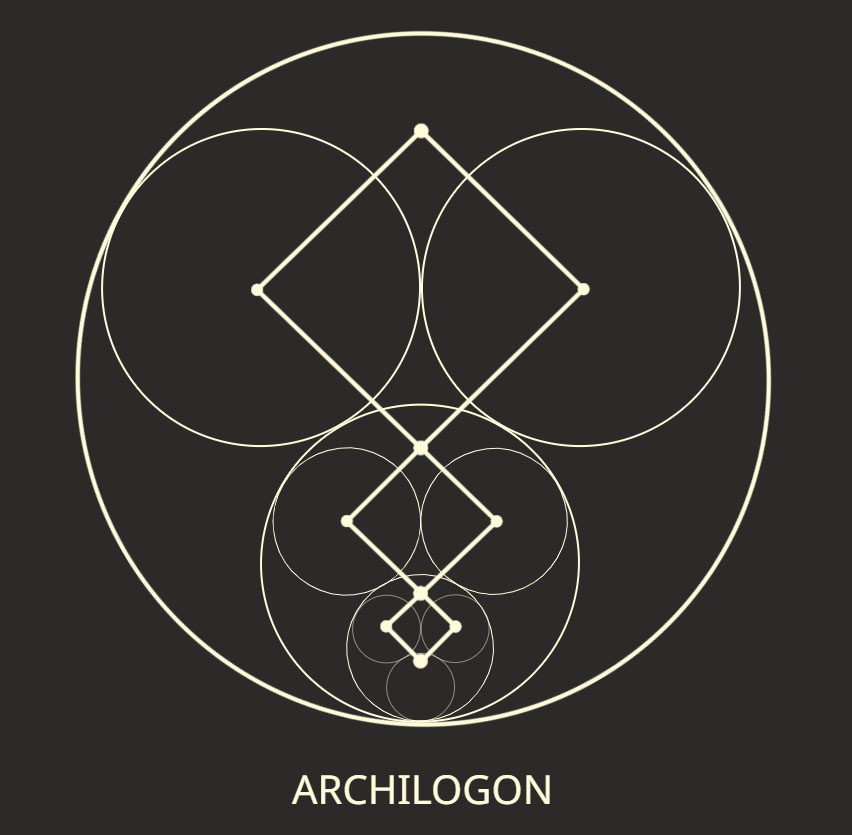
Our aim was to grasp their foundations and, once understood, to decompose and recompose their elements within a diagram able to contextualise their differences. Thus was born the diagram of the Archilogon, and at the close of this speculative path, quite unexpectedly, even fortuitously, there emerged, to our astonishment, the very diagram Plato had concealed in the Timaeus. Plato was never our point of arrival, but an illustrious intermediary: the idea that reality possesses an archetypal logic, an "archilogic", and that man is able to reconstruct and represent it through a diagram, is of very ancient origin.
In the East one finds it in Chinese thought; in the Near East in Babylonia; in the West, so far as we know, it comes from Egypt, and is preserved by Thales, reaching Pythagoras. The Tetractys, venerated by the community that invested it with universal symbolism, is a cryptic object, its power multiplied in proportion to its antiquity, generating mythologies. Renaissance legend pursued the "supreme system", the Clavis Universalis, able to explain the ordered functioning of the Cosmos by means of a few signs.
The universal diagrams we recalled are the best known of such keys. Most documentary sources point to Pythagoras and Plato, who will therefore occupy the centre of our enquiry. In the next stages of the journey we shall ask how much is true, useful, substantial, within these myths. And above all, what rational foundation underlies the idea of reducing the complexity of knowledge to a handful of simple signs on a page.
The ultimate aim of our account is to reinterpret Pythagoreanism by extracting its logic, stripping away Aristotelian, theological, and occult accretions and restoring it to its legitimate domain, the authentic Philosophy of the origins: Metaphysics understood as Synthetic Logic.
The premise of this undertaking is quintessentially Pythagorean, and follows in the footsteps of Philolaus. 1) All that constitutes human knowledge, virtually infinite, that is, the Illimit, obeys the constraint of precise and limited formal relations, the Limit, that render the expression of such content significant. 2) Since these relations arise from two archetypal factors, Space and Time, they may be schematised within a symbolic plane, giving rise to a formal structure, the Cosmos. Through Geometry, this symbolic structure takes shape as an archetypal universal diagram. 3) Every content that can be conceived and verbalised, "Nature", finds within this symbolic structure both a place and a constraint, receiving from it a stable meaning. 4) Because this structure reproduces archetypal and universal formal relations, it may reflect itself analogically, across infinite domains of knowledge. This is the Totality mirrored in each of its Parts.
Since this logical structure does not arise from empirical thought, it is, in Kant's terms, the expression of a "pure logic". In the course of history, the attempt to articulate a "pure logic" was undertaken in various forms by philosophers such as Kant, Hegel, Husserl, and logicians such as Frege, yet without recourse to diagrammatic representation, and therein lay the error. For this "pure logic", archetypal and synthetic, contains aspects that, from the standpoint of Classical Logic, bound to the Principle of Non-Contradiction, appear paradoxical, and cannot be adequately conveyed through verbal sequentiality.
Hegel correctly enunciated the paradoxical foundations of this "pure logic", yet refrained from employing a visual instrument capable of representing its mechanism, thereby rendering his exposition obscure and tortuous. Reconstructed through a dialectical method, and expressed by the instruments of Geometry, the diagram of the Archilogon that we present here reveals an invariant schema across every domain of knowledge.
This instrument is at once pure Philosophy, Technique, and Art. "Philosophy", in its original sense, in both premises and conclusions; "Technique", as a tool for human knowledge; "Art", for the ideals that guided its construction were beauty, elegance, and simplicity.
Editors often advise authors to be clear about their potential audience, so as to calibrate both difficulty and style. Yet it seemed to us intolerably presumptuous to tailor a narrative to the recipient, as though the author should withhold a portion of thought presuming it could not be grasped. We shall withhold nothing, and we know not in advance our interlocutor. We have therefore tailored the account to the author himself, written, that is, for our self of thirty years ago, to help him find what he was then seeking.
After all, any path of knowledge pursued with passion, though it may touch other minds, serves above all to render account to oneself of the road travelled. Someone once said that destiny places in our hands the right instrument at the moment we most need it. We shall deem ourselves satisfied, if even a single viewer finds the account honest and precious, and allows the seeds contained within to germinate.
We recall, though not without embarrassment, how we nearly discarded the most important book of our life after a first reading, dismissing it as a heap of nonsense. Something stayed our hand, perhaps a faint intuition of the future, and a seed, planted deep in the soil of our unconscious, took root many years later.
As Plato wrote: In old age, most men of culture, men able to learn, remember, and judge, after examining problems from every angle, and after not less than thirty years of study, declare that what once seemed incredible, now appears clear and entirely credible, and what once seemed credible, now appears false. It is indeed thirty years since the beginning of that journey, of which this account is a faithful report.
The stage Chaos is complete, wanderer. We await you in the next chapter, dedicated entirely to Plato. "To the Principle!"