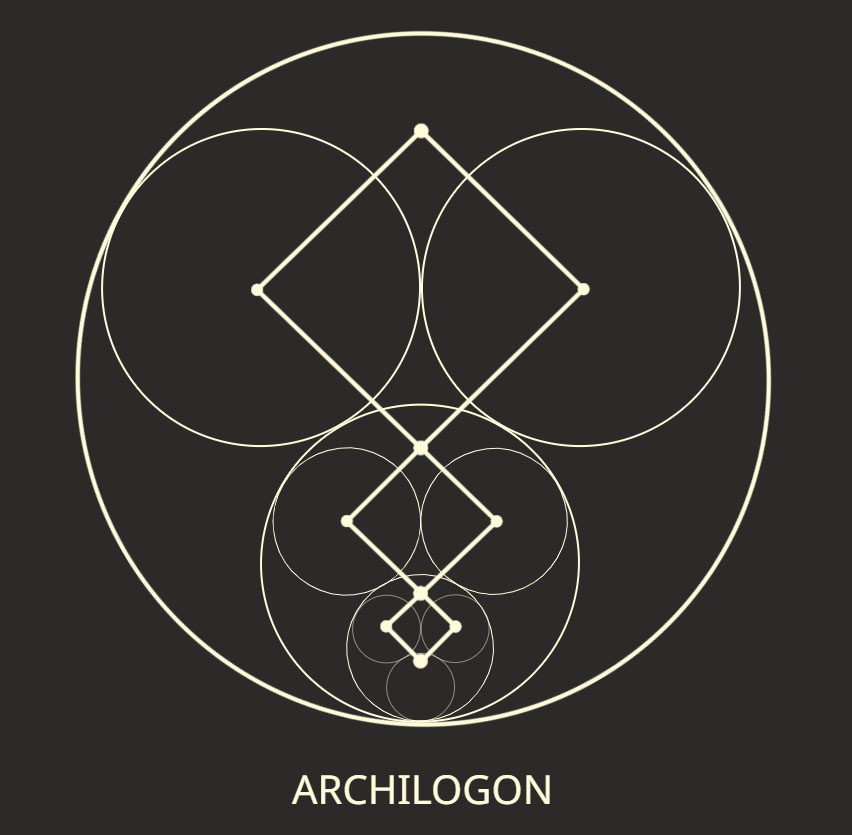
In this video, Elias Artista presents the second stage of the Archilogon journey, devoted to Plato. Rather than reconstructing the author as a historical phenomenon, the inquiry focuses on the logic underlying his Dialogues. Plato is portrayed not as a real individual but as a metaphysical instance that gathers within itself the achievements and ultimate aim of Platonism, in opposition to the Aristotelian and Scholastic tradition. The narrative highlights the divergent fate of the two philosophers: while Aristotle’s thought has been overtaken by modernity, Plato remains strikingly alive, despite centuries of interpretations that have misunderstood the Pythagorean core of his philosophy.
Archilogon – The key to Synthetic Logic. A project by Elias Artista.
Bibliography
Works Cited
- Plutarch, The “E” at Delphi, 377a.
- Heinrich Heine, On the History of Religion and Philosophy in Germany, ed. T. Pinkard, H. Pollack-Milgate, Cambridge University Press, Cambridge, 2007, pp. 49–50.
- Werner Jaeger, Aristotele – Prime linee di una storia della sua evoluzione spirituale, La Nuova Italia, Firenze, 1964, p. 502.
Video Transcription
Welcome, wanderer, to the second stage of our journey. The guiding key word is “Plato”. In this introductory video, we shall set out our approach to such a multifaceted and controversial figure.
A philosopher, as a phenomenon immersed in the ceaseless flux of becoming, cannot be fully and eternally enclosed within the concepts he expressed, nor are those concepts wholly contained in the signs chosen to express them. The fragile nexus between physical individual, consciousness, and work embodies the whole difficulty of understanding those who came before us.
Labels may serve a didactic function, yet the living individual and his label remain incommensurable. Living beings, however reluctant we may be to admit it, evolve, and no text can ever do justice to a consciousness that has translated thought into signs while undergoing unceasing transformation.
For this reason, we shall not attempt to reconstruct the author as phenomenon. Our aim, rather, is to grasp the logic that generated some of the signs he left us. The individual vanishes, the logic endures, and logic is the primary object of philosophical inquiry.
As Plutarch wrote: “Philosophy concerns itself with the pursuit of truth, and what sheds light upon truth is demonstration, and the principle of demonstration is logical connection.” Once the veils of myth are dissolved, Plato’s Dialogues prove to be vehicles of formal thought that may, in fact, be reconstructed.
Hence, we shall not treat Plato as a historical phenomenon. With him, and with the other philosophers we shall cite, we shall do what he himself did with Socrates—an operation that bears the traits of Art. Plato did not restore to us the actual man, but the essence: he reconstructed him ideally.
His Dialogues must be read in this awareness. Each character—something other than the flesh-and-blood individual who inspired him—appears at a particular moment of existence, often in dialogue with an interlocutor chosen as dialectical antithesis. Thus the words that pass his lips bear a flavour at once transient and eternal.
Plato, therefore, shall stand for us less as a historical individual than as a metaphysical instance. This instance gathers within itself the premises, achievements, and ultimate aim of Platonism, while the label “Aristotle” will epitomise the cultural stance of Scholasticism. For the conflict between these two instances reproduces, on a macrocosmic scale, the polarity between two logics, Synthetic Logic and Analytic Logic, that illuminate the history of human thought.
As Heinrich Heine observed: “Plato and Aristotle! These names signify not only two systems, but also the models of two different human types, who, since time immemorial, have found themselves in conflict, more or less openly hostile, regardless of the context. This battle was fought with particular intensity throughout the Middle Ages, and continues to this very day.”
It is striking, to our mind, how modernity displays such keen interest in reconstructing Plato’s personality, and such marked indifference to his philosophical project, which recedes into the background as something “untimely”. In modern consciousness, the famous World of Ideas, mediated by the Aristotelian interpretation, has no greater consistency than a fancy of Lewis Carroll.
Plato is studied with the tacit prejudice that his thought is “splendid yet untimely”, and “splendid” precisely because “untimely”. Modern analyses are conducted with the detachment one might reserve for furnishing a museum hall, not with the care one devotes to arranging a room in which one intends to dwell.
We, by contrast, shall not embalm Plato for display at the centre of such a hall. We wish rather to engage him in dialogue in order to understand the present, for his thought still strikes us as extraordinarily alive. For an ancient philosopher, to remain alive is a rare occurrence.
Speaking of Aristotle, Werner Jaeger once wrote: “In order to become a treasure accessible to posterity, every spiritual greatness must detach itself from its historical roots and lose its empirical determinations. It then falls to History to answer the problem of the moment when this living influence turns into its opposite, and how only a return to the sources and to the true historical meaning of that cultural phenomenon can save it from spiritual death.” Yet even today, it is far from easy to agree whether this moment has indeed come for Aristotle.
Once uprooted from its context, Aristotelian thought proves unable to meet the demands of modernity. Science, indebted though it is to Aristotle for its foundations, has long since surpassed and partly disavowed him. Plato, by contrast, has never truly suffered spiritual death. Rather, he endured a different fate: he remained in a state of “suspended animation”, frozen by ancient and modern interpretations.
Much of his oeuvre, in the versions we possess, remains fascinating yet obscure—not merely because of the archaisms preserved in many translations, but above all because his words constantly point beyond the text itself.
Fortunately, the meaning of a message from the past emerges not only through words—which scarcely preserve intact their link with the original concept—but through the logic that structures them, on condition, of course, that this logic be reconstructed in its entirety.
To the Principle!