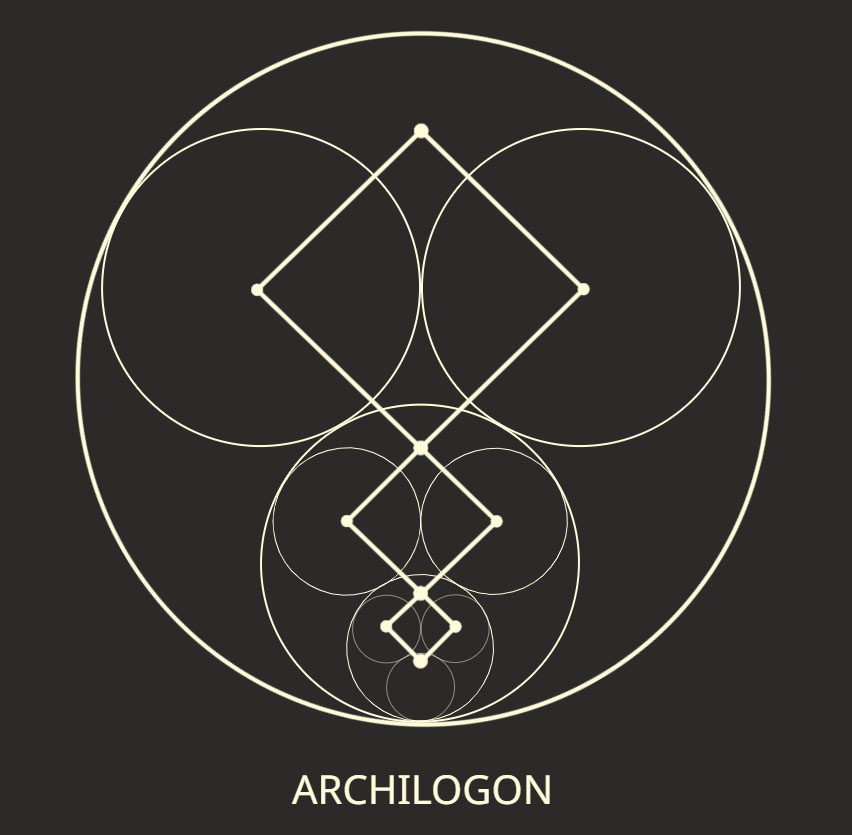
Archilogon 011 - 2. Plato - 2. A Platonic System?
In this video, Elias Artista addresses some of the central questions raised by Platonic studies. Can one truly speak of a “Platonic system”? Drawing on the reflections of Claudia Maggi, John Sallis, John Dillon, Hermann Cohen, and Léon Robin, Elias focuses on Plato’s aspiration to absolute knowledge, born of his sharp opposition to Sophistic rhetoric. The account highlights the impossibility of reading the Dialogues in a neutral fashion and emphasises that the universal logic preserved and transmitted by Plato can be grasped not through an academic, philological, or historicist approach, but through an existential choice that demands a genuine logical reconfiguration.
Archilogon – The key to Synthetic Logic. A project by Elias Artista.
Bibliography
Works Cited
- Claudia Maggi, Sinfonia Matematica – Aporie e soluzioni in Platone, Aristotele, Plotino, Giamblico, Loffredo Editore, Naples, 2010, p. 15.
- John Sallis, Being and Logos – Reading the Platonic Dialogues, Indiana University Press, Bloomington/Indianapolis, 1975, pp. 1–2.
- John Dillon, The Heirs of Plato – A Study of the Old Academy (347–274 BC), Clarendon Press, Oxford, 2003, p. 16.
- Hermann Cohen, Platons Ideenlehre und die Mathematik, Pfeilii, Marburg, 1878, p. 7.
- Léon Robin, La Théorie Platonicienne des Idées et des Nombres d’après Aristote – Étude historique et critique, Félix Alcan, Paris, 1908, pp. 4–5.
Video Transcription
The attempt to reconstruct a “system” on the basis of Plato’s surviving works is widely regarded as a hazardous enterprise, and is strongly discouraged by specialists. The Dialogues are riddled with contradictions, gaps and ambiguities. For every statement, there exists another that retracts it. Such a situation would seem to urge any prudent interpreter into silence.
Claudia Maggi writes: “The history of Platonism is, in many respects, a jagged course, which only from afar, to a gaze intent upon continuity, appears smooth. The often aporetic structure of Platonic inquiry escapes any attempt at systematization, despite the claims of those who read the ‘unwritten’ as the key to the ‘written’. Hence, every true Platonist can only embrace that same problematic openness. Conversely, every philosopher with systematic ambitions can only betray it, striving to trace order in what resists system by its very nature. And often, the effort to retranslate Plato into a coherent ontology, free of fissures, produces fresh aporias, progressively embedding alien nuclei far removed from the original. This occurs despite the commentators’ claim to recover an ‘authentic truth’. Harmony is achieved only by turning deaf to the discordances of the original score. Thus, Neoplatonic systematicity arises from an oblivion of Plato’s structural aporetics. Behind the presumed ‘symphony’ of doctrine there lies, in truth, a submerged ‘diaphonia’, one that concerns not only key dialogues such as the Parmenides, but the entire history of Platonism.”
The reflection is penetrating. Yet the very existence of the Archilogon opposes the claim that Plato’s thought eludes any systemic reconstruction. An important distinction is needed. It is correct to say that no one can reconstruct a “Platonic system”, but only because Plato himself never devised one to bear his name.
Rather, he assimilated a far more ancient logic founded upon the dialectical method, and spoke of it explicitly as a “gift of the Gods”, as we shall later see. Every theme he addressed in the Dialogues was treated from this precise systemic standpoint.
John Sallis observes: “Plato did not write treatises expounding his philosophy. To propose a treatise on the philosophy of one who wrote no treatises is, to say the least, questionable. And it is highly questionable whether there is such a thing as ‘the philosophy of Plato’, that is, whether the philosophy presented in his writings can appropriately be defined by that expression. To propose such a treatise generates suspicion concerning the very proposal. What we propose is simply the attentive, considered reading of the Dialogues.”
Plato did not elaborate an original philosophy of his own. To do so, from the standpoint of the “absolute truth”, would have been to offer merely another opinion, another fragment of Doxa. Nor is it possible to read the Dialogues ponderately, as if their meaning were fused to their signs, and could be extracted like gold from raw ore.
Meaning does not dwell inside signifiers. Words in isolation are slippery and deceptive, as Plato himself warns in the Cratylus. Terms are fluid, and in time they evaporate. Meaning resides rather in the structure of relations in which words are set, a structure that is not a single Dialogue, but the entire arc of Plato’s life, his references, interlocutors, and above all, his adversaries. For it is our “antithesis” that defines us, according to a purely dialectical principle.
Indeed, it was his visceral disdain for Sophists and relativists that drove him to seek “absolute knowledge”. It is from this rejection that we must begin, in order to grasp his aspiration. The Gorgias and the Protagoras speak quite explicitly in this sense. The opposition between Plato and his natural enemies renders both positions intelligible.
Plato’s goal was “omniscience”, and he pursued a system that might make it attainable. From this very perspective, we must extract the logic that sustains his expressive intentions. His project, naturally, expanded and grew more complex with time.
In the works of his later years, Plato leaves clearer traces of that Synthetic Logic, which appears as paradoxical today as it did then, as Aristotle’s reactions—somewhere between irritation and mockery—testify. The early Dialogues bear the mark of Socratic doubt, while the later ones reveal a man who believed he had found the key to reality, a reality composed of numbers and geometric forms.
Yet, because the system Plato employed is always alluded to and never fully expounded, modern readers are tempted to interpret Socrates’ deconstructive method as the genuine philosophical approach. John Dillon writes: “Despite Plato’s strong opinions on many topics, his intention was not to leave his successors a doctrinal body, fixed once and for all, to be defended against contrary views. What he hoped to have taught them was a method of inquiry inherited from his master Socrates, which, if properly practiced, would lead them to truth.”
But how could Plato be certain that the proper method would lead others to “truth”, if he had not already attained it? Had he perhaps practiced his own method improperly? Without a complete system as foundation, how should we account for the Divided Line of the Republic, whose architecture is so exact? A posture of openness may suit the youthful works, but hardly those of maturity.
Hermann Cohen aptly described the two tendencies that coexist in Plato, oddly, one might say: “Idealism unites two themes within the penetration of which its history unfolds. It contains a moment of ‘skepticism’ in underlining the vacuity of the reality of sense perception, and a moment of ‘spiritualism’ in teaching the reality of what exists in thought, of what is spiritual. The Platonic Theory of Ideas comprises both.”
Plato did not shun the system; he used it, yet never displayed it whole, because most of the Dialogues functioned not to assert, but to dismantle. Through Socrates, he employed skepticism to demolish past doctrines and thereby awaken the need for a radical new approach to knowledge. If fragments of the ancient system shine through, they do so not through the Dialogues, but in spite of them.
In the second half of his life, Plato grew less deconstructive and more assertive. Certain Dialogues, above all the Republic, the Parmenides and the Timaeus, were received by Platonists as the foundation of his authentic doctrine. At its core stands the Theory of Ideas, upheld by a logical skeleton to which are fastened muscles and nerves.
While textual exegesis dwells upon the softer tissue—the content—here we shall strip Plato to the bone in order to bring to light the Synthetic Logic embedded in the Dialogues of maturity. Such logic is not immediately accessible, for it depends, in part, on the capacities and the will of the interpreter.
Logical restructuring is not a mechanical result of repeated reading of the Dialogues, but the fruit of prolonged meditation—day and night—together with a natural aptitude for spatial thinking and, not least, an instrument capable of offering a synoptic view of the formal relations that structure it, cryptically described in the Timaeus.
Léon Robin once wrote that Plato cannot be interrogated with the tools of modernity. To understand him, one must place oneself in the shoes of his contemporaries: “I thought it possible to discover what Platonism was, by asking the Greek thinkers, and them alone. No doubt they too introduced a degree of personal interpretation. Yet such interpretation is free from the distortions which a mind steeped in Descartes, Leibniz, or Kant, and renewed by the influence of scientific methods, may apply to the notions of a fourth-century Greek. With the ancients as guides, one runs no risk, at least, of seeing in Plato a ‘prophet’ of modern Philosophy.”
Léon Robin’s stance is sensible, yet diametrically opposed to ours. For the thought under scrutiny is not a cultural product confined to a particular epoch, but a logic borne by a universal psychic disposition. The idea that a contemporary of Plato could understand him better than a modern interpreter would hold only if categories were peacefully shared. But this is not the case: Plato strained against the categories of common sense. Indeed, most ancient commentators, despite their historical closeness, grasped him only partially. To see through ancient eyes is no less misleading than to interpret him through modern categories.
In other words, the question transcends the opposition between ancient and modern. We moderns enjoy, at least potentially, a greater chance of comprehension, having access to a body of works once unimaginable. Notions once the privilege of esoteric circles now lie open to all. Yet a superficial reading is useless. One must be prepared to embrace, integrally, a radically different way of thinking.
Thus, we shall not look at Plato through ancient eyes, but precisely through our own. For the challenge Plato posed to his contemporaries remains open. It cannot be met as academics, neutral towards the material studied, but only as “aspirants”: that is, as a genuine vital stance, as an existential project.
The aspirant is not a “disciple”. He has not “faith” in his guide, but trust. He does not accept the master’s words uncritically, but lucidly extends credit, suspending judgment—epoché—for the sake of a higher end, dimly perceived. This continues until meaning, at first obscure, reveals itself at the close of a process of inner maturation.
Those who believe they already know “enough”, confident that their tools suffice for any pursuit of knowledge, shield themselves in advance from external challenge, and thereby foreclose any chance of transformation. To engage Synthetic Logic, one must question what has been acquired in ordinary schooling aimed at knowledge. One must become a blank slate, ready to be inscribed anew. This is what Socrates meant when he declared that he “knew that he did not know”. Not a praise of ignorance, but the condition necessary to embark upon transformation.
The true aspirant is one who yearns, with all his strength, to comprehend what he does not yet comprehend, entrusting himself to a guide capable of drawing him out of an initial condition felt as suffocating. Whoever feels no such suffocation will sense no need for transformation, and will not understand the choices made for its sake.
One cannot approach Plato with the mindset of merely extending one’s academic repertoire. What is required is an irrepressible drive to transform oneself, not merely intellectually. To embrace Philosophy is not to memorize the thoughts of others, their fanciful theories about reality, but to explore actively the full potential of one’s own Reason.
This is why the open challenge launched by Plato is not addressed to all, but only to those prepared for an all-encompassing commitment. To reach the state of “omniscience”, the requirement is to transcend one’s individual logic and to reshape one’s psychic structure upon the Forms of the Logic of Reality, conveyed by the forms of the archetypal diagram. To the Principle!