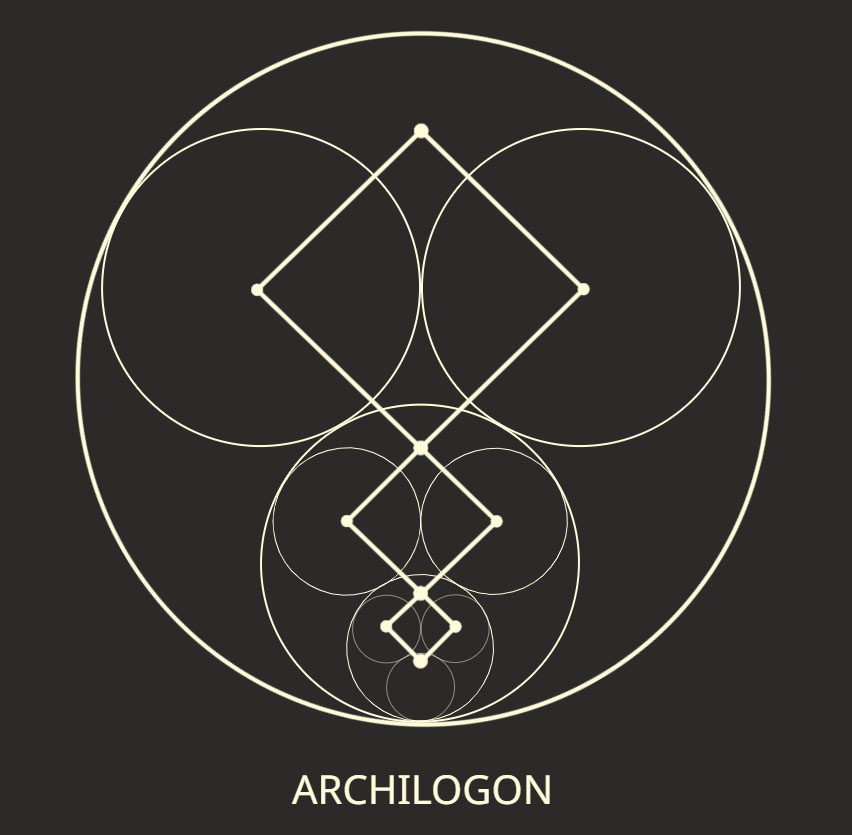
Archilogon 014 - 2. Plato - 5. The Divided Line
In this video, Elias Artista explores the celebrated passage of Plato’s Republic known as the “Divided Line.” Through the dialogue between Socrates and Glaucon, Plato distinguishes between the Sensible and the Intelligible realms, unfolding four levels of cognition: Eikasia, Pistis, Dianoia, and Noesis. With insights from Giovanni Reale and Maurizio Migliori, the video highlights the geometrical structure of the schema, emphasising its significance for reconstructing the Platonic Psyché and the Pythagorean source from which Plato drew inspiration.
Archilogon – The key to Synthetic Logic. A project by Elias Artista.
Bibliography
Works Cited
- Plato, Republic, Book VI, 509d.
- Giovanni Reale, Per una nuova interpretazione di Platone alla luce delle “Dottrine non Scritte”, Bompiani, Milan, 2010, p. 241 ff.
- Maurizio Migliori, “Lo schema onto-epistemico della Linea,” in Elenchos, XXVII, Fasc. 2, Bibliopolis, Naples, 2006, p. 468.
- The ancient diagram with the traditional depiction of the Divided Line is taken from Scholia Platonica (1938), edited by William C. Greene.
Video Transcription
As you can see in this diagram, dear Glaucon, there are two domains: one is the Sensible World, the other is the Intelligible World, what lies beyond the heaven above our heads. Have you grasped this dualism between the Sensible and the Intelligible? Yes, I have.
Observe the line, divided into two unequal segments. The shorter segment descends into the Sensible World, the longer rises into the Intelligible. Each is further divided into two unequal parts, in the same ratio. Now imagine that, on the Sensible side, there are only “shadows”, whereas on the Intelligible side there are the real “bodies” that cast those shadows. Shadows and bodies, very well. Would it not be obvious to say that the line between the two worlds separates shadow from body as the “false” from the “true”, as “opinion” from “true knowledge”? Yes, undoubtedly.
Consider now the Intelligible segment on its own. Look first at its smaller portion. That portion proceeds from the shadows to the definition of Mathematical Entities. The longer portion, by contrast, starts from those Mathematical Entities and ascends to the Ideas-Forms. That last point… I confess I have not grasped it. Let me try another path.
You know, of course, that mathematicians have demonstrated the existence of the Even and the Odd, of geometrical figures, of the three kinds of angle, and of all the other mathematical entities. These are quite certain, and generally uncontested because they are self-evident. One may therefore say that mathematicians arrive at secure principles beginning from the uncertain shadows of the Sensible World. No doubt.
Yet it is possible to start from those very entities and reach something even more certain. In that case the aim is no longer the entities themselves, but the higher reality on which they are modelled, so that, when we contemplate those entities, we are not truly thinking of the square, the diagonal, or the figure drawn, but of the superior principles that the figures represent. In short, Mathematical Entities help us to describe that transcendent dimension which our intellect cannot otherwise apprehend. I think I have understood.
Thus, in trying to grasp the structure of this so-called Intelligible World, our mind is obliged to rely on hypotheses, for our search cannot advance beyond them, using schemata that stand to bodies as shadows stand to the objects that cast them. The difference, however, is that these schemata are far more reliable than the shadows of the Sensible World. Are you speaking of geometrical drawings?
Look to the longer stretch of the Intelligible part. It symbolises that mode of reasoning, Noesis, which, by means of the Dialectical Science, uses diagrams as its point of support and departure. From there, reasoning, purged of sensible images, proceeds towards the upper end of the line to apprehend the pure Ideas-Forms.
If I have followed you, you mean that whatever is grasped by Dialectical Science is more authoritative than what other disciplines attain, and that mathematicians, although they use the intellect and not the senses, still do not reach full knowledge of their objects, and that the mathematician’s cognition, midway between subjective knowledge and objective knowledge, you call Dianoia. Exactly.
To the four segments of this line, there correspond four modes of cognition: at the summit, Noesis, or “Comprehension”; in second place Dianoia, or “Knowledge”; third, Pistis or “Belief”; and fourth, Eikasia or “Impression”. These powers are logically ordered. The nearer a form of knowing draws to Noesis, the nearer it comes to objective truth.
Here we have reimagined the famous exchange between Socrates and Glaucon in the Republic, picturing them as they converse in front of a diagram. It is curious that from antiquity onwards, the “Divided Line” has almost always been drawn horizontally, whereas its natural orientation is vertical. The Greek itself suggests as much, for example: “the lower part of the line”, at 511a, or “the higher segment”, at 511d.
On this point, Giovanni Reale writes: “It becomes clear that the reality derived from the principles is conceived by Plato not in a horizontal dimension but as a vertical structure arranged in a successive series of planes, each subordinate to the one above, and all of them dependent in like manner, upon the two supreme principles.”
It is worth stressing that the Divided Line is not a makeshift teaching aid but a precise geometrical form. Maurizio Migliori reminds us: “There has been vigorous debate between those who hold the structure to be casual and therefore philosophically irrelevant, and those who seek its rationale. Yet a construction so clearly intended in a milieu as attentive to geometrical and mathematical procedures, as was the Academy, can hardly be deemed accidental.”
This is no minor detail, for our reconstruction of the Platonic Psyché will rest on a correct reading of the schema, in which every graphical element possesses a precise, binding, indeed mathematical value. Why do we say “Psyché” rather than “soul”, as later tradition would have it? Not out of exoticism, but to distance ourselves from the notions commonly attached to the term “soul”. By the term “Psyché” we shall not refer, in a generic manner, to human interiority or to some nebulous “vital breath”, but to a determinate structure of archetypal Forms.
So when we say, metaphorically, that “the Divided Line is the ‘spine’ of the Psyché”, we are claiming that it is a portion of forms set within a more complex geometric architecture. We shall set out the entire structure later, once the premises are sufficiently clear.
In the next video we shall analyse the Divided Line in detail, for understanding its “quadripartite” structure is the first step towards recognising the Pythagorean wellspring that nourished Plato’s thought. To the Principle!