Archilogon 015 - 2. Plato - 6. The Evolution of Consciouness
In this video, Elias Artista examines the meaning of the celebrated Divided Line from Plato’s Republic, interpreting it as a symbolic representation of the evolution of consciousness. Through the reflections of Francesco Fronterotta, James A. Notopoulos, and Sybille Krämer, the account reveals how the fourfold division—Eikasia, Pistis, Dianoia, and Noesis—depicts four distinct kinds of cognition, the successive stages of an ascensional movement of consciousness toward Unity: the ultimate goal of the Synthetic Logic that animates Pythagorean and Platonic thought.
Archilogon – The key to Synthetic Logic. A project by Elias Artista.
Bibliography
Works Cited
- Francesco Fronterotta, Guida alla lettura del Parmenide di Platone, Laterza, Bari, 1998, p. 37.
- James A. Notopoulos, “Movement in the Divided Line of Plato’s Republic,” in Harvard Studies in Classical Philology, vol. 47, Harvard University, Cambridge, 1936, p. 61.
- Sybille Krämer, “Is there a diagrammatic impulse with Plato? ‘Quasi-diagrammatic-scenes’ in Plato’s Philosophy,” in Thinking with diagrams – The semiotic basis of human cognition, De Gruyter, Boston/Berlin, 2016, pp. 164 and 176.
Video Transcription
Let us pause to contemplate the Divided Line. Plato might have divided it into four equal parts, as one usually does when schematizing something fourfold. Yet he did not, and we cannot help but wonder why. It is from this enigmatic choice that our inquiry takes its start, for beneath this small rock, jutting above the surface of the water, lies a continent submerged for more than two millennia.
In the dialogue, Plato equates the knowing subject with the known object, and prefigures a schema that encompasses both in an analogical manner. He tells us that both reality and the knowledge of reality are subject to one and the same fourfold schema of Forms. Francesco Fronterotta writes: “The principle applicable to every level of this schema is always the same: the principle of absolute correspondence between ‘knowledge’ and ‘reality’, between Epistemology and Ontology. Every form of knowing, and every kind of knowing, from ‘Opinion’ to ‘true Knowledge’, depends upon the object it takes as its content, and becomes clearer the truer its object is.”
Plato proposes a triple analogical relation: he says that the horizontal line separates ‘shadow’ from ‘body’ just as the ‘false’ from the ‘true’, and the ‘opinion’ from ‘true knowledge’. This tells us, quite clearly, that the drawing expresses precise Formal Relations of Opposition which Glaucon immediately understands, for the archetypal Forms dwell within every human being. This is the very nucleus of Dialectic, the logic of two polarities.
For Plato, these Formal Relations possess a specific gnoseological status. They belong to a distinct dimension, neither ontological, since they are not Phenomena, nor psychological, since they are not Concepts, nor even semiological, since they are not merely Signs, though they must necessarily be expressed through Signs. These lines, in fact, point to something else, something neither directly accessible nor expressible in any other way.
This fourfold division expressed by the Divided Line, this “tetrad”, derives from an initial bipartition: the archetypal dialectical opposition between Subject and Object. The lower pole, which Plato designates as Doxa, we shall indicate here not as “Opinion”, but as “Subjective Cognition”. Its first level, Eikasia, is the illusory cognition determined by the individual perception of Phenomena, which we shall render as “Impression”. In a slightly more objective position stands Pistis, or “Belief”, namely, faith in what one has not directly experienced, yet is socially shared.
Conversely, in the direction tending toward the higher pole, the realm of Episteme — which we shall translate as “Objective Cognition” — Dianoia is the intellectual knowledge produced by syllogistic reasoning. Finally, Noesis, the term Plato introduces as a cornerstone, is “Comprehension”, the subordination of all preceding forms of cognition to a supreme synthesis, to the synoptic vision of the archetypal Forms that confer order and measure upon all that can be known.
Whenever, in the remainder of the account, we use the expression “Noetic level”, we shall refer to the level attained by an individual consciousness, according to this fourfold division expressed by the Divided Line. One of the keys to understanding the function of the Line is to imagine an essential movement of consciousness in four stages.
James Notopoulos writes: “To understand fully Plato’s definition of Being as ‘Dynamis’, we must include movement as a metaphysical factor in the metaphor of the Divided Line.” The evolution of a consciousness that aspires to “Objective Cognition” is a movement ascending the Line, departing from the subjectivity of sensible perception, from the Singular, and tending progressively toward the Universal, toward the comprehension of the archetypal Forms, the faculty that Plato calls “divine”.
Now, we know that at the base of the Line lies the Multiplicity apprehended by the senses, while at its summit lies the Unity grasped by the mind. And if Unity stands at the summit, the final goal of consciousness aspiring to truth, this means that the logic animating Platonic metaphysics is a Synthetic Logic.
One might wonder why Plato explains his system to Glaucon through a diagram. Sybille Krämer writes: “For Plato, the spatialisation and visualisation of thoughts are supports, not obstacles, to the comprehension of Ideas. To look at Plato from a schematic perspective opens significant insights into the systematic functions of diagrams. It also sheds a clear and revealing light on the uniqueness of his philosophical method. Plato’s diagrammatic impulse arises from his attempt to use ‘spatial relations’ as instruments for the acquisition of knowledge.”
Thus, diagrams are not merely aids to comprehension, but indispensable conditions for reaching Noesis. The Divided Line is not a simplification for didactic purposes: that figure is the only bridge between the known and the unknown. It allows one to perceive metaphysical constraints through geometrical forms, since the sensible shapes of a drawing can reproduce, and thereby render accessible, the Formal Relations that structure reality. By offering itself to the human sense of sight, the diagram enables the mind to apprehend synoptically those higher, invisible and intangible Forms that structure the Intelligible World — Forms generated by the interplay between Space and Time.
We know that the spatial and visual element in Plato is crucial. In The Republic, it helps Glaucon understand the direction of the evolution of consciousness. In the Spindle of Ananke, it delineates a structure of circular motions, ten of which are mentioned in the Laws. In the Meno, a geometric intuition enables an uneducated slave-boy to acquire notions he did not know he possessed. In the Timaeus, the spatial element dominates the entire narrative, for the Demiurge sets his abstract Forms upon a plane, the Receptacle, as an architect draws his design upon a drafting table.
The great problem is that all these images have reached us in textual form. The multiplicity of meanings and the absence of figuration have rendered many of the descriptions enigmatic. Thus, generations of Platonists have devoted themselves to reconstructing what had been lost, with results we shall examine as the narrative unfolds.
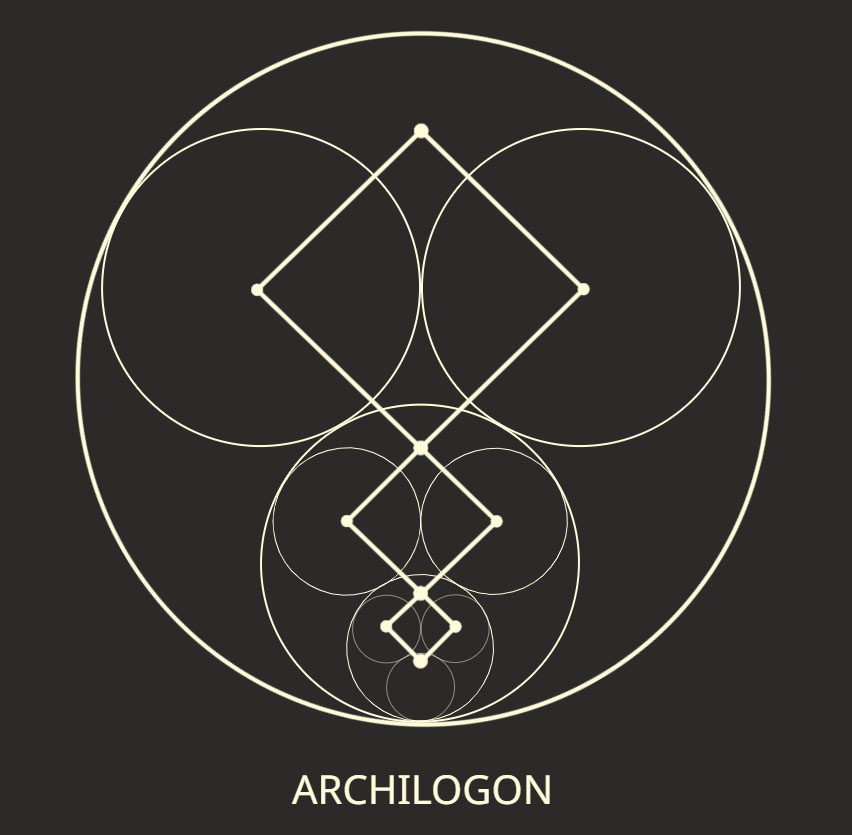
As we have already said, our working hypothesis is that the Divided Line represents the backbone of a complete diagram: the Psyché described in the Psychogony of the Timaeus. This diagram illustrates the formal principles of that logic, which would reflect not only the mode of thought of Plato and of Pythagoras before him, but of every synthetic thinker throughout history.
Moreover, we shall maintain that, without reconstructing this diagram, Synthetic Logic cannot be formalised, and therefore appears evanescent and self-contradictory, to the point of being deemed incapable of producing a shared system of knowledge.
On the basis of the traces found in Plato and the Platonists, we have pursued two projects in parallel: we have constructed a logical diagram, the Archilogon, which represents the correct and complete exposition of Synthetic Logic. This, in turn, has enabled us to reconstruct the Platonic Psyché. They are two hypothetical representations of the Intelligible World, sharing the same geometrical forms.
In the next video, we shall draw the conclusions of our brief incursion into Platonic thought, in preparation for the third stage of our journey, entirely devoted to the exposition of the discipline known as Metaphysics. To the Principle!