Archilogon 016 - 2. Plato - 7. Eidetic Intuition
In this video, Elias Artista addresses the theme of Eidetic Intuition, a crucial inferential mode for understanding Platonic thought. Beginning with the celebrated Seventh Letter, the narrative shows how Plato distrusted words and placed his faith instead in a non-conventional kind of knowledge. Through the reflections of Harold Cherniss, Philip Merlan, Léon Robin, and William James, the video explains that true philosophy cannot be reduced to a philological exercise but requires an inner act of logical reconstruction: a synthetic vision of the Forms that depends on a distinct inferential mode—spatial and visual in nature. Eidetic Intuition thus becomes the key to grasping the Synthetic Logic that animates the Platonic Dialogues.
Archilogon – The key to Synthetic Logic. A project by Elias Artista.
Bibliography
Works Cited
- Plato, Seventh Letter, 341c–342a.
- Harold Cherniss, The Riddle of the Early Academy, Russell & Russell, New York, 1962, p. 13.
- Philip Merlan, “Form and Content in Plato’s Philosophy,” Journal of the History of Ideas, Vol. 8, No. 4, University of Pennsylvania Press, Philadelphia, 1947, p. 428.
- Léon Robin, Platone, Lampugnani Nigri, Milan, 1971, p. 82.
- William James, Pragmatism and Other Essays, ed. J. Blau, Washington Square Press, New York, 1963, pp. 6–7.
Video Transcription
When quoting passages from past authors during our journey, we shall at times venture new translations, bending words beyond their customary limits in order to transcend the constraints inherent in the cultural transmission of discourse. The purpose of this project is not philological, but hermeneutic. Our aim is not to reconstruct lost documents, but the logic that produced them. For a philosophical doctrine is the attempt to articulate a logic through the arrangement of sounds and signs.
In Plato's case, our intention is not to "homogenize" the Dialogues, published for reasons we moderns can only partly discern, but to isolate their guiding thread and pursue it towards its natural destination, which, as Plato himself hints in the Phaedrus, lies beyond words. For words are deceiving. If Plato was indeed the author of the Seventh Letter, he hesitated to entrust the heart of his project to writing, aware that his words would be distorted by those who misunderstood them. The passage is bitter indeed: "Concerning these matters, there is no treatise of mine, nor will there ever be. For this knowledge is not like other forms of learning. It cannot be transmitted, but arises suddenly in the soul, like a flame kindled by contact with a living fire, and thereafter it sustains itself. Yet I know this: If I were to write or speak of it, none could write as I should. And if my words were to be misconstrued, the pain would be great. Had I truly believed these things communicable to the many, nothing would have delighted me more than to write of them for the benefit of all, revealing their nature. But such an endeavor, I think, would not profit all alike. It would serve only those few who, once given some indication, are able to advance alone to the end of inquiry. The others would earn only unjust contempt and the accusation of foolish arrogance, as happens to those who claim for themselves a noble title."
The historian and philosopher Harold Cherniss comments thus: "For my part, I do not believe that Plato wrote this letter, yet even if I did, I should admit that he himself had spoken in advance against everything that could be written concerning the true meaning of his thought. I should regard it as sheer folly, born of obstinate insolence, to attempt to describe, or even to discover, the true doctrine of a man who condemned all who have tried or ever shall try." Yet the author of the letter does not condemn those who, boldly, set out upon his own path: he merely warns them.
For a philologist, to seek truth where nothing has been written may seem an act of arrogance, but a hermeneut is not bound by the same rules, nor can he limit truth to words, since words may fail to contain it, or may even conceal it, consciously or not. Philology concerns itself with signs, on which it must rely. Our task, instead, is to reconstruct the logic that binds those signs together. The aims differ, hence the hermeneut must avail himself of the philologist only to betray him when interpretation no longer guarantees meaning, even at the risk of imposing his own. The risk is real, but the venture unavoidable, and the stakes immense.
Beyond the philologist's grammatical analysis the hermeneut's logical analysis demands Eidetic Intuition, the capacity to apprehend Forms that do not reside in words, but emerge from the relational structure of the whole. Such a capacity cannot be acquired through study alone, for, as we shall seek to demonstrate, it rests upon a psychic predisposition to spatial and visual inference. Hence Plato's doubt that his method could be universalised.
As Philip Merlan writes: "Plato is no sceptic. He may lament that the essence of all things, the truth, cannot be directly imparted, yet he feels that he possesses that truth and can aid others in grasping it. He even admits that one might grasp it without his help. Nevertheless, this truth evidently requires a peculiar training and understanding. It is a truth that, if we interpret with utmost caution the metaphor of the fire-kindled, belongs to a level different from that of other kinds of knowledge, and therefore accessible only to a peculiar kind of comprehension." If this is so, we might revive Cusanus' image of Philosophy as a "hunt" to describe our own inquiry. Any skilled investigator knows that it is one thing to reconstruct a hunter's movements from footprints, and another to pursue the same prey. Only thus do the tracks acquire meaning, revealing the hunter's logic.
Our quarry, then, is not Plato himself, but the prey pursued by Plato, which Léon Robin aptly identified: "The truth is that Plato sought a 'synthetic philosophy', one that would proceed from the simple to the complex, following from one to the other the series of intermediate degrees that are the various modes of the reality." Plato's prey is Synthetic Logic, namely, the inferential mechanism adopted by philosophers who approach knowledge through spatial and visual categories, concentrating upon the relation between the Whole and its Parts. This is why such a mechanism, our own inferential mode, has drawn us from youth into the orbit of Idealism.
Hence, at the end of our pursuit, certain Platonic statements have appeared to us luminous, without the need to torture words. Words that, once subjected to exhausting interrogations, reveal only what we wish to hear. Each philosopher thus approaches knowledge according to his innate inferential mode. The two antithetical modes are the 'Sequential', which generates Analytic Logic and the Syllogism, and the 'Structural', which animates Synthetic Logic and Analogy. The former seldom comprehends the latter.
William James interpreted these as temperamental antitheses: "The history of Philosophy is, in great measure, the history of a clash between certain human temperaments. Whatever a philosopher's temperament, he seeks, when philosophizing, to suppress this fact. He presents impersonal reasons for his conclusions, yet it is his temperament that strongly influences even his most objective premises. His temperament bends the evidence this way or that, favoring a 'warmer' or a 'colder' view of the universe. He has faith in his own temperament. Desiring a universe that suits him, he believes in whatever representation fits his nature. He feels that people of the opposite temperament are out of tune with the world's character, and in his heart deems them incompetent in Philosophy, however superior they may be in dialectical skill. Yet in debates of temperament he can claim no special knowledge or authority, and this falsifies his philosophical discussions, for the most powerful of all premises is never mentioned." What James calls "temperament" distinguishes two fundamental types, the Idealist, his "tender-minded rationalist", who acts according to principles, and the "tough-minded" Empiricist, who relies upon what he calls "facts". Psychologically, Jung terms these temperaments "Introvert" and "Extrovert". Their archetypal embodiments are Plato and Aristotle.
An 'analytic' observer, might find in this scheme an intolerable overlap of planes and disciplines, and dismiss it as "naïvely eclectic". Yet the 'synthetic' observer, through Eidetic Intuition, perceives, beneath it, an archetypal Relation, an Opposition of Forms, that transcends all disciplinary boundaries.
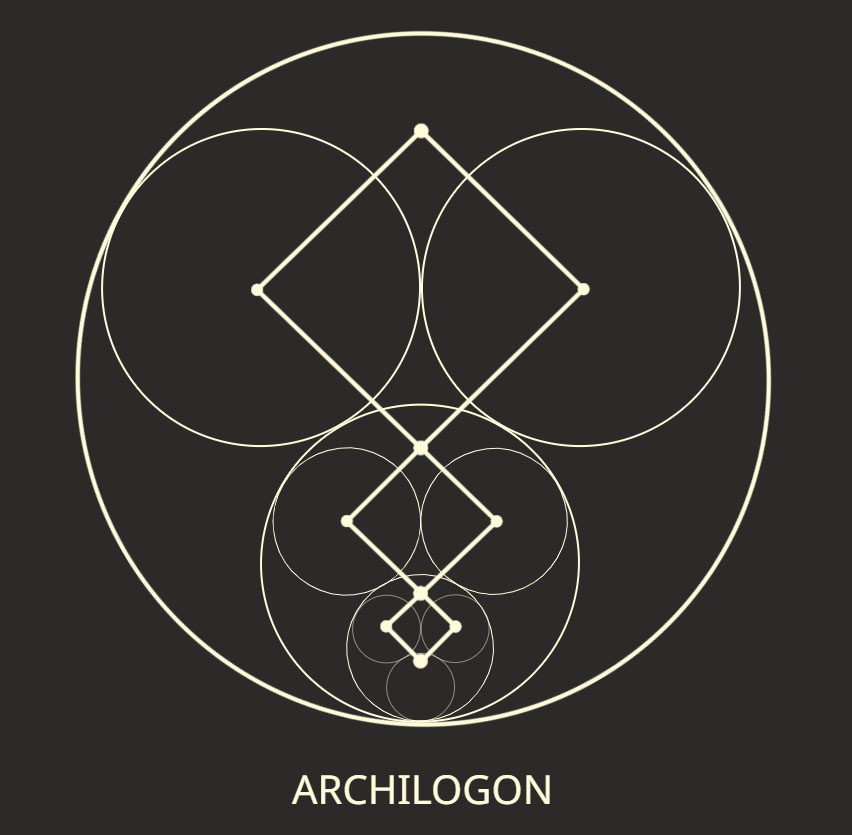
If Friedrich Schleiermacher was right that understanding a text requires the interpreter to enter the author's perspective through empathy and identification, then this is precisely our case. Instinctively estranged from Aristotle, we have always felt in Plato an indefinable consonance, a "philia", that resonated even before a clear comprehension of his Dialogues had been gained. The same spatial mode of thought that produced them has guided us, torturously, until, within our imagination, the diagram of the Archilogon took shape.
Not all who seek Plato will find him, yet it may happen that one who hunts the same prey suddenly finds him at his side, sharing an inexplicable affinity that transcends centuries. For Plato's thought springs from that "Intuition of Forms", which belongs not to him as an individual, but to every synthetic thinker. For one who discovers, late in life, that he was born an idealist, all that has been written in Philosophy has value, but the greatest value, the most honest and precious legacy he can leave to posterity, lies not in faithful adherence to any tradition, but in the clearest and purest anamnesis of his own soul, consumed, by a single spark, in the same fire.
Our second stage, wanderer, ends here. In the next chapter we shall attempt to summarise certain key concepts that have traversed Western Philosophy throughout its millennial history. We shall not pretend to adopt a neutral standpoint, but shall interpret it from the perspective most congenial to us, that of Platonic Realist Idealism. "To the Principle!"