Archilogon 017 - 3. Metaphysics - 1. The Fourth Dimension
In this video, Elias Artista introduces the third stage of the Archilogon journey, devoted to the keyword “Metaphysics.” The account explores the Pythagorean–Platonic perspective on the discipline, illustrating the four dimensions of knowledge: the Sensible World, Thought, Language, and the celebrated fourth dimension—the Intelligible World. Through the reflections of Paul Natorp, Giovanni Reale, Ernst Cassirer, and Bertrand Russell, the video shows how Metaphysics—understood as the “Science of Logic”—investigates a reality that is not empirical but “subsistent.” This confirms what Plato wrote in the dialogue on the Divided Line, where the archetypal Formal Relation of Opposition between the Sensible and the Intelligible Worlds is made manifest.
Archilogon – The key to Synthetic Logic. A project by Elias Artista.
Bibliography
Works Cited
- Paul Natorp, La Dottrina platonica delle Idee – Una introduzione all’Idealismo, Vita e Pensiero, Milan, 1999, p. 506.
- Ernst Cassirer, Sostanza e Funzione – Sulla Teoria della Relatività di Einstein, La Nuova Italia, Florence, 1973, p. 392.
- Giovanni Reale, Storia della Filosofia antica, Vol. II, Vita e Pensiero, Milan, 1988, p. 404.
- Bertrand Russell, “L’Importance philosophique de la Logistique,” in Revue de Métaphysique et de Morale, Vol. 19, No. 3, Presses Universitaires de France, Paris, 1911, pp. 288–290.
Video Transcription
Welcome, wanderer, to the third stage of our journey. The guiding word is: Metaphysics. As we noted in the chapter "Chaos", both the definition of the term and the limits assigned to this discipline remain subjects of debate.
Here we shall deal with Pythagorean and Platonic Metaphysics, whose premises are well expressed by Paul Natorp: "According to Plato, the "law of the logical" precedes Being. It is beyond Being. This is the ABC of Idealism."
This is perfectly consistent with Hegel's view, which defines Metaphysics as the "Science of Logic". Such a delimitation of Metaphysics as the study of "Pure Logic" excludes all empirical elements, thereby setting aside most modern interpretations.
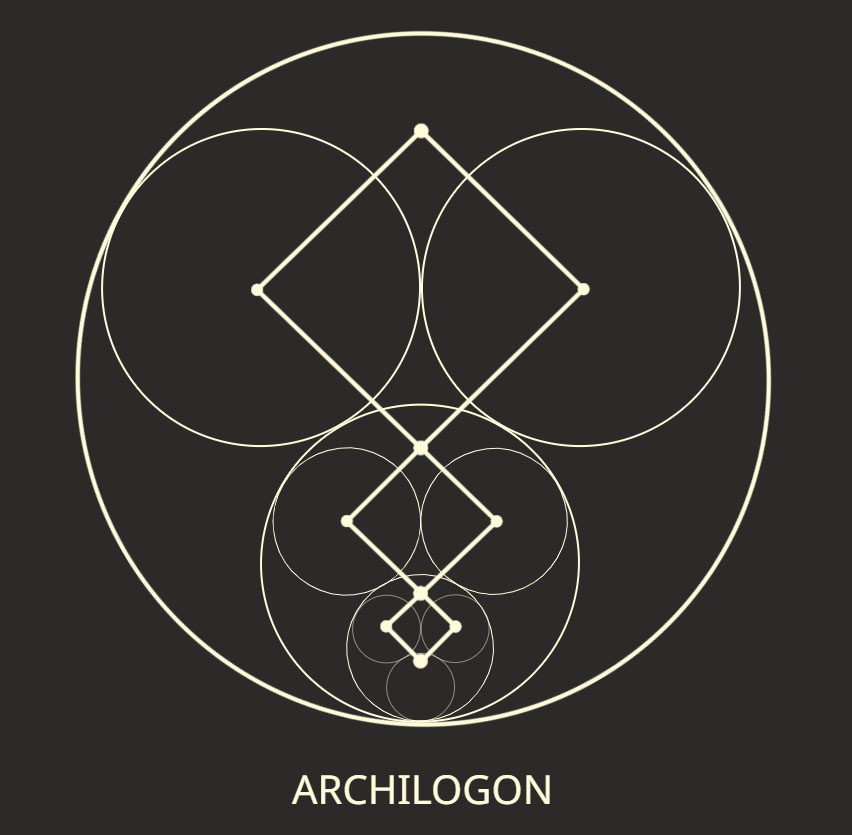
Our account begins from a diagram. The drawing will show, in real time, the progress of our inquiry, accompanying us throughout the narration. It will help us to contextualize the ideas expressed with the caveat that no concept we propose will find a place outside its borders.
This diagram represents our mental space, the formal structure that relates and gives meaning to the concepts we have acquired over time. Whatever lies beyond it signifies, for us, the incomprehensible. The reference, of course, recalls the distinction between "Knowing" and "Comprehending" formulated in the prologue. Everything that is not positioned within the diagram we may well "know", yet still fail to "comprehend".
Since we do not know our interlocutor, we shall sometimes have to imagine his mind as a "tabula rasa". Those with little philosophical practice may initially struggle to grasp single concepts, but will find it easier to apprehend the general structure. The scholar, by contrast, will face greater difficulty, for our schema may conflict with what he already holds as codified truth, and the terms we employ, drawn from differing traditions, may carry for him distinct shades of meaning.
Gnoseology, the discipline that studies the problem of knowledge, investigates the relations among three domains: One: the Sensible World and its Phenomena, that dimension we perceive through the senses and have been taught to call "the real world". Two: Thought and its Concepts, the inner, mental dimension that produces abstract representations of reality. Three: Language, the symbolic dimension that seeks to express, through Signs, those mental representations in order to share them with other consciousnesses.
These are the three fundamental dimensions of knowledge, three interdependent realms that ceaselessly modify and nourish one another, since even Signs, by virtue of their sensible aspect, become Phenomena capable of generating further representations. Philosophy has long sought to understand the mechanism of interaction among these dimensions, and the various schools have divided according to the primacy each accords to one or another.
Put simply, the first sphere is studied by the Sciences, the second by what we shall call "Psycho-Logic", the third by "Semio-Logic". By "Psycho-Logic" and "Semio-Logic" we do not refer to the historical disciplines of Psychology and Semiotics, or to their developments, but to two distinct philosophical perspectives. Thus, for instance, we shall associate Kant with "Psycho-Logic", taking it as the philosophical study of Thought itself.
At the dawn of Philosophy, however, this gnoseological framework was enriched by a fourth dimension: the so-called "Intelligible World", or "World of Ideas-Forms", a realm situated beyond sensible perception yet posited by thought. The discipline devoted to the study of this fourth dimension is, broadly speaking, called "Metaphysics", in antithesis to Physics, the sovereign science that investigates the Sensible World.
Giovanni Reale defines Metaphysics as follows: "Metaphysics concerns realities, transphysical or supraphysical realities, that stand above the physical and as such it stands in opposition to Physics. The term "Metaphysics" in its Aristotelian legacy has come to designate every attempt of human thought to surpass the empirical world in order to reach a meta-empirical reality."
To grasp the logic informing this discourse, you are invited, at least initially, to observe and internalise the graphic arrangement of the concepts. This layout is neither arbitrary nor modifiable, for it arises from a systemic vision in which every detail is a functional part of an architecture. The Relations of Opposition it expresses will gradually be elucidated in discursive form as our inquiry unfolds.
From a modern standpoint, Thought and Language are unquestionably products of human activity, whereas the Sensible World is commonly believed to exist independently of our individual perception. This belief stems from the concordance among our various sensory responses, which suggests a shared world.
The same cannot be said of the Intelligible World, whose objectivity and autonomy with respect to Thought have been rejected on account of its non-existence, and thus of the impossibility of investigating it by scientific means. We shall describe this peculiar condition of "non-existence" with the term "subsistence".
Bertrand Russell explains how thought naturally deduces this state of "subsistence" in logical and mathematical objects. Human knowledge is of two kinds: knowledge of particular facts, which allows us to affirm their existence, and knowledge of logical truths. In pure perception there is only knowledge of particular facts; in pure Mathematics there is only knowledge of logical truths. Logic and Mathematics, therefore, compel us to admit a kind of "realism", namely, that there exists a world of universal truths which do not refer directly to any particular existence. This world of universals must "subsist", since it does not exist in the same sense in which particular data exist."
Whereas the term "unreal" in common usage refers to a product of fantasy, the term "non-existent" or "subsistent", designates something objective, situated beyond the dimensions of space and time, and therefore imperceptible, yet apprehensible through a specific act of cognition.
As Plato stated in the Dialogue on the Divided Line the Sensible and the Intelligible Worlds are thus co-implicated in a Formal Relation of archetypal Opposition. Ernst Cassirer writes: "The deepest reason why the "external world" and the "inner world" are opposed as two heterogeneous realities, lies in an analogous opposition admitted between 'experience' and 'thought'. The certainty of experience is considered wholly different from that of thought. And as experience and thought are separated in their origin, so too are they divided within their respective domains of 'objects', each possessing a unique and exclusive validity."
The objects that populate the Intelligible realm, the Forms, thus possess a specific gnoseological status. They are, in the Pythagorean and Platonic view, non-existent, yet absolutely real. Since the structure of the Intelligible dimension has never been historically formalized beyond dispute, it has been downgraded and forcibly absorbed into the second sphere, that of Thought.
For those who maintain that the proofs behind any assertion must rest upon sensible evidence, the Intelligible World is, thus, a conjecture. Cornered, the ancient metaphysician turns the accusation upon his accuser: Any claim concerning the Sensible World cannot constitute "true knowledge", for it focuses upon objects, Phenomena, destined in time to lose their original traits and dissolve.
In the next video we shall see that both positions, according to Plato, when taken to their extremes, prove to be mistaken. "To the Principle!"