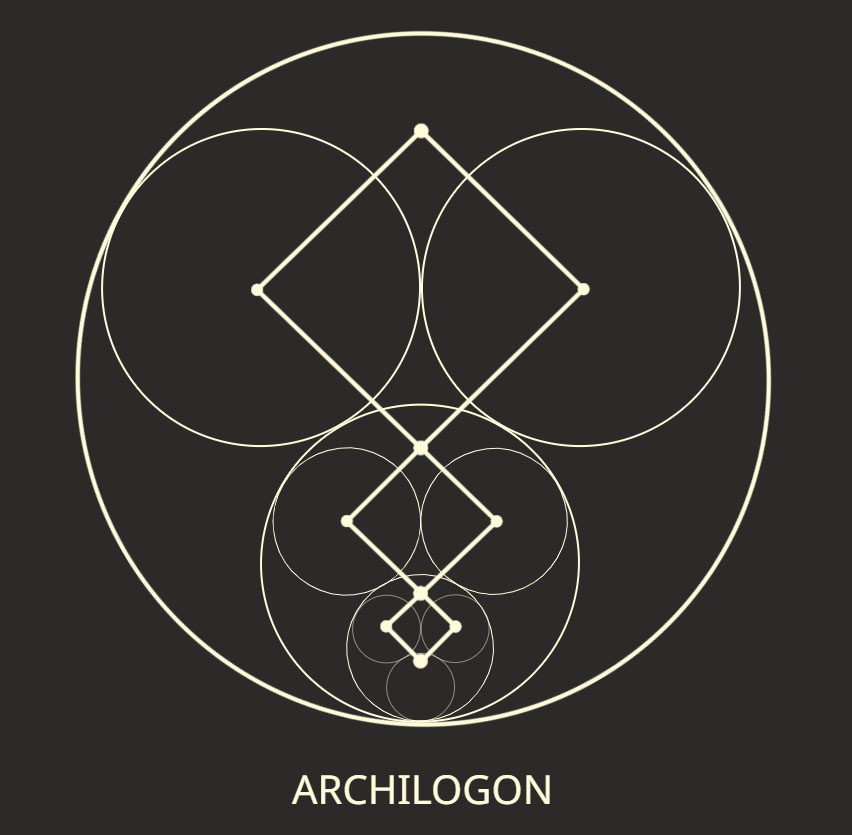
Archilogon 018 - 3. Metaphysics - 2. Reality and Being
In this video, Elias Artista continues his exposition of Pythagorean–Platonic Metaphysics. Beginning from the dualism between the Sensible and the Intelligible Worlds, the narrative shows how the concept of “Being” was contested between Idealists and Empiricists, and how Parmenides, Plato, and Iamblichus defined “true Being” as that which remains immutable beyond every transformation. Through Cassirer’s reflections and the fragments of Speusippus, the video reconstructs the logic of Unity and Multiplicity, introducing the Pythagorean notion of the One as the ultimate principle of all reality.
Archilogon – The key to Synthetic Logic. A project by Elias Artista.
Bibliography
Works Cited
- Parmenides, Fragment 1, in Sextus Empiricus, Against the Mathematicians, VII, 111 ff.
- Plato, Timaeus, 27c–28a.
- Iamblichus, On the Pythagorean Life, 159–160.
- Ernst Cassirer, Sulla Filosofia Antica – Manoscritti delle lezioni inedite di Oxford (1935) e Yale (1942), ed. G. Borbone, Bompiani, Milan, 2023, pp. 527–529.
- Speusippus, Fragment 48 Tarán, quoted by Proclus in Commentary on the Parmenides, 40K.
- John Dillon, Proclus - Commentary on Plato’s Parmenides, Princeton University Press, Princeton, 1992, pp. 583–584.
Video Transcription
Ancient Presocratic Wisdom, from which Platonic Idealism would take its point of departure, postulates a dualism: a world that exists, offered to our senses, and a world that subsists, whose absence thought perceives. Within this horizon, man lives suspended between two dimensions: the Sensible World and the Intelligible World. Between them operates a kind of continuous and profound osmosis, whose mechanism plays a decisive role in understanding the processes of transformation of reality. Within this dualism, the concept of Being has been contested by two opposing visions. Every thinker, idealist or empiricist, calls Being that dimension which he regards as the privileged object of knowledge. For the idealist, “true Being” is not what exists in the Sensible World, but what subsists, that which eludes the senses, yet constitutes the hidden cause of all manifestation.
Parmenides, one of Plato’s spiritual forebears, distinguishes between the knowledge of “true Being”, necessary and immutable, and empirical knowledge, contingent and transitory. In the poem On Nature, he warns the aspirant to Wisdom, urging him to doubt the consistency of the world of Phenomena. “You must know all things: on the one hand, the eternal and perfect Circle of Truth, on the other, the opinions of mortals, in which no trustworthy truth may be found.” For Parmenides, to be a “real” object means to be an “eternal” object. Phenomena certainly “exist”, if the defining condition of existence is to be located in a precise place in space, and a precise moment in time. Yet for Parmenides, the radical idealist, they are not “real” objects, since he assigns the concept of reality to that which remains unchanged in spite of every process of transformation, a transformation to which even the most durable aggregate of matter in the universe ultimately succumbs.
Plato, initiated into that Wisdom, inherits the antithesis between the two dimensions, and in the Timaeus writes: “What is that which always ‘is’ and has never become, and what is that which is always becoming and never ‘is’? The first, which is always in the same state, we apprehend with the intellect; the second we grasp with the senses, and it is the object of a subjective and transitory knowledge, for it is born and perishes and never truly subsists.” The Intelligible World and the Sensible World, thus, stand in proportional analogy as the “True” stands to the “False”.
Iamblichus helps us understand the deeper reasons for this judgment: “It is not worth studying corporeal objects, since they permit no stable knowledge. They are indeterminate and unattainable. Because of their distance from the Universal, we might call them ‘non-entities’, given their inadequacy to be circumscribed by any constant definition. Of what is by nature unknowable, no science can be conceived. We have no need of a science of what does not endure, but rather of a science whose object is ‘entities’ in their genuine sense, ever identical with themselves, immutable, for which the term Being is fitting. For, as Archytas said, ‘whoever knows the Universal correctly is also able to know the Particular rightly in its real essence’.”
The idealist stance of Parmenides, who treats sensible entities with disdain and enjoins us to turn our gaze toward the Intelligible World, appeared to Plato excessively one-sided. Plato does not despise the Sensible World. Instead, drawing on his Pythagorean sources, he investigates the mechanism of interdependence between these two dimensions, opposing Parmenides’ Unity of Forms to Heraclitus’ Multiplicity of Phenomena.
Cassirer explains how the state of flux of the Phenomena lay at the heart of Heraclitus’ reflection: “An object of sensible perception is but a fleeting phenomenon, a single moment in a continuous process of change. No two of these moments can be considered identical. No state ever reappears at a later instant in the same way as it once appeared. Heraclitus was therefore right to compare the world of the senses to a ‘river’, declaring that we cannot step into it twice. In the realm of phenomena belonging to Space and Time, human thought can never find any fixed point of support. It encounters no firm or stable ground on which to rest. Concentrated upon these objects, our thought is constantly driven from one position to another. It cannot come to rest or stabilize itself, for the objects in question resist such an attempt by their very nature. They possess no permanent quality or determination. Consequently, there is no knowledge, philosophy, or language capable of adequately expressing this fluctuating and wavering state of the phenomenal world. Thought and language depend upon stability, and must impart to all they touch some stable value or character.”
To overcome the ambiguity that the concept of Being carries with it, we shall use the term Being in reference to the Sensible World, and the term Reality in reference to the Intelligible World. Yet, we must remember that these are only labels, nothing more. As you have seen, we have divided terms into two distinct and opposing classes. While terms are transitory, subject to the transformations of culture and language, what endures are the Forms in which those terms have been placed. In essence, what ancient Wisdom and Idealism mean to convey, is that when our concepts and words have vanished, what will remain are always and only the Forms.
What will endure eternally is the formal and archetypal Relation of Opposition which projects itself, by analogy, onto every real antithesis we are able to conceive: Being and Non-Being, Unity and Multiplicity, Rest and Motion, Identity and Difference, Love and Strife, Day and Night, Male and Female. This ascent of thought from Concepts to Forms is the foundation of the “dialectical science” of which Plato speaks.
In the Pythagorean Metaphysics on which Plato modelled his logic, the concept of Reality was thus conveyed by a mathematical term: the One, the Whole, the All, that totality which, however, is dual in itself, since it comprises both the ideal Unity and the Multiplicity of existing things. The two dimensions, mutually implicative, cannot be disjoined, for the disappearance of one would entail, by pure logical necessity, the disappearance of the other.
A fragment of Speusippus gives voice to this dualism: “The ancients held that the One is superior to Being, and is the source of Being. For they maintained that without the One in itself, conceived as separate and autonomous, nothing would have come into existence. And thus they introduced the ‘Indefinite Dyad’ as the principle of what ‘is’.” For this reason Metaphysics, also called “Henology”, the Science of Unity, is a broader field of inquiry than “Ontology”, the Science of Being in its Multiplicity, and includes it, just as the Whole includes the Part.
Just as the Sensible World is composed of a substance in perpetual transformation, which we generically call Matter, so the substratum of the Intelligible World, composed of Forms ever identical with themselves, will be designated by the term Spirit. In the next video we shall see how the intelligible dimension coincides with the dimension that the ancients called “Logos”. “To the Principle!”