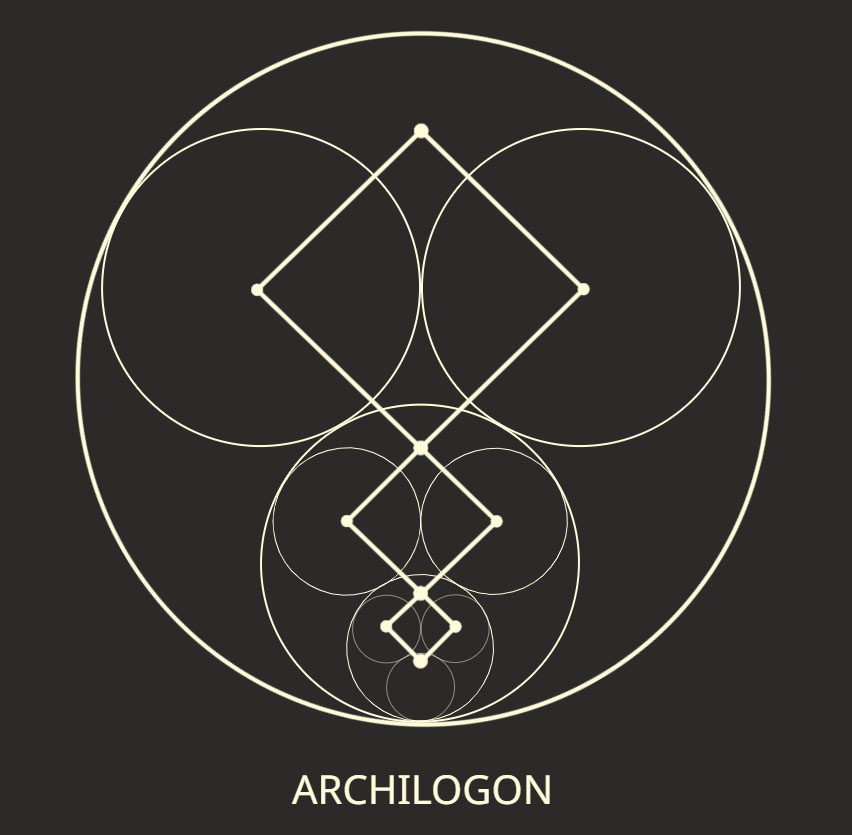
Archilogon 019 - 3. Metaphysics - 3. Peras and Apeiron
In this video, Elias Artista explores the line of continuity between the Metaphysics of the Milesian sages and the Pythagorean Dialectic that would lead to the birth of the Mathesis Universalis. Through the interpretations of Paul Seligman and Maria Timpanaro-Cardini, the discussion re-examines the role of Anaximander’s Apeiron (the Illimit), involved in an archetypal polarity with the Peras (the Limit). Particular emphasis is placed on the “distorting filter” applied by Aristotle and the Peripatetic School, who transmitted in physical and empirical terms the metaphysical concepts conveyed by ancient Wisdom and Idealism, thereby obscuring their genuine logical function.
Archilogon – The key to Synthetic Logic. A project by Elias Artista.
Bibliography
Works Cited
- Paul Seligman, The Apeiron of Anaximander – A Study in the Origin and Function of the Metaphysical Ideas, Athlone Press, London, 1962, pp. 18 and 154.
- Maria Timpanaro-Cardini, Pitagorici antichi – Testimonianze e frammenti, Bompiani, Milan, 2010, pp. LXV–LXVI.
- Iamblichus, On the Pythagorean Life, § XXVI.
Further Reading
- Aristotle, Metaphysics.
- Aristotle, Physics.
- Theophrastus, Commentary on Aristotle’s Physics.
- Porphyry, Life of Pythagoras.
- Diogenes Laertius, Lives.
Video transcription
The question is: "when" and "how" did Western thought first become aware of, and begin to reflect upon the "non-existence" of the Intelligible World?
The feeling of being subject to something that shapes human life has always existed, and, at an immediate level, it manifests itself in the religious sentiment.
The divine pantheons are nothing but the dramatic representation of a system of forces that govern and direct phenomena according to "arcane" laws.
When this perception of a supersensible order becomes socialized and ritualized, it turns into Religion; when dramatized by Art, it becomes Mythology, but from the Pythagorean and Platonic perspective, it is pure Philosophy.
In his Dialogues, Plato calls Philosophy "the science of the divine". "Divine" and "ideal" are synonymous.
Metaphysical Philosophy therefore consists in the study of the intelligible dimension and its transcendent bonds, in abstract and impersonal form.
Paul Seligman analyzed that delicate turning point at which Mythology, the dramatic narrative in which divine actions intersect those of mortals, begins to be stylized into philosophical forms, a moment ideally embodied in the passage from Hesiod to Anaximander.
Anaximander was among the first to attempt an account of the origin and structure of the world through a non-poetic language, postulating universal laws that no longer obeyed divine caprice.
Only a few fragments of his work survive, filtered through minds such as Theophrastus and Simplicius.
The innovation he introduced lay precisely in language: by refraining from attributing the transformation of reality to the "will of the Gods" and identifying instead an impersonal principle, "arché", Anaximander, as Seligman notes, "secularized cosmogony and thus took a first step toward a science of nature." The sages of Miletus - Thales, Anaximander and Anaximenes - laid the foundations of Metaphysics and we shall later see to what extent their reflections were indebted to Egyptian culture.
Of their writings, only fragments remain, insufficient to reconstruct a doctrinal corpus.
It is, however, possible to reconstruct the Pythagorean doctrine linked to Milesian Wisdom by connections that historiography has not yet fully clarified.
From Philolaus of Croton we learn that the Pythagoreans adopted an archetypal dialectical polarity: the 'Apeiron" - the Illimit, or the Indefinite, opposed to the 'Peras', the Limit, or the Definite.
This dialectical relation was expressed in the language of Mathematics, giving rise to a tradition that, centuries later, would be known as the "Mathesis Universalis".
Seligman writes: "The union, or harmony of Opposites, became a key concept in Pythagorean thought, and, from a functional point of view, corresponds to the metaphysical idea of Anaximander." Maria Timpanaro Cardini also highlights this connection between Anaximander and the Pythagoreans, though she inverts the archetypal polarity, assigning the 'Apeiron' to the Intelligible World and the 'Peras' to the Sensible. "Many times in the course of our work we have recalled Anaximander in relation to the Pythagoreans.
Now we seem to discern the point of junction between the two conceptions.
To Pythagoras and his circle it appears that the 'Apeiron' itself would remain isolated and inert, and hence incapable of explaining the Sensible World if it were not dialectically opposed by a term expressed and opposed to it: the 'Peras'.
The 'Apeiron', to be valid, required the 'Peras'.
Their synthesis would be 'Number', and within 'Number', 'Apeiron' and 'Peras' would assume the mathematical form of the 'Even' and the 'Odd'." It is, however, necessary to question the terms of this polarity, which convince neither logically nor idealistically.
For Idealism, as we have seen, considers the Phenomena of the Sensible World to be "indefinite".
Anaximander is quoted by Aristotle, and then by Theophrastus, whose work is lost, but survives in fragments, through Diogenes Laertius and Simplicius, writing centuries later.
The Peripatetic School is thus the filter through which knowledge of the ancient Mylesians has reached us.
A distorting filter, since none of the Peripatetics, beginning with Aristotle, seems to have grasped the logic animating the sapiential doctrines and Pythagorean and Platonic Idealism.
Aristotle interprets Anaximander's 'Apeiron' according to the empirical paradigm of his own Physics, translating into material terms what in the archaic context denoted a metaphysical principle.
This is not so much an error, as a lack of understanding of the original framework.
Aristotle aimed to transform Physics into a demonstrable science.
Every principle, therefore, had to be definable, observable in its effects, and reducible to categories of cause and matter.
The 'Apeiron' thus became for him a physical quantitative concept: the "indefinite that extends without measure", thereby losing its character as a formal and archetypal principle.
The fragments of Anaximander that have come down to us, detached from their original context, do not allow us to determine the precise meaning of the terms.
We cannot anchor the original concepts to their terminology until we have reconstructed the logical system from which they sprang.
Understanding is possible only through the reconstruction of the Synthetic Logic conveyed by the archetypal diagram.
In this new perspective it becomes clear that the 'Apeiron' the Indefinite, or the Illimit, is the principle governing the world of Phenomena, while the 'Peras', the Definite, or the Limit, is the principle structuring the world of Forms.
In any case, the exact reconstruction of Anaximander's thought is useful only at the historical level.
What matters to us, is to recover the mechanism of the formal and archetypal opposition that Pythagoras would adopt and develop through mathematical instruments.
What we know, or believe we know, about Pythagoras, who left no writings, depends on the filter of his later interpreters.
What moderns think they can attribute to him derives from a personal criterion of plausibility, and there is no escaping this limitation.
For centuries, Porphyry's "Life of Pythagoras", Iamblichus' "Pythagorean Life", and Book VIII of Diogenes Laertius' "Lives and Doctrines of the Eminent Philosophers" have served as the sources from which to extract the core of his thought.
Yet the criteria for selecting biographical material are elastic, and often include episodes that require reinterpretation.
In the biography by Iamblichus, for instance, we find the symbolic scene of the birth of the "Mathesis Universalis" embodied in a flash of pure intuition.
As he walked through the streets of Croton near a blacksmith's shop, Pythagoras was struck by the difference in sounds produced by hammers striking an anvil.
Reflecting on the cause, he imagined that the pitch of each sound might be determined by the weight of the instruments.
Hammers of equal weight produced identical notes, but when their weights stood in a ratio of two-to-one, the sounds they emitted lay an Octave apart, like the two 'C' notes separated by seven white keys on a piano.
The discovery had enormous consequences.
It equated two domains that to common sense appear divided by an abyss, showing that a quantitative difference, a mere increase or decrease in the quantity of sonic vibrations, can yield a qualitative variation in a phenomenon, namely a different note.
Whether the story be true or not, its essence reveals that Pythagoras' inquiry rested on the premise of a bond between two worlds, at once distinct and united.
The Sensible World was internally structured according to the dictates of a logic that could be apprehended and represented through the symbols of mathematical language.
Pythagoras envisaged a science by which, starting from numerical relations, from Formal Relations, humankind might interpret the Phenomena of the Sensible World, concluding, with Philolaus, that "all that we can know is number".
That is to say, the universe is measurable and orderable, because the structure of the Intelligible World is potentially reflected in human consciousness, and 'Proportion' is the key capable of unlocking the Logic of Reality. "To the Principle!"