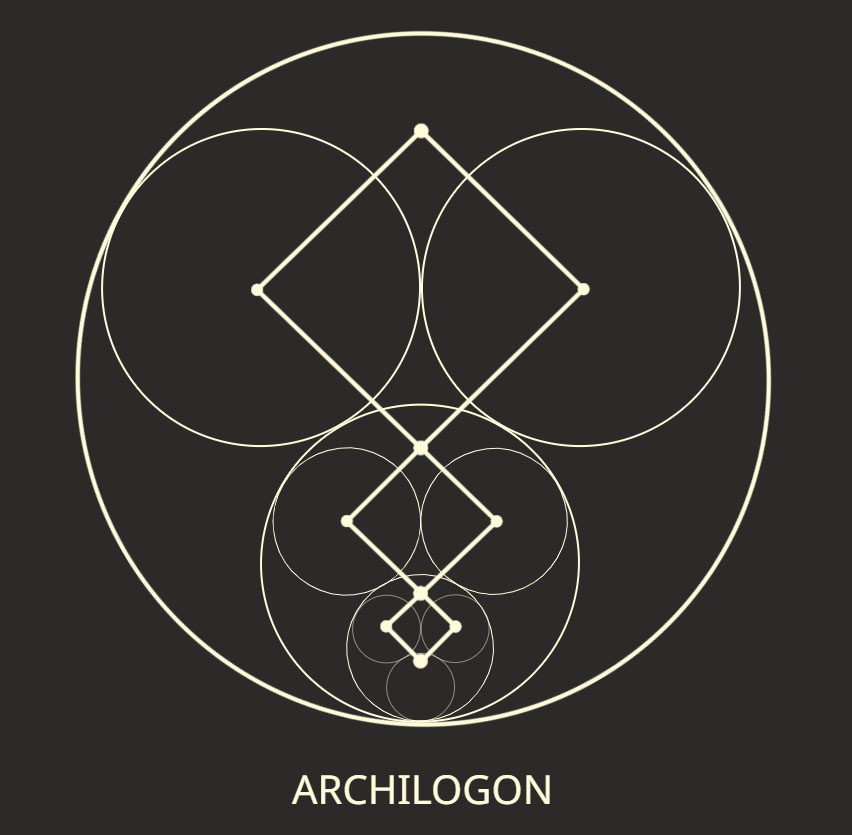
Archilogon 022 - 3. Metaphysics - 6. Eidos
In this video, Elias Artista probes the very core of Platonic enquiry, reconstructing the meaning of the Greek term “Eidos” (“Idea-Form”), understood as a transcendent constraint that structures the so-called “Intelligible World”. Drawing on the Platonic Dialogues, he sets out the main features of the Ideas-Forms, sharply distinguished from sensible phenomena. Referring to the analyses of scholars such as Giovanni Reale and Hermann Lotze, Elias shows how, for centuries, Platonic doctrine has been distorted by the Aristotelian interpretation, which treats the Ideas as “hypostatisations” of universal concepts and thus contributes to the marginalisation of Platonism within academic discourse. He then clarifies the use of terms such as “Form”, “Idea” and “Essence” and, in the final part, links the Ideas-Forms to Pythagorean Mathematics, the archetypal diagram and the dialectical method, showing how geometrical figures provide the only adequate way to represent transcendent constraints.
Archilogon – The key to Synthetic Logic. A project by Elias Artista.
Bibliography
Works Cited
- Leonardo Taràn, Speusippus of Athens, Brill, Leiden, 1981, pp. 13-14.
- Hermann Lotze, Logica, ed. it. 2010, pp. 993-997.
- Giovanni Reale, in Natorp, La Dottrina platonica delle Idee - Una introduzione all'Idealismo, Vita e Pensiero, Milan, 1999, p. XXIV.
- Giovanni Reale, Per una nuova interpretazione di Platone alla luce delle “Dottrine non Scritte”, Bompiani, Milan, 2010, p. 166 e 266 sgg.
Further Reading
- Konrad Gaiser, La Dottrina Non-Scritta di Platone (1968).
- Syrianus, On the Metaphysics of Aristotle, 103, 15.
- Karl Friedrich Hermann, Geschichte und System der Platonischen Philosophie, C.F. Winter, Heidelberg, 1839.
Video transcription
Let us now turn to a concept that lies at the very heart of Platonic inquiry, condensed in the Greek term eidos, which in this narrative we have translated as Idea-Form. What, then, are these Ideas-Forms, the objects that populate the fourth gnoseological dimension of knowledge, the so-called Intelligible World? In the Dialogues, Plato offers hints and fragments of arguments; at times he maintains that the Ideas-Forms possess certain features, yet he never provides a complete and systematic list.
From what emerges in the Dialogues, we may attribute to the Ideas-Forms the following characteristics: Universality and Objectivity. What generates the Ideas-Forms is not the human mind, which is naturally subjective; rather, they are expressions of reality itself. Intelligibility and Incorporeality. The Ideas-Forms are grasped by the mind, not by the senses, for they are devoid of materiality. Reality and Subsistence. “Apparent” is whatever stands in a relation of dependence upon something that possesses substance, as a shadow belongs to the body that casts it. The Ideas-Forms do not depend upon any other entity, whereas Phenomena take shape in accordance with the Ideas-Forms. Causality and Archetypicality. It is the Intelligible World that generates the Sensible World. It is its origin and foundation, while the latter is its material manifestation. Immutability and Eternity. Only matter undergoes transformation; the Ideas-Forms, which are not material, are eternally identical with themselves. Truth and Stability. When the intellect apprehends the universality of the Ideas-Forms, it apprehends what is true. Sensibility, by contrast, which would confer consistency upon the ever-changing Phenomena, does not yield certain knowledge.
Non-existence. The Ideas-Forms are located in no place and at no moment in time, and in this sense they do not exist. To summarize all these traits in a single definition, we might say that the Ideas-Forms are “transcendent constraints”. In the course of this narrative, we shall seek to clarify the meaning of this definition.
The first step towards understanding the nature of the Ideas-Forms more clearly, is to rule out, from the horizon of our hypotheses, what they are not, for their definition has been blighted for centuries by Aristotle’s interpretation. Prior to the approach of the Marburg School, there was broad agreement in treating the Ideas-Forms as universal classes of concepts, obtained by abstraction and then hypostatized, since Plato’s Realism had been banished from academic discourse after the delegitimization carried out by Kant.
The classical Aristotelian interpretation is neatly summarized in the following passage by Leonardo Taràn: “For Plato, the Ideas are the hypostatization of all universal concepts. To every kind of thing to which we apply a common name, there corresponds a single, eternal and immutable Idea, which exists outside time and space. Each idea is a perfect individual that exists for itself, separate from the many particulars that participate in it or imitate it, and separate from the corresponding concept in the mind. The Ideas, not the ‘always-changing’ particulars, are the genuine objects of thought and knowledge. If we in any way comprehend particular things, it is only because they receive from the Ideas whatever reality they possess. There are Ideas not only of natural entities but also of artifacts, abstractions, actions, passive states, relations and numbers. These ideal numbers are not sets of units, for each number as an Idea is a perfect unity, which like every other Idea has no parts, is derived from no principle and is in no sense the product of any other Idea or element. Each Idea exists in and for itself, outside the limitations which space and time impose upon phenomenal existence.”
If we wish to understand Plato, we must forget what we have just heard. The notorious “hypostatization” is the theory according to which a concept may somehow “be turned into a substance” for reasons that remain obscure, thus generating an abstract model of things. This reduces the Theory of Ideas to a childish construction unworthy of serious critical attention, as Hermann Lotze observes: “Plato ascribed to the Ideas an existence separate from things and yet, as his critics tell us, of a kind ‘similar’ to the existence of things. It is remarkable that the traditional admirers of Plato’s profundity are in such placid agreement in attributing to him a thesis so absurd. Were Plato indeed to have taught this, such admiration would hardly be justifiable. If the Ideas must have their dwelling in an intelligible place beyond the heavens, and are at the same time described as ‘without a dwelling,’ such an expression makes it abundantly clear to anyone who understands the mentality of the ancient Greeks, that they do not belong to what we call ‘the real world’. For the Greeks, what is not in physical space does not exist at all, and when Plato relegates the Ideas to a dwelling that is not in physical space, he is not attempting to hypostasize a concept by bestowing upon it some kind of real existence. On the contrary, he is clearly warning us precisely against any such attempt.”
Synthetic thinkers have always intuited that Plato intends something quite different, yet in the absence of any alternative proposals to the dire notion of “hypostatization”, it is difficult to rid oneself with impunity of Aristotle’s interpretation, long considered an unavoidable point of reference.
Giovanni Reale writes: “Aristotle has been the cause of a misunderstanding of the Platonic doctrine of Ideas, which not only lasted for a very long time, but which still persists. I can say from experience, having spent long years translating, interpreting and commenting upon Aristotle’s Metaphysics, that for polemical reasons he did indeed present the doctrine of Ideas in the worst possible light. Aristotle conceives the Ideas as illegitimate ‘hypostatizations’ of universals and tends to physicalize them in their features, making them appear as an unwarranted duplication of sensible things. Seen in this way, the Platonic Ideas would prove useless, both for the reality of things and for the knowledge of them.” Aristotle proceeds in this fashion both to differentiate himself as sharply as possible from his master, and to render the Ideas as vulnerable to criticism as he can.
In our view, Aristotle did not seek to distance himself from Plato out of antagonism. Rather, he did not understand the theory of Ideas, and not through any lack of intellectual capacity, but because he did not possess the fundamental pieces of the mosaic. Above all, he did not possess the explanation of the function of the archetypal diagram, assuming, of course, he ever had access to its visual form.
For common sense, however, it appears impossible that a thinker so eminent and so close to the source of the doctrine might have misunderstood it, and this impression is strengthened by the common assumption that the relation between Plato and Aristotle was a direct one, unmediated by any filters. Lotze, for instance, writes: “It seems incredible that Plato’s sharpest disciple, instructed through personal contact with his master, should have misconstrued him in so crucial a point as this. At the same time we are justified, by the nature of his polemic against the entire doctrine of Ideas, in supposing that his attack is directed in part against certain misunderstandings of the Platonic doctrine which had become entrenched in the early Academy. The hypothesis from which his analysis often begins, namely, that there are as many specimens of each idea as there are instances of its application in reality, is a criticism that finds no warrant in Plato himself.”
In the chapter “Academy” we shall subject to scrutiny the prejudice surrounding the relation between Plato and Aristotle, and we shall explore some alternative hypotheses. In order to clear the ground of the Aristotelian reading, and approach Plato from a rational standpoint, it is necessary to refer to three indispensable works: The Platonic Doctrine of Ideas (1903) by Paul Natorp; Plato’s Unwritten Doctrine (1968) by Konrad Gaiser; and Towards a New Interpretation of Plato (1984) by Giovanni Reale.
Reale, for example, addresses the complex question of the terms employed by Plato: “The term ‘idea’ is generally used to translate the Greek words ‘idea’ and eidos. Unfortunately, this translation, which is in fact a transliteration, is not the most felicitous, because in modern usage, ‘idea’ has acquired a sense foreign to Plato. The exact translation of the term would be ‘form’. For when we moderns speak of an ‘idea’, we usually mean a concept, a thought, a mental representation, something, in short, that belongs to the psychological plane.”
In this narrative, then, we shall translate the Greek term eidos as “form”, “idea”, or “essence”, depending on the context. By “form” we shall indicate a purely logical and metaphysical constraint, representable through the shapes of the archetypal diagram, for example: a segment, a point, or a circle. By “idea” we shall indicate one of the human conceptual and analogical correlates, applicable to each specific form, for example: the Good, Justice, Beauty. By “essence” we shall indicate the specific quality of each Idea-Form, determined by its position within the diagram.
As we have seen from Aristotle’s account, the Platonic Ideas-Forms are correlated with Pythagorean Numbers. In what sense does the object eidos call to mind Pythagorean Mathematics? For the same reason that we cannot directly see our own eye, except through its reflection in a mirror, it is impossible for us to know the Forms directly. They are, in fact, the presupposition of our knowledge.
Once these Forms have been deduced by way of speculation, Mathematics enables us to elaborate a logical structure that can be represented visually. This structure, made of formal relations expressed by geometrical lines, allows us to frame our sensible objects of knowledge, to endow them with meaning, and thus to comprehend their position within the Whole of which they are Parts.
Let us clarify this, by means of an example drawn from the analysis of language. We are able to apprehend directly the grammatical elements employed in a meaningful sentence. These are the “sensible elements” of discourse: we can hear their sound, or see them written. Yet to perform the logical analysis of the sentence, we must identify, on the basis of clues that are not always evident, the invisible formal relations in which those terms are involved and by which they are constrained.
In order to reconstruct this logical structure from a Pythagorean perspective, it is necessary to make use of the mirror of Mathematics, the discipline that lays bare formal relations. Mathematical entities, geometric figures bound together by numerical proportions, are structural elements of the diagram of the Psyché, a fragment of which emerges into view in the Divided Line.
No document has transmitted to us an image of the diagram in its entirety, for, as we shall see, Plato guarded it as a relic. And this absence constitutes a particularly serious loss for Philosophy. Without the support of the original Pythagorean diagram any rational definition of the Ideas-Forms would be, for subsequent generations, an undertaking with very slim chances of success.
To explain the nature of the eide, of these “transcendent constraints”, in the clearest possible way, in the next video we shall rely upon a simple and intuitive metaphor. “To the Principle!”