Archilogon 025 - 4. Symbol - 1. Four Movements
In this video, Elias Artista introduces the fourth stage of the Archilogon project, devoted to the Symbol and to a re-reading of the history of Metaphysics as a movement of transformation governed by an inner logic. Starting from Plato’s Realist Idealism and from the subsistence of the Intelligible World, he shows how Metaphysics has been progressively misconstrued, rigidified, marginalised and subordinated to other domains, up to Kant’s critical turn. A four-phase movement is proposed: the passage from Metaphysics to Science, from Science to Thought, from Thought to Language and, finally, an ongoing movement of return from Language to Metaphysics. Within this framework, Elias identifies Ernst Cassirer’s theory of Symbolic Forms as the beginning of Metaphysics’ reappearance on the scene after the disenchantment of the twentieth century.
Particular attention is devoted to the function of the Symbol as a bridge between the Sensible and the Intelligible: through the sign, for instance in the form of a diagram, the Symbol enables the mind to rise from the concrete figure to the pure Form, restoring the Intelligible World not as a mystical dimension but as the logical architecture of Reality. The Archilogon situates itself precisely at this stage of return, where Metaphysics reappears in its most rigorous and structural guise.
Archilogon – The key to Synthetic Logic. A project by Elias Artista.
Bibliography
Works Cited
- Immanuel Kant, Scritti Precritici, Laterza, Bari, 1982, pp. 105–106.
- Paul Natorp, La Dottrina platonica delle Idee - Una introduzione all'Idealismo, Vita e Pensiero, Milan, 1999, p. 5.
Further Reading
- Georg W. F. Hegel, Phenomenology of Spirit.
- Edmund Husserl, La Crisi delle Scienze Europee e la Fenomenologia Trascendentale, ed. E. Paci, Il Saggiatore, Milan, 1961.
Video transcription
Welcome, wanderer, to the fourth stage of the Archilogon project. In the previous stage of our journey, we sharply delimited the perimeter of Metaphysics, defining the discipline as “the study of the logical structure of Reality”. Given the heavy stratification of historical interpretations with which the term “metaphysics” has been laden, this may have seemed, to some, an arbitrary delimitation. Yet we have not subordinated our interpretation to any particular doctrine: the Archilogon is the outcome of a reconstruction of the Synthetic Logic from which particular doctrines have sprung. A Synthetic Logic anchored in an archetypal diagram, the expression of a spatial and visual inferential mode that we have here termed Structural Deduction.
Conversely, to some synthetic thinkers, especially those familiar with esoteric doctrines, this definition of Metaphysics may have appeared as a truth so simple in its evidence, and yet so inexplicably neglected by academic Philosophy. At this point we cannot avoid asking: if Metaphysics had always been so clearly distinguishable from what is not Metaphysics, why does Kant come to speak of it in such dramatic terms? “To satisfy the rightful desire of the mind, which, accustomed to inquiry, would feign attain to definitive knowledge of Being, one must venture into the bottomless abyss that is Metaphysics. A dark ocean, without shores and without beacons, where one must conduct oneself like a sailor who, steering across a sea not yet charted, no sooner sets foot on any stretch of land than he examines his voyage, and asks whether unnoticed currents may not have deflected his course, despite all the precautions prescribed by the art of navigation.”
What conception of Metaphysics does Kant have in mind when he speaks of a “bottomless abyss”, or a “dark ocean”? To answer this question we shall retrace here, in a necessarily partial and approximate way, the historical parabola of Metaphysics, presenting not so much a chronicle of errors, as of the inner tensions of Western Thought. An unresolved struggle between the need for meaning and the demands of Science, between the intuition of Forms and the rejection of their mystique. From a Platonic standpoint, the history of Philosophy will here be read as the symbolic narrative of a “loss” and of an existential void, and of the ways in which that loss has been masked, worked through, or repressed.
Let us therefore return to our fixed points. Plato’s Realist Idealism affirms the full gnoseological reality of the Ideas-Forms, placing them beyond Thought, in a distinct dimension called the Intelligible World. This dimension, the object of metaphysical inquiry, subsists independently of any knowing subject or human consciousness that might ratify its validity. Its structure rests upon necessary Formal Relations prior to every Phenomenon, Concept, or Sign. The objects of the intelligible dimension, the Ideas-Forms, are not produced by the human mind. They can, however, be reflected by it, provided that the knowing subject undertakes a reconfiguration of the logical set-up of his mental universe.
Idealism, in the realist sense adopted in this account, is thus the position of those who recognize the Forms not as “transcendental conditions of the possibility of Thought”, in Kant’s wake, but as genuine “transcendent constraints”. For this reason we shall not linger over the many historical declensions of Idealism, for its psychologizing versions appear, from the present vantage point, as fragile compromises, attempts to fill with subjectivity the void left by the loss of an autonomous and subsistent dimension.
Paul Natorp wrote, in a somewhat pessimistic tone: “To understand Idealism: this understanding has, it must be said, almost vanished in our age, and I believe, together with a few other scholars, it is this to which we must restore an absolute necessity. In truth, one would be led to think that such a restoration ought long ago to have taken place, given the prodigious labor devoted by an entire human generation to understanding Kant. Yet there must undoubtedly be quite particular difficulties at the root of the fact that, with regard to Idealism, no kind of agreement has evidently been reached, despite such fervent efforts.”
From a standpoint that is fully “idealist” and resolutely “realist”, we shall now re-read the parabola of Metaphysics in the history of Western Thought, articulating it in four fundamental movements. Over a long process of transformation, ancient Metaphysics has been progressively marginalized and subordinated to Theology, Psychology, or Linguistics. Philosophy itself, once its custodian, has ended by relegating it to the margins of rational discourse, yielding to the pressing demands of Science. Yet after the disenchantment of the twentieth century, and in particular after the failure of the great systems, the possibility of a return to the origin reopens today, at least in principle. The more attentive will not fail to notice the affinity between this interpretation, though in many respects divergent, and the Hegelian position, which outlines a single great coherent movement of transformation of Reality, governed by an inner logic.
We shall divide this overall movement into four forms. The first runs from Metaphysics to Science; the second from Science to Thought; the third from Thought to Language. The fourth is a movement of return, not yet concluded, from Language to Metaphysics. In our view, this fourth movement begins with Ernst Cassirer’s theory of Symbolic Forms. Although Cassirer adopts a Kantian standpoint, that is, he outlines a history of human culture, the Symbol strongly recalls the Platonic Intelligible World.
The term “symbol” comes from the Greek symbolon, derived from the verb symballein, meaning “to bring together”, “to connect”. The Symbol enfolds within itself an invisible relation between two objects separated by an abyss. Thanks to its twofold nature, on the one hand it has a sensible form, namely a Sign; on the other it has an intelligible referent: for instance, in the case of a diagram, it embodies a precise Formal Relation. A Sign with symbolic valence, thus, enables the mind to “fasten on” to something other than the Sign itself. Starting from a concrete figure, the mind ascends to the pure Form.
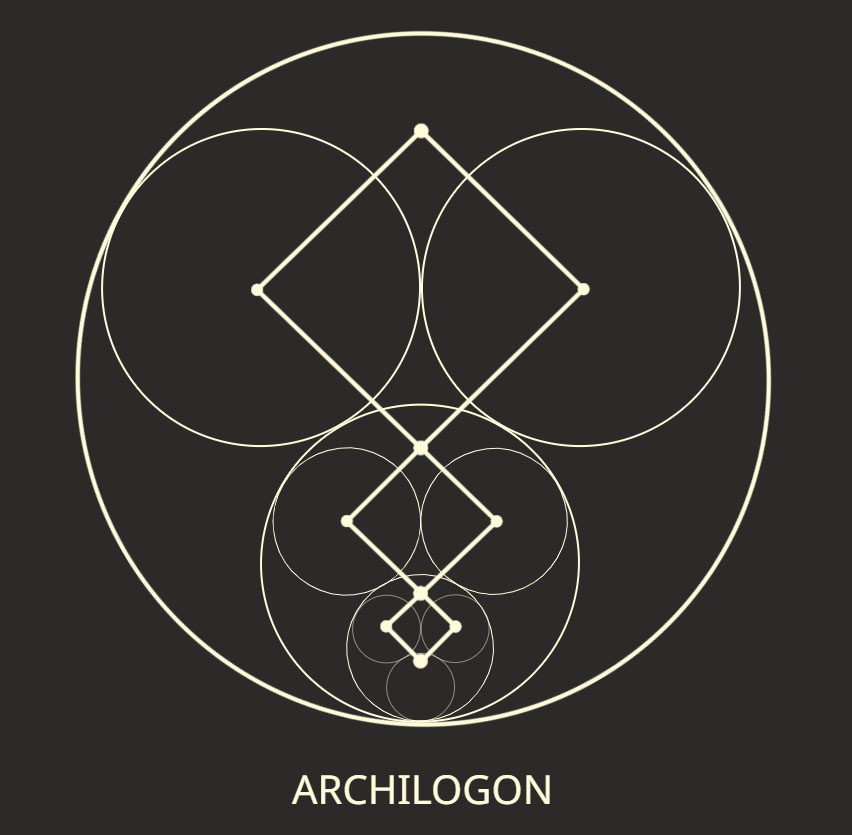
In this sense, the Symbol goes beyond the function of “aesthetic object” or “didactic aid”, and becomes the only instrument capable of expressing a structure of transcendent constraints. Whenever a geometrical figure enables the mind to grasp a Formal Relation, it functions as a “bridge” between the Sensible and the Intelligible. Through the use of vectors, our diagram thus represents the transformation of an object, in this case Metaphysics, from one Form to another.
In this process, original Metaphysics appears to vanish progressively from the historical picture. Yet since, from an idealistic perspective, Reality is governed by a cyclical movement in two phases, this apparent “retreat” is, in truth, a first movement of “departure” that prepares a second movement of “return”. To use neoplatonic terminology, a first movement of Procession and a second movement of Conversion. Seen from this total standpoint, Metaphysics does not emerge defeated and annihilated from its “encounter-clash” with Science. Rather, it evolves precisely through contact with what, at first, appeared external and antithetical.
Hegel would say that Spirit, originally “in itself”, must pass “outside itself”, in order finally to return “to itself” enriched with a total and absolute awareness. In the first of our four movements, that is, the passage from Metaphysics to Science, the Intelligible World of Pythagoras and Plato collapses under Aristotle’s insistent demand for empirical evidence. With Christianity, metaphysical Unity is fused with the personal God. With Scholasticism, Metaphysics is bound to Theology and to the binary logic of Identity and Non-Contradiction. As modern Science consolidates, the inevitable occurs, in order to free Philosophy from the innumerable dogmatic encrustations: misunderstood and deformed, Metaphysics undergoes Kant’s reform.
In the second movement, from Science to Thought, Kant no longer speaks of an objective “fourth world”, except in negative terms. The Idea-Form is rebaptised the Noumenon and declared “an unknowable object”. The great metaphysical questions are translated into terms of “conditions of possibility of the mind”. Philosophy, therefore, withdraws into a kind of “masked Psychologism” while at the same time seeking an anchorage in empirical data, in an attempt to re-establish its credentials as “Science”.
In the third movement, Kant’s system provokes a reaction and attention shifts to Language, through which he had in fact elaborated his Categories. It becomes apparent that natural languages do not express an objective thought but guide and shape it. The project of formal languages and Symbolic Logic is born. One seeks to construct a pure, rigorous, mathematical system of Signs. Yet this formalism has a cost. The more precision increases, the more contact with human experience and meaning diminishes. The mechanical logic anchored in the principles of Identity and Non-Contradiction yields correct conclusions, but ones that are humanly cold, and devoid of significance. Thus a part of Philosophy, with Husserl, begins once more to voice a demand for meaning.
It is in the fourth movement, the one that begins from Language, that the shadow of Metaphysics announces its return to the stage. With Nietzsche, the idea of an intelligible order of the real had collapsed, yet certain twentieth century thinkers realize that without a formal structure external to the mind, the world dissolves into a myriad of subjective interpretations. Among them, Ernst Cassirer shows that the human mind organizes experience through Symbolic Forms, and that every scientific law already goes beyond the sheer sensible datum. Whenever the scientist seeks an objective law that unifies scattered data, he is implicitly reconstructing a transcendent constraint. At that moment the physicist, knowingly or not, reconstructs the Intelligible World.
The Archilogon situates itself precisely at this point. It recovers the Intelligible World not as a mystical dimension, but as the formal architecture of the real. The reconstruction of the archetypal structure will show that what has disappeared is not Metaphysics itself, but only its misunderstanding and its irrational interpretation. Thanks to the Symbol, which is the shadow of the pure Form, Metaphysics is able to return to the stage of Philosophy in its most authentic guise. “To the Principle!”