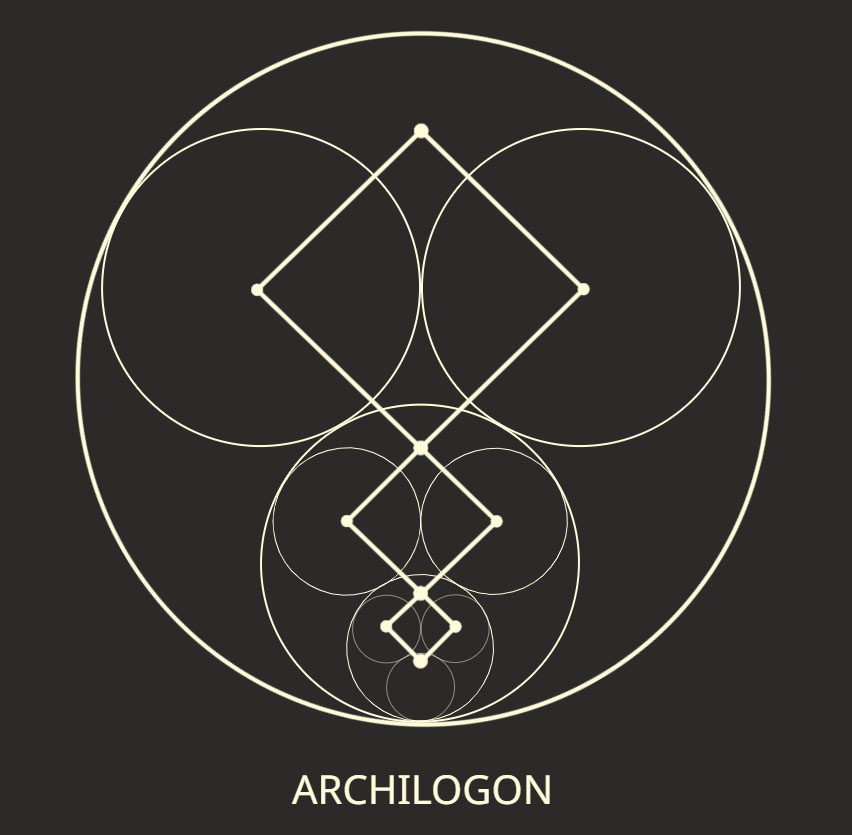
Archilogon 031 - 5. Nous - 1. The Whole and the Part
In this video, Elias Artista introduces the fifth stage of the Archilogon project, aiming to compare Plato’s realist Idealism with Kant’s transcendental Idealism. The discussion begins with Marcus Aurelius, who describes individual consciousness as a “fragment” of Universal Consciousness. This perspective helps to reconstruct the formal relation between Part and Whole that animates the Synthetic Logic on which Idealism is founded. Elias then sets out the principle of Reciprocal Implication, and above all the difference between the sub-logics of the Parts and the super-logic of the Whole. Platonic Idealism thus opens onto the possibility of a logical “reconfiguration” — a genuine “transcendence” — that replaces the individual standpoint with that of the set, the Totality, the Whole.
Archilogon – The key to Synthetic Logic. A project by Elias Artista.
Bibliography
Works Cited
- Marcus Aurelius, Meditations, Book V, 27.
- Marcus Aurelius, Meditations, Book V, 8.
Further Reading
- Walter Burkert, Griechische Religion der Archaischen und Klassischen Epoche, Stuttgart, 1977.
Video transcription
Welcome, wanderer, to the fifth stage of the Archilogon project. In this new chapter we shall bring Plato and Kant into dialogue, showing how their two idealist positions, though divergent in important respects, nonetheless arise from a common matrix, the Synthetic Logic that informs both visions.
Idealism rests, first and foremost, upon the relation between two archetypal logical Forms: the Part and the Whole. We shall begin from a celebrated passage that contains, in nuce, the core of the idealist conception.
In one of his Meditations, Marcus Aurelius writes: “He lives with the Gods, who continually shows them a soul content with what has been allotted to it, and who does what his daimon indicates, what Zeus has given to each, as a fragment of himself, to be guardian and guide. And this is each person's intellect and reason.”
Marcus Aurelius offers us here a glimpse of Stoic doctrine. Stoicism is the natural development of the idealism advanced by Plato’s early Academy, though with a far sharper emphasis on ethics and practice. In this meditation, the man who, more than any other, embodied Plato’s ideal of statecraft, puts before us a very ancient idea: each Singular Consciousness, he suggests, is only a fragment, an apospasma, of the Universal Consciousness embodied by the supreme God.
How, as moderns, should we position ourselves in relation to the idealist vision that emerges from this passage? We might, for instance, label it “poetic” and judge it aesthetically, admiring its form. Or we might label it “theological”, and keep a certain distance from its content, as we do with creeds that are not our own. Yet we might attempt a different route: we might try to understand the underlying logic and explore its implications.
If, setting aside poetry and theology, we adopt even a modest logical approach, we may well agree that the conclusion is simply the consequence of the formal relation between a Whole and its Parts. In other words, the sum of all Individual Consciousnesses constitutes an “ideal set” to which, without offending Reason, one may assign the label Universal Consciousness.
If this seems a defensible assumption, what appears far less evident is a further idealist claim, contained in Plato’s famous passage on the Cosmos, namely, that an Individual Consciousness, the Part, is potentially capable of conforming itself to the Universal Consciousness, the Whole.
This idea is condensed in the expression omoiosis theo which we might render as: “assimilation to God”: the final end of Platonic knowledge. This claim rests on trust in an alleged capacity of the mind to transcend its individual limits. We say “alleged” because the phenomenon cannot be verified, being purely interior.
Yet if we accept, as a working hypothesis, that the individual mind can reconfigure itself, we may cautiously, purely for exploratory purposes, move from the what to the how, and ask idealist thought in what ways an individual consciousness might undertake such a reconfiguration.
By “assimilation to God”, one does not mean a physical transformation, nor an extension of human perceptual faculties. One means, rather, a qualitative transformation in the logical mechanism: a different manner of thinking that produces a different vision of the world.
It is this perspective that leads Marcus Aurelius to say: “You must gladly accept whatever happens to you, for two reasons: First, because it had to happen to you, it was prepared for you, directed towards you in some way, woven into a fabric that reaches back to the most remote causes. Second, because what happens to each in particular contributes to the perfect integrity of Zeus, who governs the universe. If you cut off a Part, even the most insignificant, the Whole loses its integrity, its connection, and its continuity with the other Parts.”
Let us isolate the formal elements that ground Marcus Aurelius’ perspective. First of all, from a purely logical standpoint, the Whole implies the Part, and at the same time the Part implies the Whole. This double implication constitutes the first fundamental axiom of the Synthetic Logic that animates the idealist vision.
What relation holds between the two poles of this polarity? In the case of the relation between Individual Consciousness and Universal Consciousness, it is easy to see that the sub-logic of Consciousness-as-Part must differ necessarily from the super-logic of Consciousness-as-Whole.
The Part, in order to preserve itself as Part, must remain severed from the Whole. Otherwise it would be reabsorbed into the Whole, losing the very features that define it precisely as a Part. In fact, the birth of a conscious being, its entry into manifestation, into act, means the detachment of a fragment that resided in purely potential form within that set we have called the Universal Consciousness.
The subsequent “reabsorption” of an Individual Consciousness into the Universal Consciousness would, inexorably, occur at physical death. Yet if an Individual Consciousness were to aspire to be “reabsorbed” into the Universal Consciousness while still alive, the only way would be to remodel its own logical connections: to cease reasoning as Part and begin to imagine itself as Whole.
How can such a logical reconfiguration be undertaken? Two approaches present themselves: a mystical one and a philosophical one. Mystical literature suggests that one may attain a state of “supreme indifference” towards one’s ego, by suspending the ordinary functions of the mind that preserve us as individuals, those functions that contribute to the formation of a sub-logic of Part.
Here, however, we shall not dwell on this pragmatic mystical approach because we intend to explore the hypothesis from a strictly philosophical standpoint.
The first step for anyone who aspires to logical reconfiguration is, of course, to understand how the mechanism of the super-logic functions, a mechanism foreign to every Individual Consciousness. The fundamental, purely formal feature of the super-logic of the Whole is that it must contain, within itself, all the sub-logics of the Parts that compose it, even when those sub-logics contradict one another.
The peculiar property of the set is precisely this: it renders indistinct those Parts that are distinct from one another by contradiction, since it is that very distinction that makes them, precisely, Parts. This becomes the key to transcending the limits of the individual mind: the reconciliation of what, from the limited standpoint of the Part, appear irreconcilable.
Whether any Individual Consciousness has ever truly succeeded in this endeavour is a question we leave to the literature. Our concern here is the mere logical possibility.
As we shall see more clearly later, the sub-logic of the Part is Binary and Decompositional because binarity is the principle by which the Part is severed from the Whole. The super-logic of the Whole, by contrast, is Ternary and Compositional, because the dualism Whole-and-Part is held together by a unity that stands above both elements when taken separately.
The overcoming of binarity is, in the first instance, conditioned by the recognition of a Relation of Opposition. This is why philosophers, since the most ancient times, who have investigated the super-logic of the Whole, have placed at the foundation of their doctrine the Dialectical Method, which consists in identifying Relations of Opposition wherever they subsist.
The Relation, which in our diagram is represented by the vertical line, is the element that holds Thesis and Antithesis together, and at the same time keeps them apart. The dialectical Relation of Opposition is, in effect, the conjunctive and disjunctive element of Synthetic Logic.
We shall discuss it in depth in the stage entitled Dialectic.
An obvious consequence of the containing and reconciling capacity of the set, the Whole, the Totality, is that the super-logic of Universal Consciousness necessarily transcends subjective thought, that is, thought produced by an individual mind. It therefore qualifies, precisely by virtue of being universal, as Objective Thought: the total sum of the Parts, the limit beyond which one cannot go, since the Whole is, in fact, the extreme limit.
This is the indispensable formal premise for understanding Idealism, which, summarized as concisely as possible, explores the logical consequences generated by the dynamic relation between the actual Part and the potential Whole.
Speculation, the inferential method characteristic of Idealism, is a process of thought in two moments: one creative, the other logical. It begins with an hypothesis of a necessary connection between Forms. It then subjects that hypothesis to logical verification in order to determine whether the relations imagined between the Forms are indeed necessary.
Speculation begins from the most comprehensive concept possible, namely the Whole, and seeks to rediscover within it its internal elements, its constituent Parts. The method of logically decomposing a Whole is called dialectical because it is anchored in the Relation of Opposition that every affirmation, or Thesis, weaves with its negation, or Antithesis.
Given the overwhelming evidence on which the sub-logics of the Parts rest, the purely ideal super-logic of the Whole, neither easy to understand nor easy to assimilate, has been pushed to the margins of rational discourse. That is because its formal codification has always seemed a desperate undertaking.
Moreover, to investigate Universal Consciousness means to “transcend” the sensible dimension and venture into a dimension, that of pure Forms, that exceeds the three epistemological domains admitted by modernity. In short, it means confronting once again the concept of transcendence that Immanuel Kant set aside three centuries ago.
If we feel entitled, here, to reactualise the problem of transcendence, it is because it has been misunderstood and misrepresented. For this reason, we are inclined to claim that Kant did not delegitimize Pythagorean-Platonic Metaphysics. Rather, he brought to light the logical incoherence of the pseudo-Metaphysics that followed.
In the next videos, we shall attempt to recount this delicate turning point. “To the Principle!”