Archilogon 034 - 5. Nous - 4. Understanding and Reason
In this video, Elias Artista introduces philosophical vocabulary as a structural problem: terms such as “Intuition”, “Reason”, and “Understanding” shift their meaning across traditions and translations, generating an ambiguity that destabilises any genuine comparison between Kant and Plato. To clarify the functions of thought, Elias takes as his foundation the Formal Relations identifiable within Platonism (and adopted by the Archilogon), and reconstructs the double opposition between Sensibility and Intuition, and between Reason and Understanding, drawing on Nicholas of Cusa and the distinction between Ratio and Intellectus. He then shows how, in later philosophy, the Concept/Sign relation between these two faculties was semantically inverted. The Archilogon’s proposed remedy is therefore the diagram: a stable structure of Forms that allows one to move beyond a Sign mistakenly crystallised by tradition, assigning Concepts a position that is stable and consistent with the function they express.
Archilogon – The key to Synthetic Logic. A project by Elias Artista.
Bibliography
Works Cited
- Immanuel Kant, Le Tre Critiche, Mondadori, Milan, 2008, pp. 914–915 (Critique of Judgement).
- Nicholas of Cusa, De Coniecturis, I 6, 23.
- Georg W. F. Hegel, La Scienza della Logica, Laterza, Bari, 1925, p. 5 (Preface to the First Edition).
- Plato, Timaeus, 37b–c.
Further Reading
- Plato, Parmenides.
Video transcription
In laying the foundations of his metaphysical edifice, in the Critique of Judgment, Kant employs the image of a deep critical excavation and of a work of simplification:
“If, under the general name of Metaphysics a system is to be completed, and it must be, since it is of the utmost importance for the use of Reason, critique must first have explored the ground for this building so deeply as to uncover the first foundations of that faculty of principles independent of experience, lest the structure collapse at some point, that would inevitably bring about the ruin of the whole.”
Kant speaks of “principles independent of experience”, that is, of his a-priori elements, and he speaks of Metaphysics as the system of Reason. This cannot but raise a question: what does he mean by the term Reason? For it is by no means self-evident, and it drags behind it a range of meanings and references that are anything but uniform.
To address the relation between Kant and Plato, we must, indeed, clarify certain terms that have been remodelled over time, because their semantic ambiguity generates persistent difficulties. If we set aside the faculty of Sensibility, the only one that retains a measure of obviousness, Intuition, Reason and Understanding exemplify how terms shift according to who sends the message and who receives it.
Since they do not rest on immediate evidences, they can overlap improperly, and in doing so, they complicate philosophical discourse enormously. The confusion grows exponentially, because translators are often forced to render the terms corresponding to Understanding and Reason by the generic word mind, prudently erasing the distinction between two functions of thought.
To grasp the concept that lies behind the terms, we must therefore step over the Sign, and attempt to intuit the Form that governs it. The Platonic tradition proposes a double opposition: Sensibility opposed to Intuition, and Reason opposed to Understanding. The formal qualities of these faculties derive from the possible relation between Unity and Multiplicity.
Take the first opposition: Sensibility is the faculty by which we know through the mediation of our senses. Its objects are phenomenal and singular stimuli. Intuition, by contrast, is a kind of cognition not mediated by the senses, a mental apprehension of pure and universal Forms, made of Space, Time, and reciprocal Relations, by virtue of which thought can frame its objects of knowledge and place them within a unitary structure.
We therefore have clearly distinguished and opposed, on the one hand, sensible perception of Phenomena, and on the other, the intuition of Forms.
As for the second opposition, between Reason and Understanding, the matter is more complex, owing to the semantic fluctuations of the two terms. To clarify it, we must call upon Nicholas of Cusa. In the terminology of Cusa’s Platonic system, the Intellect, in Latin Intellectus, is held to be superior to Reason, in Latin Ratio, and would represent, in the human being, a faculty he describes as “divine” in nature:
“Intellectus contains opposites that, for Ratio, are mutually incompatible. From the standpoint of Ratio, for instance, Motion is opposed to Rest and cannot co-exist with it. Within the Intellectus, by contrast, Motion and Rest do not cancel one another out, they are complementary.”
Unlike Ratio, which Cusanus takes to be grounded in the Principle of Non-Contradiction, the Intellectus would grasp the common root of what appears contradictory, rendering Multiplicity unitary through that coincidence of opposites which is the paradigm of a “divine” logic, or, in our terms, the super-logic of the Whole.
Cusanus thus assigns to Ratio an analytic and binary function, and to the Intellectus a synthetic and ternary function. The tradition to which he appeals also seems etymologically sound: the term Ratio, division, suggests a disjunctive function, the principle of Multiplicity, and therefore of Analysis. By contrast, Intellectus, from intelligere, “to gather into one”, names the activity of thought that seeks the Unity of the manifold, and therefore expresses a Synthetic function.
From XVIII century German Philosophy onward, however, we witness a semantic reversal, reinforced by later translation conventions, through which many modern languages end up labelling these functions in the opposite way. Kant assigns an analytic function to Understanding, Verstand, while assigning a synthetic reach to Reason, Vernunft.
This inversion forces us to strain the traditional link between Concept and Sign that has generated confusion, and to reclaim the role of the diagram as a geometrical solution to a lexical problem. For us, what grounds conceptual opposition is the formal and dialectical opposition between two processes: one binary and decompositional, the other ternary and compositional.
If we adhere to German idealist terminology, we shall therefore say: Understanding operates through the Principles of Identity and Non-Contradiction, the pillars of Aristotelian binary logic. Reason, by contrast, projects itself beyond the limits of Understanding, arriving at a reconciliation of opposites, through that synthetic and ternary principle which stands at the centre of our inquiry.
This synthetic and ternary function assigned to Reason will be formalised by Hegel, who will relegate Understanding to a subordinate role. Thus we read in the Science of Logic:
“Understanding determines and holds fast determinations. Reason is negative and dialectical, because it dissolves the determinations of Understanding into nothing.”
In everyday English, usage can reinforce the same ambiguity. The term reasonable suggests a conciliatory, compromise-seeking attitude, whereas the term intellectual is more often associated with analytic reasoning. The contrast is not exact, yet it mirrors the semantic drift introduced by old translations.
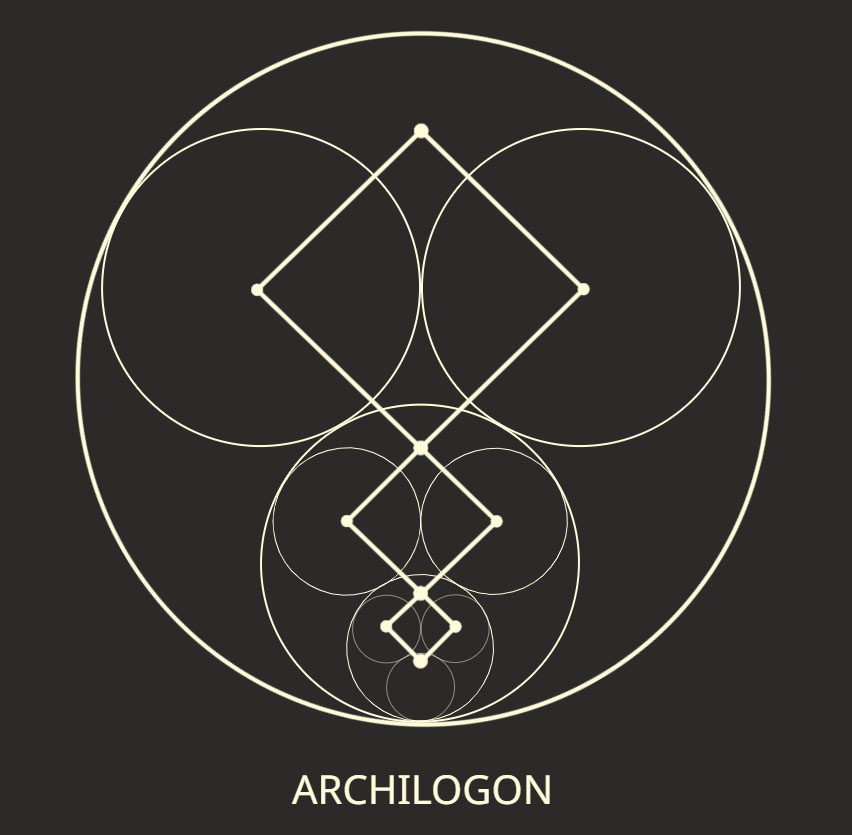
To overcome this ambiguity, which is no small matter, since it can render any analysis slippery and deceptive, in the archilogic diagram the human cognitive faculties are arranged according to precise formal oppositions. Whatever the terminology, we must always remember this: it is a term’s position within the diagram that determines its meaning.
The instrument we use, the diagram, illuminates the bond between Concept and Sign by placing them within a stable structure of forms. In the present case, we assign the disjunctive and analytic property to the right and the conjunctive and synthetic property to the left. As for terminology, we follow the tradition of German Idealism since it has left subtle traces in everyday usage.
Once these load-bearing axes of the Archilogon system have been established, we can say that the vertical axis of our diagram is, in a sense, passive. Intuition and Sensibility receive “the given”, something that exists independently of the subject: metaphysical Forms and physical Phenomena.
The horizontal axis, by contrast, is active or elaborative. Reason and Understanding, respectively, compose and decompose that material, transforming it into Concepts and Signs. Naturally, both Understanding and Reason have the freedom to operate on Concepts and Signs in opposite directions, depending on whether these faculties are directed towards the Sensible or the Intelligible dimension.
This freedom, as Plato suggests in a passage of the Timaeus, lies at the root of errors and distortions. The distinction between the decompositional and compositional functions of thought is not a merely technical matter.
In fact, Understanding and Reason, as we shall see as the narrative unfolds, ground two opposed and complementary logics: Analytic Logic and Synthetic Logic, which we have set ourselves the task of formalizing.
In the next video, we shall focus on Kant’s relocation of the faculty of Intuition within the sensible dimension. “To the Principle!”