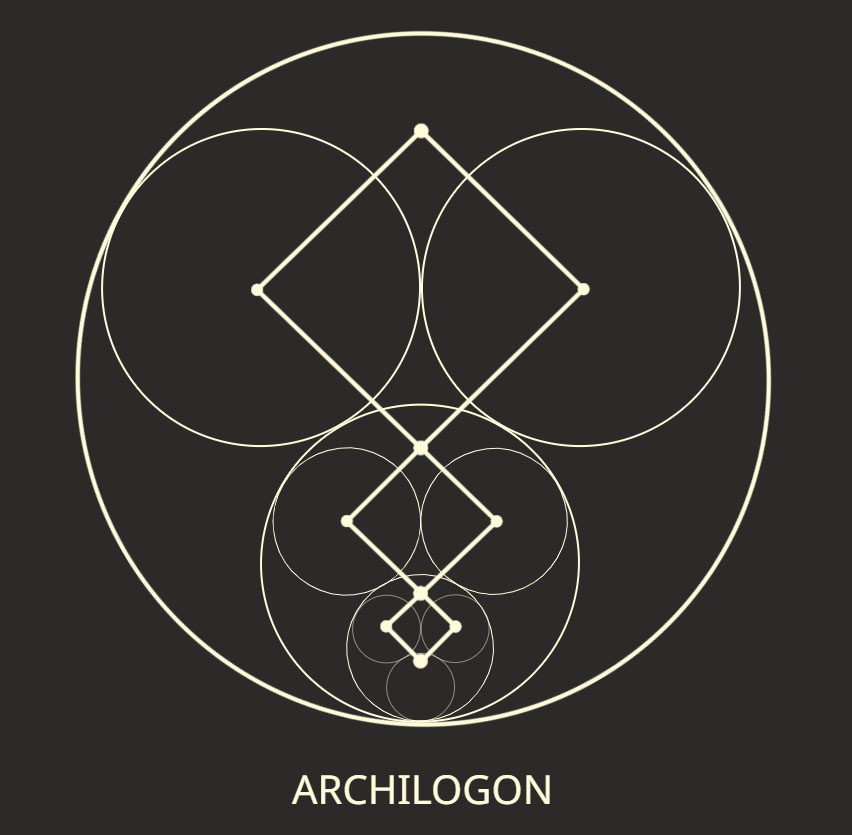
Archilogon 035 - 5. Nous - 5. Idealism in Three Dimensions
With the aid of a dual schematic, in this video Elias Artista shows how Kant — misled by the Aristotelian tradition — disqualifies the Pythagorean–Platonic Intelligible World, shifting attention from the “transcendent” to the “transcendental” and thereby reducing Metaphysics to the study of the mind’s logical possibilities. Through the archetypal diagram, Elias reconstructs the configuration of the human faculties in accordance with Synthetic Logic, and brings into focus Kant’s key-move for turning Philosophy into a science: namely, relocating Intuition within the sensible dimension. Kant maintains that Space and Time are mental forms that arise from the encounter with the Phenomenon, contrary to the Platonic perspective, which upholds the subsistence of the Forms and the autonomy of the intuitive process, as suggested in the Phaedo. For Plato, the Forms—the transcendent archetypes of Pure Concepts—are accessible to the human mind not as a consequence of contact with the Phenomenon, but through a process of Anamnesis within human interiority.
Archilogon – The key to Synthetic Logic. A project by Elias Artista.
Bibliography
Works Cited
- Immanuel Kant, Prolegomena to Any Future Metaphysics, §14.
- Plato, Phaedo, 65c.
- Immanuel Kant, Critique of Pure Reason, "Transcendental Doctrine of Elements Part II", "Transcendental Logic", "Of Pure Reason as the Seat of Transcendental Illusion", "A. Of Reason in General".
Further Reading
- John Sallis, The Gathering of Reason, State University of New York Press, Albany, 2005, p. 44 ff.
- Cesare Luporini, Spazio e Materia in Kant, Sansoni, Florence, 1961, p. 45.
Video transcription
Kant appears to be one of Plato’s greatest adversaries, because his transcendental system deprives of legitimacy the Intelligible World, that is, the autonomous and self-subsisting dimension transmitted to Plato by the Pythagoreans.
Yet that delegitimation was almost inevitable, because the Intelligible World, under the influence of the Aristotelian interpretation, had come to be understood as an “alternative realm” to the real one, populated by pseudo-objects that Kant would declare “unknowable”: the Noumena.
The Metaphysics Kant proposes in its place does not study Forms as “transcendent constraints”. Instead, it focuses on reconstructing the full range of the human mind’s logical possibilities, whose formal elements, understood as Pure Concepts, he defines as a-priori.
We shall now attempt to schematise the position of the human faculties outlined in the previous video, beginning from the Pythagorean system we reconstructed in our study of Synthetic Logic. We shall first consider the entire four-dimensional epistemological system, and then narrow the analysis to the psycho-logical dimension alone, applying the archetypal, dialectical and analogical schema.
Let us recall that, from the Pythagorean standpoint, the vertical axis always expresses the antithesis between Unity and Multiplicity, whereas the horizontal axis always expresses the antithesis between Composition and Decomposition.
In his system, Kant operates on two fronts: by denying that human beings can know intelligible objects directly, he first “erases” the Intelligible World as a subsisting dimension, and consequently shifts attention from the transcendent to the transcendental, that is, to its psycho-logical reflection.
Now let us observe the diagram on the right, which focuses solely on the psycho-logical dimension, and see how Kant, by denying the possibility of intuiting intelligible objects, drags Intuition downwards, relocating it within the Sensible dimension.
Once the dimension of Forms is removed as a subsisting reality, Metaphysics is reduced, for Kant, to the study of a region of the human mind populated by Pure Concepts.
As a consequence, Kant splits the functions of Reason and Understanding, according to whether they are directed towards pure or empirical elements. It is evident that this relocation of Intuition is the keystone of the entire system.
Space and Time, which for Plato are the sensible reflections of the Forms of Unity and Multiplicity, arise for Kant only as a result of contact with the Phenomenon:
“I think that all the properties that constitute the intuition of a body belong only to its Phenomenon.”
For Plato, by contrast, Intuition is a faculty diametrically opposed to sensory perception of Phenomena, because it is antecedent to the Phenomenon. The Forms of the Intelligible World are independent of sensible experience.
Human beings do not need to infer these Forms from contact with the Phenomenon, since they are already within us, and can be brought to light through a process of Anamnesis.
During this activity of self-exploration—this excavation into one’s own interiority—the stimuli produced by Phenomena are instead a source of profound disturbance, as Plato writes in the Phaedo:
“The soul reasons best when none of the senses troubles it, neither sight, nor hearing, nor pleasure, nor pain, but when it gathers itself as much as possible into itself, abandoning the body, and, so far as it can, breaking its bond with it and reaching out towards essence.”
Now, when Plato maintains that the Forms are transcendent, and subsist independently of the individual mind, it is because they are not produced by human beings. Rather, they are intrinsic to the “logic of reality”, and are merely “reflected” by the human mind, in the form—so to speak with Kant—of Pure Concepts.
The difference between Kant and Plato might seem of minor importance, since the former locates those same Forms within the mind, whereas the latter places them in a distinct dimension, one that the mind can nevertheless reconstruct in its entirety through speculative activity.
Yet the implications are far deeper, because for Plato, following Pythagoras, the whole universe is shaped by the same laws. Logical Forms, therefore, do not belong exclusively to the human mind; they are the constraints, by virtue of which Reality itself takes its shape.
Indeed, the fact that the laws of Physics can be reconstructed by human beings through a speculative process creates difficulties for Kant’s position, as we shall see later.
Kant, however, cannot endorse the Pythagorean thesis of a formal identity between Pure Concepts and Forms, because, to do so, he would first have to find the key to the consonance between “mind” and “reality”, and would have to encode that identity in a dynamic formula.
Kant instead lists his Pure Concepts in a Table, but he does not succeed in reconstructing a dynamic logical system. The fact remains that, in reducing the original four epistemological dimensions to three, Kant is forced to remodel the work of Reason.
Several scholars have noted how fundamentally ambiguous the concept of Reason is in Kant. In the Transcendental Dialectic, roughly halfway through the Critique, Kant sets out to characterise it, and does so by using it in two senses, one narrow and one broad.
In the narrow sense, Reason, as a synthetic faculty, is opposed to the analytic faculty of the Understanding. In the diagram, the right-left opposition.
In the second, broader sense, as a faculty that reworks the material supplied by Intuition, Reason is opposed to Sensibility. In the diagram, the upper-lower opposition.
Kant therefore has to split both Reason and Understanding, depending on whether the material is empirical or pure. We thus have an “Empirical Reason” which, directed towards Phenomena, abstracts from the content of empirical knowledge, and a “Transcendental” or “Pure Reason”, which, as he writes:
“contains within itself the source of certain concepts and principles which it borrows neither from the Senses nor from the Understanding.”
Yet, as our diagram shows with particular clarity, Kant’s “erasure” of the Intelligible World and his reduction of the transcendent to the transcendental generate an asymmetry that greatly complicates his system.
For, on the one hand, he needs a “contrary opposite” of the Understanding, that is, a synthetic faculty opposed to the analytic one, while, on the other hand, he needs a “correlative opposite” of Sensibility, that is, a faculty that sets the Unity of thought against the Multiplicity of the senses.
In effect, then, the “disappearance” of the Intelligible World as a fourth dimension, which for realist idealism is the dimension of objective Forms, on which all the other dimensions are modelled, represents an exceptionally grave loss for Philosophy.
In the next video, we shall explore the reaction of the realist idealists to this “disappearance”. “To the Principle!”