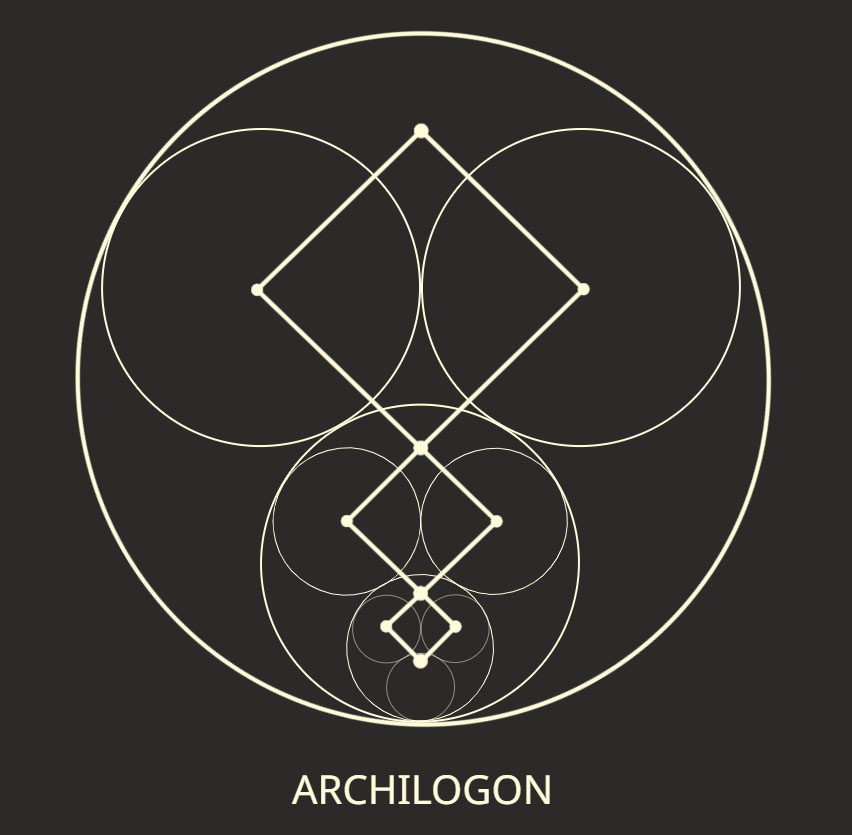
Archilogon 037 - 5. Nous - 7. The Subsistence of the Forms
In this video, Elias Artista reconstructs the argument by which, in Plato’s dialogue, the character of Parmenides rejects the reduction of Forms to mere Concepts: if thought gathers the multiplicity of what exists into a unity, then Unity must subsist as a Form prior to the concept that thinks it. The discussion then turns to Kant, who replaces the transcendence of Forms with Pure Concepts and a priori conditions of the mind, situating his Categories within the structure of subjectivity. In this way, by shifting attention from reality to mind, the issue is not resolved but transferred into a dimension that modern philosophy finds more manageable on epistemological grounds.
Archilogon – The key to Synthetic Logic. A project by Elias Artista.
Bibliography
Works Cited
- Plato, Parmenides, 132b.
- Philip Merlan, Dal Platonismo al Neoplatonismo, Vita e Pensiero, Milan, 1994, pp. 51–52.
Further Reading
- Plato, Meno.
Video transcription
Why does Plato argue, so forcefully, that Forms subsist independently of the human mind that thinks them? What deductive reasoning underlies this claim?
This is the crucial question that the character of Socrates, four centuries before Christ, puts to the character of Parmenides in the celebrated dialogue Parmenides, which confronts the nature of Forms and the reason they cannot be reduced to mere Concepts.
Pressed by Socrates, Parmenides offers an answer of striking clarity:
“Unless, Parmenides, each of these Forms is a concept present only in the human mind.”
“A concept of what? A concept of nothing?”
“No, that is impossible.”
“Then it will be a concept of something.”
“Yes.”
“Of something that exists or that does not exist?”
“Of something that exists.”
“And if thought reduces the multiplicity of what exists to a unity, can we say that this ‘unity’ exists prior to the concept?”
“Yes, we can.”
“Is not this ‘Unity’, then, discerned in all phenomena, a Form?”
“It seems perfectly logical to me.”
Parmenides distinguishes between Concepts and Forms, establishing that Concepts are subordinate to those transcendent constraints that condition human cognitive activity. And, in the wake of Pythagoras, he invokes the archetypal Forms of Unity and Multiplicity.
Centuries later, in order to justify something that precedes and conditions the cognitive act, Kant will coin his a priori elements. The Form of Unity of which Parmenides speaks will become, for Kant, the Category of Totality, that is, a Pure Concept, a structural element within the architecture of Reason.
Pure Concepts, then, would be present in the human mind a priori, and modern thinkers align themselves with Kant’s conclusions, since admitting the subsistence of anything transcendent becomes an insurmountable taboo.
At this point, however, if Parmenides were to meet Kant, he would likely raise the following objection: if something is present in every human being, and is therefore universal, necessary, and valid for all times, might one not say that it exists independently of the individual minds of thinkers? Would it not rather be the reflection of a structuring reality that gives form to everything that exists?
If to think means to transfer the perceived Singular into the Universal, do these two Forms—the Singular and the Universal—not subsist independently of whatever content is transferred into them? Do they not subsist before and after human consciousness, as eternal Forms to which all the laws of Nature must necessarily be subordinate?
We do not intend, here, to steer you towards an easy answer. We ask only that judgment be suspended until the end of our account.
A note is needed here: for Pythagorean and Platonic thought, Forms, though naturally intuited by every human being, do not present themselves to individual consciousness in a necessary structure. This is evident enough; otherwise every human being would be naturally “objective”.
The individual mind intuits the metaphysical Forms that are reflected in Concepts. Yet the uneducated individual, without specific training and a logical reconfiguration, is not able to grasp how these Forms relate to one another in a necessary way, because he does not possess the “key”, namely, the “equation of reality” contained in the archetypal diagram transmitted by the Pythagoreans.
For example, the celebrated slave in the Meno dialogue manages to grasp how certain basic geometrical elements relate to one another, because the logic of Forms is intuitive. Yet he clearly lacks the capacity to reconstruct, objectively, the universal structure of archetypal Forms.
Intuition, then, provides the material to be connected, the elementary pieces, but it is metaphysical Speculation that connects them in a logically necessary way.
Kant, too, lacks this “key”, and the proof is, as we have already said, that the psycho-logical reflection of Forms, that is, the celebrated Categories, will be listed by him in a simple table, rather than being structured within a dynamic logical diagram.
After Kant, if we set aside the dazzling parenthesis of German Idealism, the Intelligible World, reduced to the “fantastic dimension of the Noumena”, officially disappears from any Philosophy that aspires to call itself “scientific”, yet it continues to haunt it, like a ghost.
The term Realism begins to attract adjectives such as “extreme” or “exaggerated”, as though a “moderate” position could even exist. In time, Realism becomes an unwelcome position—so unwelcome, in fact, that, as Philip Merlan recalls, Plato is deprived of his own doctrine:
“There was a moment in history when philologists struggled to defend their interpretation of Plato as an ‘extreme realist’, against attacks from philosophers who felt compelled to ‘save’ Plato. In their view, a great philosopher could not possibly have embraced so absurd a perspective.”
The definition of a priori elements has, inevitably, been a matter of controversy. Kant rejects an “innatist” interpretation, insisting that his system does not contain innate items, but predispositions.
Since they are merely potential, the a priori elements are activated by experience and it is this empirical basis that would allegedly guarantee their validity. Yet this explanation clarifies nothing.
For if the Forms of Space and Time were activated by our earliest experiences in contact with Phenomena, that would indicate, all the more, that these Forms are not original constituents of the mind, but of that reality to which the mind conforms from the very instant it enters the world, since Nature obeys universal laws that transcend singular Phenomena and determine them, as Science teaches us.
Kant then merely shifts the problem; he does not resolve it. And in order not to admit a transcendent dimension, which would place back at the centre of the stage the “charlatans of the spirit”, he complicates the matter with a rather ambiguous notion of a priori, which he will then have to defend against the many attacks of his critics.
The pivotal point of the controversy between ancients and moderns must, therefore, be sought in the correct definition of a key concept: that of objectivity. We shall address it in the next video.
“To the Principle!”