Archilogon 039 - 5. Nous - 9. Objectivity and Transcendence
In this video, Elias Artista examines the relation between Objectivity and Transcendence in the light of Plato’s Divided Line and the Archilogon. Since Objectivity coincides with the “Logic of the Whole”, the individual mind—shaped by the “Logic of the Part”—can attain it only by transcending its initial psycho-logical dimension and reconfiguring its logical architecture upon archetypal Forms. Hence the critique of Kant: if the intelligible dimension is eliminated, the very possibility of affirming anything objective is eliminated as well. Newton’s example, and the Law of Gravitation reached through a process of pure speculation, illustrates the passage from the perception of a singular phenomenon to the comprehension of a law, understood as a genuine “change of dimension” in consciousness.
Archilogon – The key to Synthetic Logic. A project by Elias Artista.
Bibliography
Works Cited
- Immanuel Kant, The Jäsche Logic, Introduction, I, 16. In Lectures on Logic, Ed. J. M. Young, Cambridge University Press, Cambridge, 1992, p. 531.
- Immanuel Kant, Prolegomena, 3-5. Ed. it. Laterza, Bari, 1948, p. 84-86.
- Immanuel Kant, Prolegomena, 38. Ed. it. Laterza, Bari, 1948, p. 108.
- Immanuel Kant, Prolegomena, 20. Ed. it. Laterza, Bari, 1948, p. 97.
- Georg W. F. Hegel, Lezioni di Storia della Filosofia. Ed. it. Codignola, Sanna, La Nuova Italia, Florence, 1964, Vol. III 2, p. 288.
Further Reading
- Isaac Newton, Principi Matematici della Filosofia Naturale, ed. A. Pala, UTET, Turin, 1965.
Video transcription
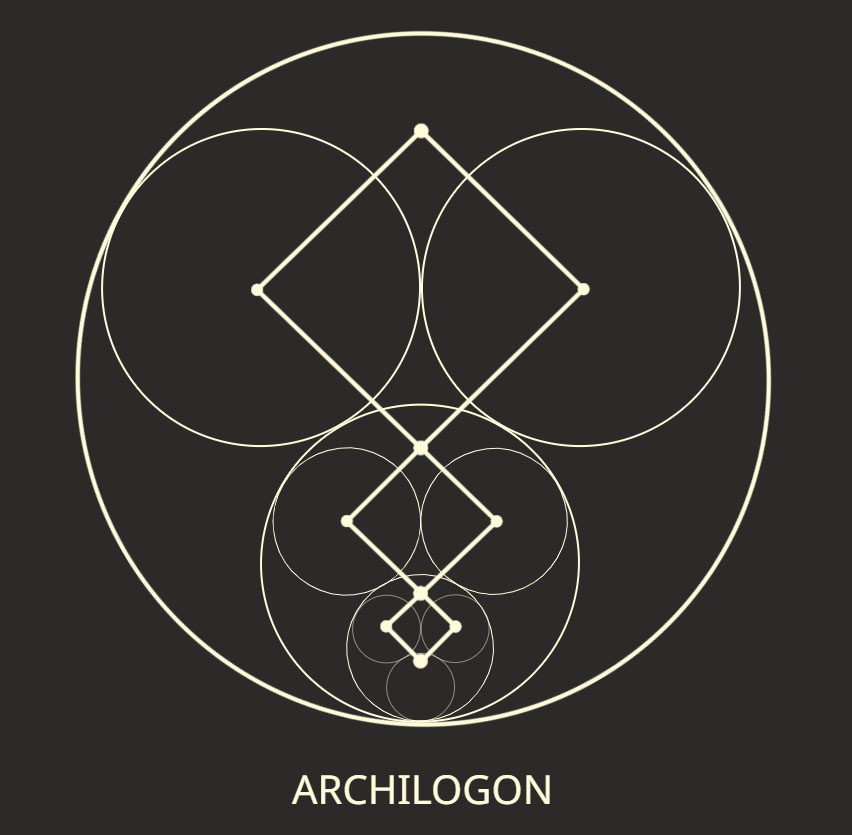
Let us pause to observe our archetypal diagram. It displays the four human cognitive faculties framed by the four levels of knowledge indicated by the Divided Line.
For the moment we shall set aside the two lowest Platonic levels, which we shall address later, and consider only the two circles touched by the Divided Line: that of Noesis, the goal of synthetic and ternary Reason, and that of Dianoia, the goal of analytic and binary Understanding.
In this representation, the larger circle of the Intelligible World encloses the smaller circle of the Sensible World, and thus represents the super-logic of the Whole, which includes the sub-logic of the Part. The super-logic of the Whole is transcendent, universal, potential and objective, because its Unity comprises the Multiplicity of the sub-logics of the Parts, which are immanent, singular, actual and subjective.
The sub-logic of the Part, however, is potentially objective, and can become so when it rises through the synthetic and ternary faculty of Reason above the Thought that grasps singular Phenomena and reaches the knowledge of the Forms. These arise from a dimension that withdraws from every perception yet is reflected within human interiority in a subliminal region. These reflections, these “shadows”, to use Socrates’ own words, are Kant’s a-priori.
In the Republic dialogue, Plato does not ask what the bodies that cast the shadows are, because he knows that they possess no intrinsic Properties. Forms, indeed, are not distinguished by Properties but by Relations. They are precisely logical Forms, which can be expressed through geometric lines and circles, forms modelled upon immaterial constraints purely intuited.
Now, Kant claims that, if we use correctly the rules of logic which he seeks to formalise, human thought is able to reach Objectivity:
“Logic is the Science of the Mind, an a priori science of the necessary laws of thought, not in relation to particular objects but to all objects in general. It is a science of the correct use of the mind not in a subjective sense, that is, not according to empirical or psychological principles, but in an objective sense, that is, according to a priori principles by which one ought to think.”
Yet, as the diagram makes clear, in striving for Objectivity, thought must necessarily “transcend” its initial psycho-logical dimension, because at that moment it ceases to be the Logic of the Part and embraces the Logic of the Whole. What is objective is, at once, universal, potential and necessary.
For if Objectivity were actual and immanent, all human beings would be naturally objective without any effort. And if it were singular rather than universal, no science could exist, because it would be impossible to enclose the perceived singular phenomena within a law.
The point, then, is this: if Kant truly succeeded in erasing the transcendent intelligible dimension, he would also erase the very possibility for the individual mind to attain Objectivity and would thus place himself in check. For however sophisticated his system may appear, he could no longer affirm anything objective, nor could he apply that claim to his own Categories, since he would “imprison” himself within the psycho-logical and subjective dimension.
Isaac Newton moved from the singular perception of an apple falling from a tree to the formulation of the Law of Universal Gravitation. Yet in accomplishing this, his consciousness literally changed dimension. It passed from the sensible to the intelligible, from Eikasia, that is, the impression of the apple, to Noesis, that is, the comprehension of the law, by applying a schema of Formal Relations that did not reside in the apple, but in the intelligible dimension of the Forms, which at that moment were suddenly reflected in Newton’s mind in their correct configuration.
This is because, through a speculative process, Newton reconfigured his own logical architecture. The Law of Gravitation, one of the Formal Relations belonging to the Logic of Reality, not only pre-exists all trees and all apples, but also Newton’s own mind. And it is that law — “which mortals struggle to comprehend”, as Heraclitus says — that produced the notorious fall.
Newton thus ceased to reason like a player, and began to reason like the creator of the game. When it remains in its state of psychological individuality and subjectivity, to which empirical thought pins it down, the individual mind cannot contain the objective universal. To do so, it must of necessity extend beyond its limits. That is, it must “transcend” its initial condition and reshape its logical connections upon the objective Forms.
Kant’s attempt to imprison Objectivity within the individual mind is aporetic. The Part cannot actually enclose or comprehend the Whole, except when it has itself become Whole. The mind-as-Part must therefore “transcend” itself and pass from its initial psycho-logical dimension to the metaphysical one.
The metaphysical dimension is not produced by the individual mind; it is, rather, reflected by it with greater or lesser clarity. It is reflected all the more clearly the more the surface of the reflecting mirror has been rectified.
This has important consequences for the Science of Nature. In the Prolegomena, for instance, Kant asks how a “Pure Physics” is possible:
“Among the principles of general Physics, there are some that truly possess the universality we require such as the proposition that substance persists and is not destroyed, that everything that happens always depends upon a predetermined cause according to constant laws, and so forth. These are genuine universal laws of Nature wholly valid a priori. There is, therefore, indeed a Pure Physics. Hence the question arises: how is it possible to know a priori the necessary regularity of experience in relation to all its possible objects?”
Kant rightly maintains that physical theories are not the direct product of an inductive and empirical process, because:
“The supreme legislation of Nature must reside in ourselves, in our mind. We must not ask Nature itself, by way of experience, for the universal laws of Nature. Rather, we must derive Nature, understood as universal regularity, exclusively from the conditions of possibility of experience which reside in our senses and in our mind.”
Phenomena are organised by our a-priori, through which we can formulate the laws of Nature. Kant, of course, does not think that human beings impose laws upon Nature, but that they rediscover them, comprehend them and represent them through physical theories.
What matters to him is that such general laws are the product of the a-priori, that is, of the possible forms through which experience can unfold:
“The principles of possible experience are, at the same time, universal laws of Nature which can be known a priori.”
If these laws belonged only to the physical world and not to Thought, we could not attribute to them any binding function for our Logic. If the laws belonged only to Thought and not to the physical world, phenomena might behave in ways that evade our predictions.
Kant therefore postulates an agreement between the architecture of our a-priori concepts, which constitute his transcendental system, and the architecture of phenomenal laws, which constitute a natural system.
How is this identity between laws of mind and laws of nature possible? Kant says that either these laws are derived from Nature by way of experience, or else the behaviour of Nature is deduced in general from the laws of the possibility of experience. Kant inclines towards this second hypothesis.
At this point, a Platonist cannot refrain from asking: where does this agreement between mind and Nature reside? In which of the gnoseological dimensions does that universal regularity reside, to which both the mind’s a-priori and nature’s Phenomena are subject?
Hegel asks the question explicitly:
“If universality and necessity are not found in external things, the question arises: where, then, are they to be found?”
Their identity, Kant replies ambiguously, resides in the “conditions of possibility of experience”. This seems less an answer than an escape route. What gnoseological dimension is this? It is neither the mental nor the physical one, since both are informed by it. It is neither existent nor actual, since it is not located in Space and Time, and is at once potential and necessary.
This dimension would have to contain everything that is possible and everything that is not, exactly like the rules of chess, which are contained neither in the chessboard or the pieces, nor in the minds of the players.
This dimension of possibilities is the Intelligible World, the world of pure Forms, the transcendent world of the Metaphysics of Pythagoras and Plato, not the Aristotelian caricature, nor its mental and transcendental version.
In the next video, we shall complete the critique of Kant and deepen the analysis of the concept of transcendence in the individual mind as it strives in search of Objectivity. “To the Principle!”