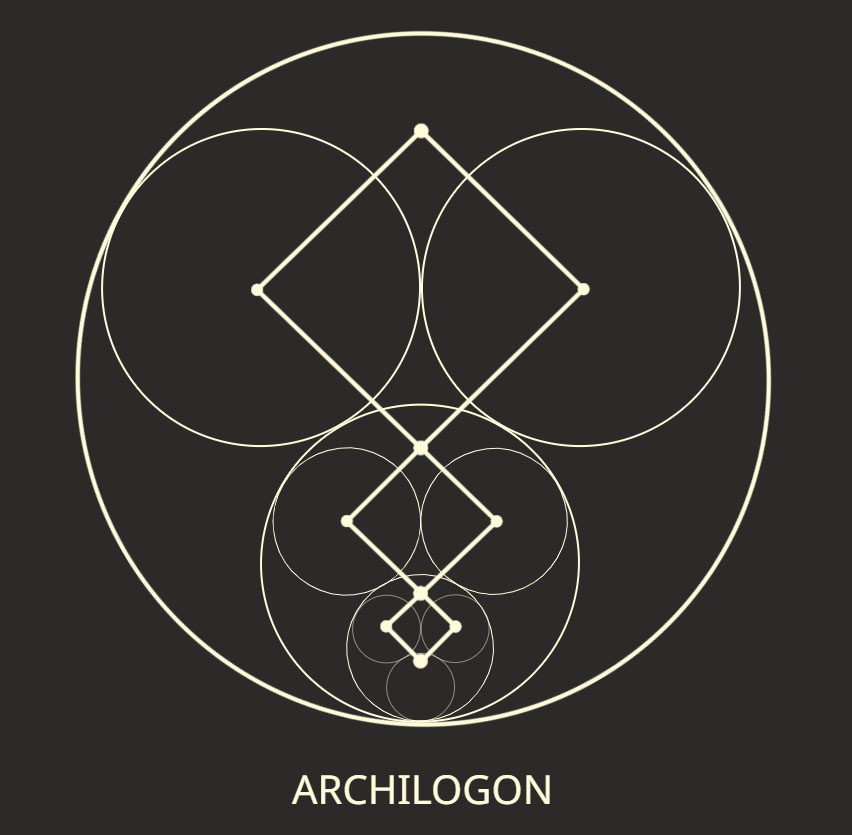
In this video, Elias Artista explores more deeply the relation of formal consonance between Plato and Kant, showing how, in accordance with Pythagorean doctrine, Subjective Thought may rise to Objective Thought through the contemplation of archetypal Formal Relations. The video introduces the presupposition of archlogical inquiry, clarifies the role of the Archilogon as a universal instrument for the reconfiguration of thought, and interprets the Kantian Categories and the Platonic Ideas-Forms as convergent expressions of one and the same logic, the logic that several philosophers have identified as “Pure Logic”.
Archilogon – The key to Synthetic Logic. A project by Elias Artista.
Bibliography
Works Cited
- Edmund Husserl, Ricerche Logiche, vol. I, ed. G. Piana, Mondadori, Milan, 1968, pp. 172–173.
- Werner Jaeger, Aristotle: Fundamentals of the History of His Development, La Nuova Italia, Florence, 1964, p. 567.
Further Reading
- Giovanni Reale, Per una nuova interpretazione di Platone alla luce delle “Dottrine non Scritte”, Bompiani, Milano, 2010.
- Marcus Aurelius, Meditations.
Video transcription
The essential consonance between Plato and Kant was expressed in various forms by the Marburg School, although the spirit of the age was far more inclined to draw Plato over to Kant’s transcendental side than to bring Kant over to Plato’s transcendent side.
Even so, that consonance was still far from being expressed through a logical diagram, although this is the only way to reconfigure the individual mind according to archetypal Formal Relations and render its reflective surface as clear as possible.
In this chapter Nous, we believe we have clarified sufficiently the presupposition of archilogical inquiry: only by virtue of the peculiar relation between Subjective Thought (Doxa) and Objective Thought (Episteme) can one understand the need to construct a universal semiological instrument.
For it is through contemplation, through theoria, of the Relations between archetypal Forms that the philosopher becomes able to reconfigure the architecture of his own mental universe according to the structure of the Forms of Reality.
And it is this very instrument that allows us to conclude the analogical identities between Kant and Plato. If philosophical theories are structures made of logical Relations between Concepts, then only a universal logical structure can frame the thought of both, thereby bringing identities and differences to light.
Structure defines the Relations among its internal elements. We can say that logical place signifies. If two Concepts that appear different possess the same relational properties, determined by their specific position within a logical structure, then they are equivalent, analogous.
In the chapter devoted to the construction of the Archilogon, we shall show the relation of formal consonance between Plato’s Psyché and Kant’s Pure Reason.
At the moment when Kant deduces his Categories, that is, the logical forms through which Reason knows reality, he is in fact reconstructing, through a speculative act, the intuited archetypal Forms, the Forms through which reality has shaped human Reason, and which Kant’s consciousness reached and understood in the very act of depersonalising itself.
In the chapter Analogy, we shall discuss how Kant attains Objectivity through the dialectical method, the mechanism of Synthetic Logic, in which two opposed elements are mediated by a third.
In carrying out a Structural Deduction, of which we shall speak in the chapter Pythagoras, in order to recover his Categories, Kant reaches the noetic summit, albeit unconsciously, because he continues to advance, so to speak, with his back turned to the Intelligible World, whose existence, in fidelity to his own criteria, he cannot prove by means of the instruments of Science.
The Kantian Categories are among the highest fruits of the human spirit. The architecture of Pure Reason does indeed arise as the product of an individual mind, yet it is something more, and something qualitatively different. In the speculative labour of reconstructing the Categories, Kant’s reflection subordinates itself to the logical forms determined by Space-Time, and through this self-discipline it changes shape, assuming the very form to which it submits.
That is, it rises from Subjectivity to Objectivity, from Singularity to Universality, and lays aside its individuality exactly as, in the course of a calculation, a mathematician sets aside his subjectivity and becomes the vehicle of something impersonal and objective that transcends the initial psycho-logical dimension.
We are here in the sphere which, as Husserl writes, belongs to Pure Logic:
“The objective content of science, insofar as it truly fulfils the intention proper to it, is wholly independent of the subjectivity of the one who conducts the inquiry, and of the peculiar nature of human beings: it is precisely an objective truth. Pure Logic is concerned precisely with this ideal aspect, that is, with form. This means that it is not concerned with what belongs to the particular matter of specific individual sciences, with the contingent properties of their truths and of their forms of connection, but with what pertains in general to truths and to their theoretical interconnections. Therefore every science, from the standpoint of objective theory, must conform to its laws, which possess an absolutely ideal character.”
Plato’s Ideas/Forms and the Categories reconstructed by Kant are one and the same. The Platonic Ideas, seen from above, are the expression of a supreme Logic of Reality. The Kantian Categories, seen from below, are the catalogue of the possibilities of Thought, organized into a complete and coherent system, which a mind rediscovers within itself as reflections and reconstructs when it disciplines itself to think objectively.
Subjective Thought and Objective Thought are not two Contrary Opposites, but two Correlative Opposites. They represent the same path apprehended at two different stages of development and in two different configurations.
As Marcus Aurelius says, an individual mind is a fragment of the Universal Mind, because its subjectivity is due to its condition of bodily separateness, of being a Part, which chains it to existence, that is, to a precise place in Space and a precise moment in Time.
Its level of development is measured by the breadth attained by consciousness, which, in the pursuit of true knowledge, is under tension towards the Universal. The Universal does not reside in a mind focused upon the Singular. It resides in the mind that thinks the Universal by consciously raising itself to the Universal.
When chess players play, neither of them moves the pieces according to the whim that would secure victory by sweeping the opponent’s pawns aside with a wave of the hand. The individual thought of both is subordinated to the universal logic of the rules. It is shaped, adapted, transformed. It is no longer the product of two distinct consciousnesses. Both are fused into a single form that transcends them.
And during the game the two players do not need to speak: they understand one another with regard to possible and impossible moves, almost as though they were reading each other’s thoughts. Reading each other’s thoughts is a poetic metaphor for saying that one thinks by means of the same form.
What the two players cannot understand in one another, to humanity’s fortune and misfortune alike, are their individual strategies, precisely because these are not universal. They are individual, distinct, differently formed, because they are directed not towards universal ends, but towards particular and singular ones.
Plato tells us that human thought is capable of development, and that it passes through phases brought about by a logical remodelling. Objective Thought, Episteme, is nothing other than the adjustment of Subjective Thought, guided by will and discipline, to the Logic of Reality.
And the Archilogon, whatever its historical origin may be, is the instrument that can help Subjective Thought conform itself to Objective Thought through the contemplation of the Formal Relations that constitute its structure.
In the chapter Symbol, we recounted the exile of Philosophy from its original vocation in order to offer an elementary compendium of the idealist perspective that informs our project, then focusing on the particular relation that binds Kant to Plato and on the divide opened up between ancient and modern Gnoseology.
Much has been left aside. Yet all the themes embraced by Philosophy, ethical, political, juridical, aesthetic, are subordinate to the problem of knowledge, because our way of knowing determines the orientation of our choices, and therefore of our actions.
The logic of a consciousness focused upon empiria generates a type of human behaviour substantially different from that shaped by a logic focused upon ideality. One who acts on behalf of the Part indeed struggles to understand one who acts on behalf of the Whole.
The Pythagorean way of life celebrated by Plato is the fruit of this logic, and in the next chapters we shall reconstruct it as faithfully as possible.
Over the centuries Plato has been explored in depth above all from the ethical, political and pedagogical points of view, since these aspects are easily singled out. Yet such doctrines are the direct consequence of their place within a global, pansophic architecture: they are the fruit of a Synthetic Logic.
Jaeger writes:
“For Plato, Socrates’ moral problem had from the very beginning been a problem of knowledge. The question of correct moral insight, of phronesis, to use the name that Socrates had taken from the current usage of the Greek language, concealed within itself the still deeper problem of the essence of knowing in general and of the true nature of being.”
Without a convincing answer to Socrates’ question, ‘How does man know what he knows?’ any assertion, even the most authoritative, appears weakly grounded, and is therefore exposed to the corrosive irony of that master who claimed to know nothing.
In the next chapters we shall go back in order to take up once again, and deepen, the red thread of Idealism, that is, its Pythagorean core, by recounting the community founded and guided by the greatest spiritual heir of Pythagoras.
“To the Principle!”