Archilogon 042 - 6. Academy - 1. The Platonic Dialogue
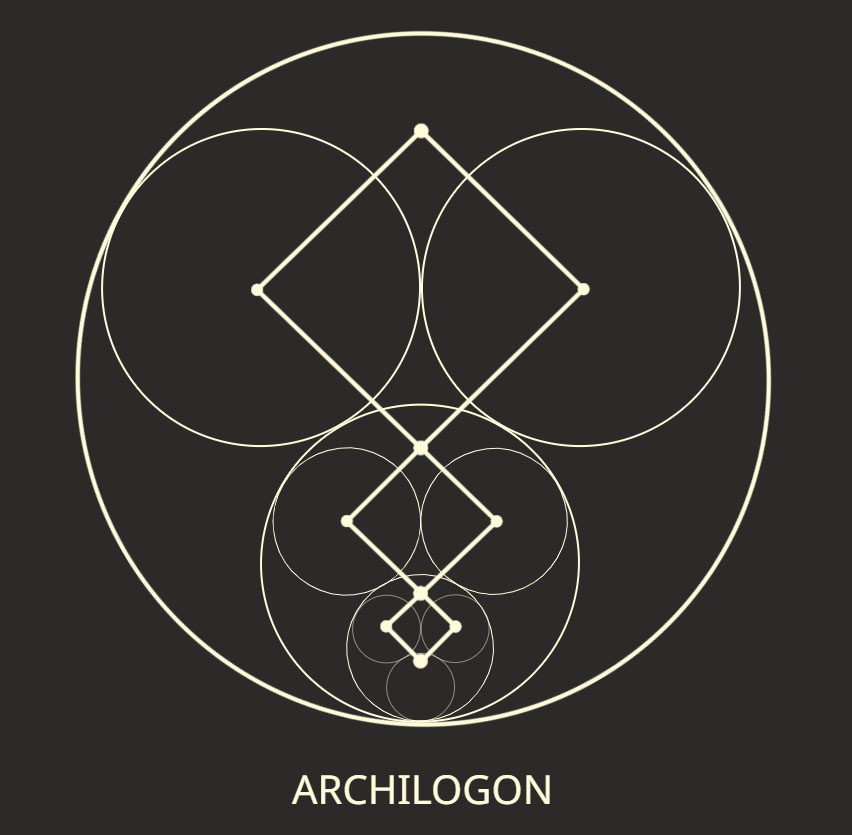
In this video, Elias Artista highlights the role assumed by Plato’s Academy in transmitting fragments of the Pythagorean doctrine, a doctrine that never appears in the Dialogues in a wholly explicit form. From a historical point of view, while the scepticism displayed by the character of Socrates would become the paradigm of Philosophy’s authentic attitude, the Pythagorean matrix would gradually recede into the background because of its obscurity and its supposed dogmatism. From the standpoint of the reconstruction of Synthetic Logic, however, Socratic criticism should instead be interpreted as a preliminary negative moment, a tabula rasa, the necessary prelude to the mental reordering of the pupil who aspires to Episteme. Among the traces of Pythagoras that emerge in the Dialogues, particular importance attaches to the role and meaning of the One, not as an abstract concept, but as a diagrammatic representation of the structure of Synthetic Logic.
Archilogon – The key to Synthetic Logic. A project by Elias Artista.
Bibliography
Works Cited
- Diogenes Laertius, Lives of the Philosophers, Preface, 12.
- Plato, Republic, 525a.
Further Reading
- Harold F. Cherniss, Aristotle’s Criticism of Plato and the Academy.
- John M. Dillon, The Heirs of Plato: A Study of the Old Academy (347–274 BC).
Video transcription
Welcome, wanderer, to the sixth stage of the Archilogon project. In this new chapter, we shall attempt to reconstruct Plato’s transmission of the Pythagorean doctrine, bringing into focus Aristotle’s particular role within the Academy.
The speculative activity that serves as the philosopher’s instrument does not begin with Pythagoras, yet the term “philosopher” does. Diogenes Laertius tells us so when he reports a passage from Heraclides Ponticus. Heraclides was a member of the Academy and one of the candidates to succeed Speusippus as “scholarch”:
“Pythagoras was the first to use the name ‘philosophy’ and to call himself a ‘philosopher’.”
Pythagoras is the first to define himself as a “philosopher”, in the sense of “one who aspires to Sophia”, that is, to knowledge of the ancient metaphysical doctrine. Before him, there are no “Philosophers”, but “Sophoi”, the Sapients, those who transmitted Sophia. This is not a matter of labels, but of substance, because the term “philosopher”, later extended in a generic sense, bears for the Pythagoreans a precise meaning that we shall explore over the course of this chapter.
We possess no first-hand documents concerning the aims and methods of the first philosopher. The task of witness therefore passes into the hands of Plato, who may be regarded as the second great philosopher, precisely because he is one in the Pythagorean sense. Yet, owing to the scepticism displayed in the Dialogues by his idealised Socrates, Plato appears to modern readers as the first true representative of Philosophy, to which there is now a tendency to assign an eminently critical function.
In this shift of function, Pythagoras, the inventor of the term, is brutally stripped of his role. The “Socratic” Plato, who would occupy centre stage for centuries, would tend to cast the “Pythagorean” Plato into shadow, and modern readers decidedly prefer him less, on account of certain apparently dogmatic positions whose rationale we shall gradually seek to bring back to light.
In the coming chapters, we shall show that Socratic scepticism, long regarded as Plato’s true face, represents for him only a preliminary phase of conceptual purification, a necessary prelude to the reconstruction of true Pythagorean Philosophy, and that everything irrational later attributed to the Philosopher of Samos is merely the result of a distortion of his original thought.
Since, in the process of transmission, the refraction of the Pythagorean doctrine takes place as it passes through prismatic consciousnesses, our plan of enquiry will be to identify that “ray” before it is refracted and deformed by the noetic level of the one who grasps it, filters it, and transmits it anew.
If we may go so far as to believe, with reasonable confidence, that we can reconstruct the original Pythagorean doctrine learned by Plato, it is because it is not merely a doctrinal content, but an absolutely coherent and rational logical system, one that the philosophers engaged in the project of a Mathesis Universalis would seek to reconstruct for centuries.
Thus, two hundred years after Pythagoras and four hundred years before Christ, in an olive grove on the northern outskirts of Athens dedicated to the hero Academus, Plato founds that circle which would remain alive for more than nine hundred years, until its closure by decree of the Roman emperor Justinian in 529. Here Plato gathers around himself curious and enterprising thinkers, with whom he subjects many arguments inherited from earlier Philosophy to rigorous criticism.
From the Dialogues we can infer only part of the workings of this circle, piecing them together with other sources, such as Aristotle’s notes. At a certain point, Aristotle would leave the Academy in order to found a new circle, the Peripatos. Many of the arguments debated within the Academy begin from Pythagorean conceptions, and in particular from the Mathesis Universalis inaugurated by Pythagoras. Plato writes:
“Among those disciplines that lead and guide us towards the contemplation of Being, there is the Mathesis, which concerns the One.”
As the narrative unfolds, we shall see that “the One” is by no means an abstract and generic concept, but the precise and geometrical diagrammatic representation of the structure of Synthetic Logic.
To begin our five-chapter historical journey into the Mathesis Universalis, we shall therefore start from the traces scattered throughout the Dialogues. Dialogue appears an unusual stylistic form for anyone preparing to transmit important content, and one might well ask why Plato chose to adopt a dramatic style that does not shrink from irony, sarcasm, gossip, and even the occasional comic digression.
It is not impossible that he first conceived these works on the basis of real discussions held within the Academy on specific themes, in which the fictive roles of “thesis” and “antithesis” were sustained by two or more interlocutors. He may later have intervened upon this framework, artistically reworking it under the guidance of a more general design.
The character of Socrates, reflecting Plato’s own function within the group, stimulates an interlocutor, sometimes gently, sometimes sharply. This interlocutor embodies a conviction, an attitude, a practice, or a traditional philosophical position, and in conversation with Socrates he is brought face to face with problems of which he had never become aware, eventually realising that his ideas had been accepted uncritically, under the pressure of contingent motives.
At times, the figures who animate the dialogue are people moving within the orbit of the Academy. At other times, famous figures from public life or from earlier Philosophy appear, such as Parmenides or Zeno, in order to reveal certain doctrinal weaknesses or inconsistencies.
Through this dialogical pattern, Plato shows how knowledge is structured by logics that necessarily and inevitably come into conflict, yet he does not set out any blunt alternative. The fact that he adopts a critical approach to the material, however, does not resolve itself into a merely deconstructive exercise, for that would reveal an underlying relativism which he opposed in a clear and unequivocal manner.
Plato instead advances his critique from a highly particular standpoint, which he never renders entirely explicit. Between the lines he leaves traces of “something” to which he attributes great importance, and which may lead us into the presence of a truth higher than any thesis and any antithesis.
In the next video, we shall explore the role of Dialectic within Plato’s Academy. “To the Principle!”