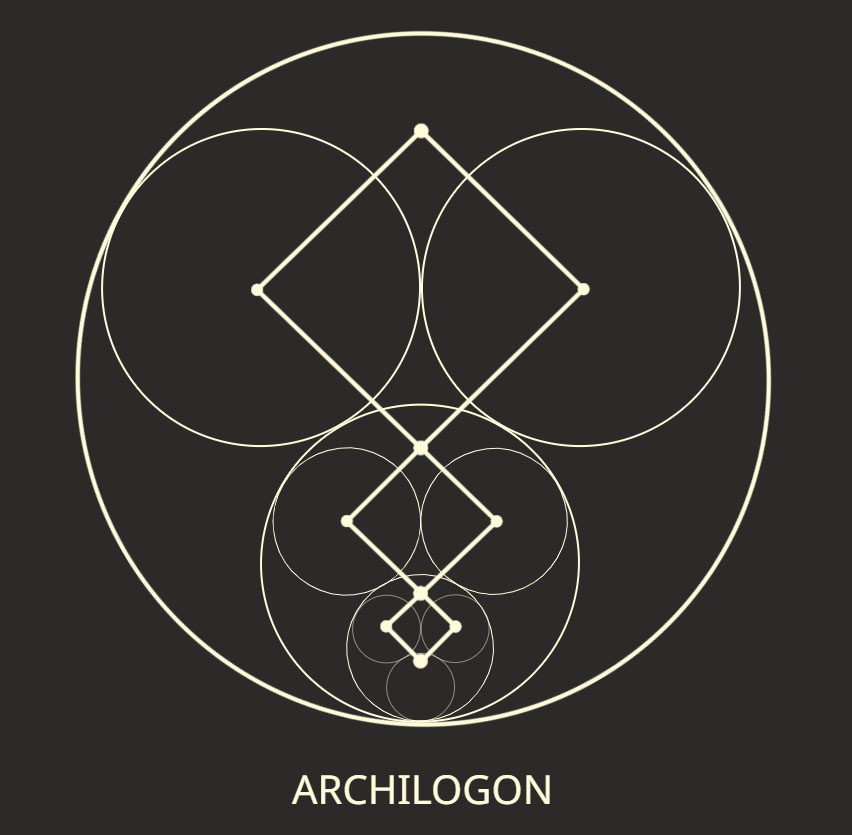
Archilogon 043 - 6. Academy - 2. Dialectic and Mathesis
In this video, Elias Artista explores the presence of a Mathesis Universalis ante litteram within the Platonic and Pythagorean tradition, with particular attention to Plato’s Unwritten Doctrines. Through the Philebus, the Parmenides, and the testimony of authors such as Giovanni Reale, Konrad Gaiser, Proclus, and Philip Merlan, the video shows that Platonic Dialectic is not simply an art of dialogue, but a logical-formal method grounded in the relation between Unity and Multiplicity. Ideal Geometry, Ideal Numbers, and the Formal Relations between Ideas-Forms are thus presented as instruments for reconstructing the structure of the Intelligible World. This path leads to a new interpretation of the relationship between Plato, Socrates, and Pythagoreanism, and prepares the ground for the subsequent inquiry into the figure and teaching of Pythagoras.
Archilogon – The key to Synthetic Logic. A project by Elias Artista.
Bibliography
Works Cited
- Plato, Philebus, 16c.
- Giovanni Reale, Per una nuova interpretazione di Platone alla luce delle “Dottrine non Scritte”, Bompiani, Milan, 2010, pp. 233-234.
- Plato, Parmenides, 144.
- Konrad Gaiser, La Dottrina Non Scritta di Platone – Studi sulla fondazione sistematica e storica delle scienze nella Scuola Platonica, Vita e Pensiero, Milan, 1994, p. 28.
- Proclus, Commentary on Plato’s Parmenides, 729-730.
- Aristotle, Metaphysics, A 5, 986a, 20.
- Philip Merlan, Dal Platonismo al Neoplatonismo, Vita e Pensiero, Milan, 1994, pp. 66-67.
Further Reading
- Linda M. Napolitano Valditara, Le idee, i numeri, l’ordine – La dottrina della Mathesis Universalis dall’Accademia al Neoplatonismo, Bibliopolis, Naples, 1988, p. 35.
Video transcription
Several scholars have investigated whether ancient materials, and more broadly the philosophical and mathematical tradition surrounding ancient Platonism, may reveal traces of a Mathesis Universalis ante-litteram. The answer is affirmative. The Tübingen School and the Milan School likewise confirm that the Unwritten Doctrines reveal such traces in at least three respects: first, the identification of different planes of Reality — principles, numbers, mathematical entities, phenomena — arranged hierarchically from the simplest to the most complex; second, the identification of Ideas/Forms with Numbers; third, the polyvalence of each principle. The One, for example, is both the Universal that contains everything and the smallest unit within a series.
In the Philebus, Plato outlines the philosophical method to which he feels most deeply bound. This passage is extremely important, because it summarises, in the clearest possible way, the logical premises that guide his philosophical inquiry:
“The ancients, who were better than we are and closer to the Gods, handed down to us this message: that the entities we call ‘eternal’ are constituted by Unity and Multiplicity, and therefore contain within themselves the seed of Finitude and Infinitude. Since this is the nature of things, in every domain we must seek, each time, to establish the idea of Unity, and we shall find that it is implicit. Once we have obtained it, we must then consider whether it may be divided into two or three or further parts, and then, conversely, lead each of those parts back again to Unity, until we realise that the original Unity is not merely Unity, nor simply Multiplicity and Infinitude, but possesses a structure. Thus we cannot attribute the idea of Infinitude to Multiplicity before we have defined all the Formal Relations that stand between Unity and Multiplicity. Only then may we begin to divide that Unity indefinitely. The Gods, as I said, entrusted to us the task of examining, learning, and transmitting this method. But nowadays the so-called “wise” unify and separate as chance dictates, more or less than is necessary; and after Unity, they pass straight to Multiplicity, ignoring everything that lies between. This is why, in the arguments we conduct among ourselves, we distinguish those of a ‘dialectical’ nature from those of an ‘eristic’ nature.”
Dialectic, then, must not be confused with a kind of “dialogic art”. It is, rather, a particular logical and formal approach. For Plato, any reasoning that does not rest upon a formal basis is eristic reasoning: empty, aimed at persuasion, at convincing one’s interlocutors of its own validity, precisely because it lacks the traits of intrinsic necessity and evidence.
To reconstruct that logic capable of guaranteeing the validity of knowledge, capable of guiding the reader towards truth, it is necessary to undertake a path of Anamnesis and to employ the instruments of Ideal Mathematics, and above all of Geometry.
When consciousness experiences the Sensible World, Plato writes in the Republic, it discriminates whether the object perceived is “one” or “many”. This polar Opposition between Unity and Multiplicity leads the philosopher to speculate upon the intermediate logical forms, and upon the way in which these relate to one another, eventually generating, through their interweaving, the structure of the Intelligible World.
Alongside its ordinary use, Geometry possesses an Ideal use, whose aim is precisely to grasp and represent that structure. Giovanni Reale writes:
“Each Idea is placed in a precise position within the Intelligible World, according to its greater or lesser universality, and according to the more or less complex form of the relations it maintains with other Ideas situated above or below it. This web of relations, therefore, can be reconstructed and determined through Dialectical Logic and, for the reasons explained, can be expressed numerically, since number, precisely as such, expresses a relation. Thus, in the conception of number as ‘relation’ lies the key to reading and understanding this truly delicate point of the ‘Unwritten Doctrines’.”
The interpretation of the Ideal Number as the measure of relations between Forms is not confined to Arithmetic. In Plato, it also includes geometrical relations, thereby defining a genuine diagrammatic structure, as already prefigured in the Parmenides:
“The One may be represented by a figure that is at once linear and circular.”
It is important to stress once again that Plato is not the inventor of this method. Rather, he draws upon the achievements of the Pythagorean school, which, through the dialectical method, had elaborated a structure composed of Four/Ten archetypal Forms.
Proclus is convinced that, far beyond the role of “sceptical inspirer” which emerges in the Dialogues, Socrates had initiated Plato into Pythagoreanism:
“The Theory of Ideas existed also among the Pythagoreans; Plato himself proves this in the Sophist, 248a, when he says that the Italic Sages were ‘in consonance with the Ideas’. But the most eminent philosopher in postulating the Ideas was Socrates. Beginning from his search for exact definitions, Socrates distinguished the things that are objects of definition, and from them proceeded towards ideal causes.”
Socrates guides Plato towards Pythagoreanism and towards the Mathesis. All Ideal Numbers are contained in the relations among the first four, and these Formal Relations unveil the “metaphysical web of the whole of Reality”, because these Forms, through the power of Analogy, structure every domain of knowledge that is decomposed into its archetypal elements.
Konrad Gaiser writes:
“This hypothesis of an analogy between the entire structure of reality and the particular domain of Mathematics, may be regarded as the fundamental presupposition of the whole of Platonic ontology. On the basis of this universal conception, Plato can in general use the field of Mathematics, which permits a systematic and rigorous unitary synthesis, as a sphere of verification for the doctrine of Being. When Mathematics discovers and sets out the arithmetical and geometrical relations, and laws that hold in connection with dimensionality, Number, Line, Surface, Body, it thereby provides, so to speak, a model through which it becomes possible to discover and verify, with exactness and evidence, the structure of the whole of reality.”
From the Pythagoreans, Plato inherits the archetypal formal structure made of numbers and forms, and proceeds to extend it to the domain of natural language, in order to reveal, on the basis of geometrically determined qualities, the “Essences of Reality”, that is, its distinctive qualities or characteristics. He thus develops an answer to Socrates’ question concerning the true nature of Ideas such as the Good, the Beautiful, and the Just.
We said that the relation between Unity and Multiplicity is the fundamental Relation of Opposition. Let us take the Idea of Pleasure, the subject of the Philebus. Pleasure has two aspects: although it appears to be a single Idea, it results from the sum of innumerable cases of life through which it becomes manifest to our sensibility.
The philosophical problem is to understand the relation between this Unity, purely intuited by the mind, and the Multiplicity of empirical cases in which that Unity manifests itself. The question is: Does “Pleasure” subsist as an Idea in itself, transcendent, beyond individual immanent experiences? Plato, in his Realism, answers affirmatively.
Aristotle, by contrast, will regard the Idea as the product of a “hypostatisation”, that is, of an undue “concretisation” of a classificatory abstraction: a mere concept mistakenly elevated to the status of “substance”.
The Pythagorean method, defined as dialectical, proceeds from Multiplicity to Unity, and from Unity to Multiplicity, through the identification of Oppositions. We know this aspect because it is attested by the famous list reported by Aristotle in the Metaphysics.
Upon the Pythagorean, numerical, and archetypal polarity of ‘One’ and ‘Many’, Plato and the Academics superimpose, by analogy, several dialectical polarities, which we shall analyse in the course of our account. On the interchangeability of these dialectical polarities, Merlan writes:
“In Platonic dialectic we cannot expect a consistent terminology. What one writer calls ‘divisible’ and ‘indivisible’, ‘participable’ and ‘imparticipable’, another may call ‘unlimited’ and ‘limited’; a third, ‘the same’ and ‘the other’; a fourth, ‘one’ and ‘many’; a fifth, ‘ungenerated’ and ‘generated’; a sixth, ‘intelligible’ and ‘sensible’, and so on. It is evident that we must understand the idea; once we have done so, we can easily observe that all these pairs of terms express one and the same dualism, although from rather different points of view.”
For Synthetic Logic, the interchangeability of concepts and terms is not the fruit of arbitrariness. It is determined and constrained by a precise structure of underlying geometrical Forms. We shall retrace the concept of Dialectic historically in the chapter devoted to it. In the next video, by contrast, we shall touch upon the historiographical approach to the figure and teaching of Pythagoras. “To the Principle!”