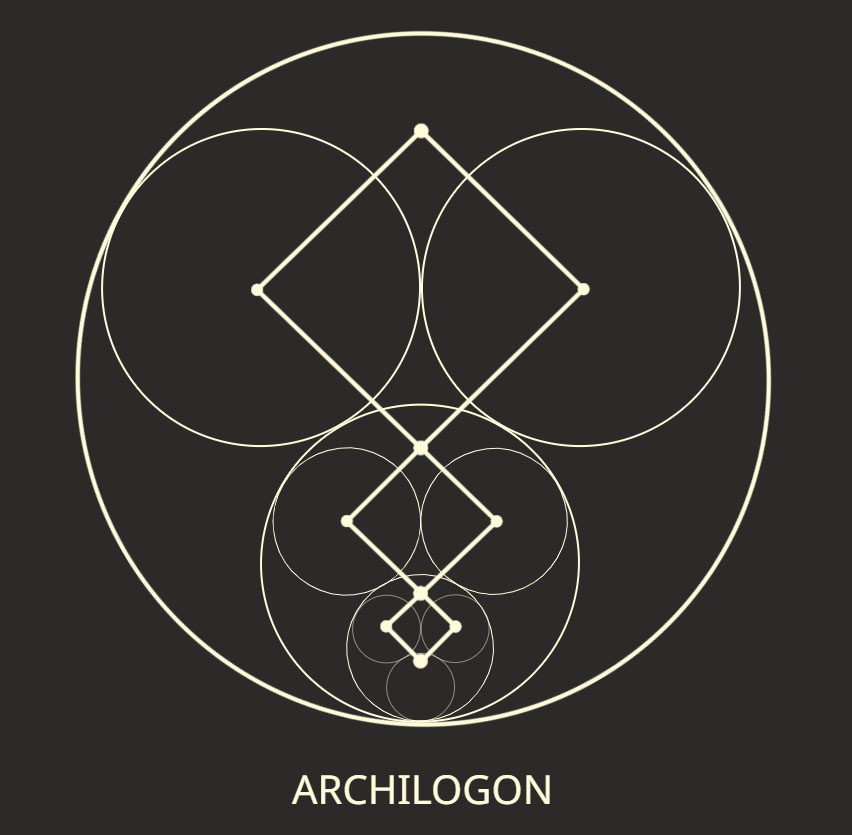
Archilogon 044 - 6. Academy - 3. Monism and/or Dualism
In this video, Elias Artista addresses the problem of the relation between Monism and Dualism in Plato’s philosophy, showing how this opposition can be understood through a particular logic that transcends the Principles of Identity and Non-Contradiction. Drawing on the testimonies of Simplicius, Eudorus of Alexandria, Plato, and Proclus, the video reconstructs the Pythagorean dialectical polarity between the One-Whole and the One-Part, which, within the archetypal diagram, gives rise to the famous pair of the “Great” and the “Small”. Through diagrammatic representation, it becomes clear that Monism and Dualism are not incompatible perspectives, but two complementary modes of focusing on the same logical structure. The path thus leads to the definition of a “field of polar tension”, the foundation of Dialectic, the inner mechanism of Synthetic Logic.
Archilogon – The key to Synthetic Logic. A project by Elias Artista.
Bibliography
Works Cited
- Simplicius, On Aristotle’s Physics, 181, 7.
- Plato, Parmenides, 144.
- Proclus, Platonic Theology, IV, 10, 34.
- Aristotle, Metaphysics, 987b, 25.
Further Reading
- Margherita Isnardi Parente, “La Akroasis di Platone”, in Museum Helveticum, no. 46, Schwabe, Fribourg, 1989, p. 162.
Video transcription
Plato’s philosophical approach raises several theoretical problems, among them the alleged conflict between Monism and Dualism. The Pythagorean dialectical method introduced in the previous video might lead us to think that Plato conceived Reality as divided into two antithetical principles. Yet this appears to clash with the celebrated conception of the Good as a single and supreme entity, a view that would later make him a standard-bearer of Christian monotheism.
Now, if we were to reason by means of the Principles of Identity and Non-Contradiction proper to classical logic, we might remain trapped in uncertainty. If Reality is monadic, it cannot at the same time be dyadic. Eudorus of Alexandria, quoted by Simplicius, offers us some precious clues:
“It may be said that the Pythagoreans affirm that, on a higher plane, the One is the principle of all things, whereas, on a lower plane, there are two principles of produced things, namely the One and its opposite. All things conceived as oppositions must be subordinated to it: what is good is attributed to the One, what is evil to its opposite. The reason why both are not higher principles is that, if one of the two were the principle of certain things, and the other the principle of others, then neither would be an absolute principle, as the One is.
I therefore maintain that the followers of Pythagoras preserved the One as the absolute principle, and then added to it two further principles. These two principles are defined by many names: the first is called ordered, defined, knowable, male, odd, right, light. The other, opposed to it, is called disordered, indefinite, unknowable, female, left, even, darkness.”
We thus understand that, for Pythagoras as for Plato, it is possible to reconcile Monism with Dualism. Yet, to do so, we must undertake a change of logic, one that allows us to bypass the Principle of Non-Contradiction. Or rather, to “embrace” it on a higher plane.
This new logic cannot be adequately described in words, because within a discursive sequence contradiction is condemned to persist, as is clear from Eudorus’ quotation. Hence the need to resort to diagrammatic representation.
By way of example, we shall here take as our Platonic paradigm the dialectical polarity between the Idea of the Good, the most famous of the Platonic Ideas, and the individual acts in which the Good manifests itself. In this dual embryonic schema of the Archìlogon, we have visualised the natural transition from Pythagorean Forms to Platonic Ideas, a topic that will belong to the future chapter entitled Psyché.
Let us isolate the diagram on the left, the Pythagorean one. Let us observe it first as a totality, the Whole, and then as the sum of its internal elements, its two Parts. Here the Monad is represented by the outer circle that contains everything, while the Dyad is composed of the Monad plus a second element, namely “that-which-is-not-the-Monad”: the inner circle, joined to and at the same time separated from the Monad by the vertical axis.
The diagram shows three elements, yet depending on where we direct our attention, we may alternatively discern:
A) Two antithetical unities, represented by the two extremes of the axis connecting the large circle and the small circle. If we focus only on this opposition, Dualism emerges.
B) One synthetic circle enclosing the whole. If we focus only on this form, Monism is brought into relief.
With a little help from the imagination and an alternating focus, the diagram shows us how both interpretations are true, thereby neutralising the Principles of Identity and Non-Contradiction.
Pythagoras and Plato express themselves through different symbolic systems: the former uses mathematical entities, the latter natural language. Yet the logic is superimposable, because it arises from the same underlying schema of Forms.
One might ask why we have represented dialectical polarity through this figure composed of two circles of different sizes, placed in such a particular position. We might, after all, have drawn the opposition by means of a simple segment, like the famous Line of Nicholas of Cusa.
The reason will become evident during the construction of the Archìlogon, but its origin lies in the Parmenides, and in Proclus’ commentary on it in the Platonic Theology. Passage 144 of the Parmenides, where we find the nucleus of Synthetic Logic, is without doubt the most important passage in the entire history of Metaphysics:
“Being, then, fragments itself into the multiplicity of Beings, and is present in each of them, from the smallest to the greatest. It fragments itself into parts of every magnitude and of unlimited number, and each of these parts is a definite Being. Each part of Being, that is, every Being, whether small or great, is also in itself a Unity.
Since Unity-as-Whole cannot be the same as Unity-as-Part, it is necessary to divide Unity into two distinct-yet-equivalent forms, for the whole is necessarily equivalent to the sum of its parts, neither greater nor lesser.
The One-Whole that shatters into Multiplicity is therefore, at the same time, also unlimited Multiplicity. Since the One-Parts are parts of a whole, the One-Whole represents their limit, for what contains the multiple within a whole is certainly its limit. Thus Being is at once both “one” and “many”, both “whole” and “parts”, both “limited” and “unlimited”.
If Being as One-Whole is limited, it will have extremities, namely a beginning, a middle, and an end. Every whole is composed of these three elements, not one fewer. Thus the One-Whole may be represented by a figure that is at once rectilinear and circular, composed of these elements, such that the One-Whole appears simultaneously “in-itself” and “other-than-itself”.
Each of the One-Parts is within the One-Whole, and none is outside it. If all Parts are in the Whole, and we have affirmed that the One is simultaneously each Part and the Whole, then the One-Part is included by the One-Whole; and so it may be said that the One is “included within itself”.
The One-Whole cannot be in each of the One-Parts, because if it were in any one of them it would no longer be One-Whole. Therefore, if the One-Whole is not in any of the parts, it must be either nowhere or elsewhere. If it were nowhere, it simply “would not be”. Since, as Being, it “is”, it can only “be” elsewhere.
Thus, when the One is in a single Part, it is in “other-than-itself”; whereas, when it is in all Parts, it is “in-itself”. And so the necessary conclusion is that the One is “in-itself” and simultaneously in “other-than-itself”.”
Of this “figure at once rectilinear and circular”, such that the One-Whole appears simultaneously “in-itself” and “other-than-itself”, the Platonic manuscripts have transmitted no diagram to us. And, if we set aside the passage on the Psychogony in the Timaeus, to which we shall devote a crucial chapter, then, in order to find in ancient documents a figure that may correspond to the description just given, we must come to Proclus.
Indeed, the passage of the Parmenides concerning the division of the One is commented upon by Proclus in the Platonic Theology in a theosophical manner:
“Unlike the entities that, in the Sensible World, when generating, bring the generated entities to light outside themselves, when divinity generates it does not thrust outward, separating from itself, the products it has generated. On the contrary, it generates them within itself, and there envelops and retains them.
From this point of view it represents their “place”, like a “womb” that enfolds them, surrounding them on every side; and by its own original generative power it retains and contains within itself, from the very beginning, all the entities derived from its procession and their manifold varieties of form.
Indeed, all beings have come into existence in the Gods, and are surrounded and preserved by the Gods. For where could they go, if they were separated from the Gods and from their containment? And in what manner could they subsist, were they to be separated from them even for an instant?
Thus the divine and generative entities contain and envelop the products they have generated. They determine their essence insofar as they are their immediate causal principles, and at the same time they represent the universal and necessary aspect of their particulars. The generating entities produce the derived entities in a transcendent manner, and at the same time envelop their own products, preceding their composite nature through simplicity, and their Multiplicity through Unity.”
Proclus’ geometrical figures contained in his Commentary on Euclid’s Elements are rather well known, but not his metaphysical diagrams. The Munich Library, however, preserves a sixteenth-century manuscript which, in relation to this passage on the “womb”, contains the following diagram.
The diagram represents the One-Whole that “contains itself” in reduced form, that is, the One-Part. The conjunctive and disjunctive vertical axis is missing, since by the time of Proclus, as we shall see, the geometric key of Pythagoras had been lost. Yet the position of the included circle is peculiar, because, not being at the centre, it does not appear as a classical emanation.
One could say that, in relation to the One-Whole, the One-Part is in a state of “identity” and at the same time of “alterity”. This is why, when it is In-Itself, that is, in the position in which it is itself, the large circle, the One is called the Same; and when it is in Other-than-Itself, it is called the Other, the small circle.
This dialectical pair is indicated by Plato through the expression “the Great and the Small”, mega kai mikron, mentioned by Aristotle. In geometrical terms, the pair reproduces the dialectical polarity between Unity and Multiplicity, bringing us back to the opening of Philolaus and to the opposition between Limit and Illimit.
The division of the One into two distinct forms, One-Whole and One-Part, generates a vertical axis representing the bipolar and dialectical tension, which is at once conjunctive and disjunctive. The One-Whole contains the One-Part, yet at the same time is “other-than-itself”, although within itself.
To Proclus’ spare diagram we have added other representative elements: at one end of the vertical axis there is a point, symbolising the static cohesion of Unity; at the other end there is a vector, symbolising the infinite possibility of decomposition proper to Multiplicity. We shall return to this field of polar tension when we examine the Parmenides in greater depth.
For now, however, we may anticipate that this diagrammatic interpretation is archetypal in relation to the whole of idealist thought, and establishes itself as the basic formal structure of Archilogic, which is transcendent, and of Synthetic Logic, which is immanent, and which tends and aspires towards the former.
What we shall do in the coming chapters devoted to the Mathesis Universalis is detect its presence in the logic of certain “synthetic” philosophers throughout history. The next immediate step, however, will be to understand, from a historical point of view, how Plato came to recognise Pythagoras as a master of logic. “To the Principle!”