Archilogon 046 - 6. Academy - 5. The Pythagorean Circle
In this video, Elias Artista proposes a possible connection between the organisation of Pythagorean communities and the internal structure of Plato’s Academy. Iamblichus’ account, drawing upon the testimony of the former Pythagorean Aristoxenus of Tarentum, outlines a rigorous process of selection and a severe discipline imposed upon aspirants. Such care was necessary because the comprehension of Pythagorean doctrine depended not merely upon the acquisition of notions, but upon a profound reconfiguration of the individual’s logic, made possible by a new way of life. The video also recovers the original meaning of the term “philosopher”, understood as a “member of the confraternity of aspirants to Sophia”, a meaning far removed from the generic sense the term later acquired. Finally, it highlights the fundamental role of the three celebrated books of Philolaus of Croton, known under the titles "On Nature" and "On the Cosmos", which most probably contained the original diagram described in the Psychogony of the Timaeus.
Archilogon – The key to Synthetic Logic. A project by Elias Artista.
Bibliography
Works Cited
- Iamblichus, Life of Pythagoras, 17, 199, 252–253.
- Iamblichus, Exhortation to Philosophy, §2.
- Plato, Gorgias, 508a.
- Diogenes Laertius, Lives of Eminent Philosophers, VIII, 15.
- Stobaeus, Anthology, I, 21, 7.
Further Reading
- Leonid Zhmud, Pythagoras and the Early Pythagoreans, Oxford University Press, Oxford, 2012, p. 417.
- Carl A. Huffman, Aristoxenus of Tarentum - The Pythagorean Precepts (How to Live a Pythagorean Life), Cambridge University Press, New York, 2019.
Video transcription
According to the surviving evidence, Plato’s Pythagoreanism took root and developed through three decisive encounters. The first was with Socrates. The second arose from his journey to Italy and his meeting with Archytas of Tarentum. The third was his discovery and study of Philolaus of Croton’s work entitled On Nature.
When Plato founded his circle in Athens, the Academy, we cannot rule out the possibility that he sought to model his community upon a Pythagorean circle, organised into different levels of depth, at least two. This is suggested by the fact that Aristotle speaks with a certain detachment of some of Plato’s disciples, the “so-called Pythagoreans”, towards whom he adopts a particularly critical attitude.
To understand some of the internal mechanisms of the Platonic Academy, it may therefore be useful to consider how a Pythagorean community functioned. Iamblichus offers valuable evidence in this respect, drawing upon the testimony of Aristoxenus of Tarentum, a former Pythagorean and a contemporary of Plato and Archytas.
The Pythagorean communities that sprang from the original group founded by Pythagoras at Croton in the V century b.C. were small confraternities bound together by strict discipline and rules of communal life. To gain some sense of their internal organisation, let us listen to Iamblichus’ account:
Pythagoras did not admit as a member everyone who presented himself, at least not before testing him and examining him with great care. He began by enquiring into the candidate’s relationship with his parents and relatives. He then observed whether his laughter, speech and silences were appropriate to the occasion or out of place. Next, he examined the candidate’s aspirations, his companions, the subjects of his conversations, the way he spent his leisure time, and what caused him joy or sorrow. He observed his physical appearance, gait and bodily movements, for he believed that visible characteristics were signs of the soul’s invisible tendencies.
After subjecting the candidate to this examination, he kept him waiting for three years, secretly observing his capacity for constancy, his genuine love of study, his aversion to fame and his contempt for public honours. The candidate was then required to observe silence for five years. This was a test of self-restraint, since mastery of the tongue is among the most difficult of achievements, as those who instituted the Mysteries explain.
During this probationary period, each candidate’s possessions were placed in common and entrusted to appointed stewards, administrators or lawgivers. After five years of silence, those probationers who had earned approval through dignity and modesty, and who were considered worthy of receiving the doctrine, became “members of the inner circle”. They were permitted to listen to Pythagoras speaking from behind a curtain. They attended the sessions without intervening and without seeing the master, thereby offering further proof of their capacity for self-control.
These disciples were generally known as the Acusmatics. If they were ultimately rejected at the end of the trial, they received twice the wealth they had originally contributed. The inner members, however, erected a funerary monument to them, as though the rejected candidate had in some sense “died”. If they later encountered him, they treated him as a stranger, declaring that the man who had aspired to become a Pythagorean was dead.
Since the purpose of education was to form upright and honourable men, Pythagoras did not impart false doctrines. Nor did he employ the devices used by the Sophists, whose aim was to ensnare the young. Pythagoras taught an authentic doctrine that embraced both empirical and ideal knowledge. The so-called “Sophists”, by contrast, dishonourably used notions stolen from the Pythagoreans as bait with which to attract the young, promising them a rapid course of instruction and turning them into charlatans.
Yet to impart ideal knowledge to souls that remain confused and agitated is like pouring clear and pure water into a well whose bottom is covered with mud. The sediment is stirred up, the water loses its clarity, and a dangerous exchange of impurities takes place between master and disciples.
The intellect and heart of aspirants who are not yet ready are overgrown by a dense and thorny wilderness. This suffocates and obscures the soul’s gentle, tranquil and rational power, preventing the development and elevation of their spirit. This wilderness of invasive passions must therefore be cleared away through a severe discipline that works like fire or the sword.
Only when the aspirant’s Reason has been freed from these harmful elements can knowledge be imparted, and useful and good things be sown within the soul. Such was the care Pythagoras devoted to preparation for the doctrine. Since he paid such close attention to examining the mental dispositions of potential aspirants, he insisted that the teaching and communication of his doctrines should be governed by the strictest rigour.
A Pythagorean community was therefore organised in layers. Its system of admission ensured that only those aspirants who displayed firm control over their impulses and a genuine inclination towards speculation could gain access to the central nucleus: the inner circle guided by the master, where the heart of the doctrine was finally disclosed.
It is evident that, for Pythagoras, the psychic condition of the learner could not be separated — as modernity would later suppose — from the notions he was expected to absorb. Such a separation would have been not merely useless, but dangerous, like placing a weapon in the hands of a madman or a child.
The aspirant must first show that he intuitively understands the nature of the Good and is drawn towards it, since this provides a clear indication of his aptitude for Synthetic thought. Only then may he be admitted to the doctrine. This is the meaning of Iamblichus’ warning:
It is dangerous to give a sword to a madman, just as it is dangerous to give power to a wicked man.
The term philosopher, coined by Pythagoras, was intended to distinguish the members of the confraternity, the philoi, from the “learned”, who merely collected notions, and from the “rhetoricians”, who persuaded crowds. Philosopher meant something like “a member of the confraternity of aspirants to Wisdom”, rather than — as the later tradition would understand it — the generic and colourless “lover of knowledge”.
The member of the confraternity of aspirants to Wisdom, the philosopher, is therefore one who willingly undertakes to transform his way of life, so as to transform his way of thinking, and thereby gain access to a knowledge that would otherwise remain beyond his reach.
Let us repeat this, because it is crucial: the key is not the acquisition of arcane notions, but the transformation of one’s way of life, so as to transform one’s way of thinking and make oneself willingly fit, ready and capable of receiving a new vision of the world.
All Pythagorean precepts point in this direction, and they cannot be understood without this conscious striving to detach oneself from the Sensible World. This effort is the first physical act that prepares the way for psychic detachment from the sub-logic of the Part, since the ultimate end of Sophia is conformity to the super-logic of the Whole.
Anyone who desires material wealth, public recognition or personal comfort reveals, through these very inclinations, an extreme unsuitability for Pythagorean Philosophy.
To give only one example, placing one’s possessions at the service of the community meant voluntarily separating oneself from the means that sustained one’s physical self. If the aspirant proved unable to do so, whether through fear or greed, this showed that he was not yet ready. His consciousness still had to complete its exploration of the Sensible World, until it reached the point of saturation and began to experience rejection.
This is why the layered organisation of the community was indispensable. However sincere an aspirant’s initial intentions might be, if he later had doubts or revealed some weakness, leaving the outermost circle during the early stages of discipleship caused no serious harm, either to the aspirant or to the community.
Owing to the immense reputation Pythagoras acquired during the early years of his activity, the title philosopher — which gradually became synonymous with “one who possesses profound knowledge of truth” — was later assumed, quite improperly, by figures who had no connection with the Pythagorean confraternities. Plato therefore took care to reaffirm the term’s original distinction in a celebrated passage of the Gorgias:
The Philosophers say, Callicles, that heaven and earth, Gods and human beings, are bound together by analogy, consonance, order, intelligibility and perfection. It is precisely because of these affinities that they call the universe “Cosmos”, thereby indicating something opposed to disorder and chaos. Yet although you call yourself a “philosopher”, you seem to take no account of this, and you fail to grasp the geometrical analogy that unites human beings and Gods.
We know nothing about whether Plato ever approached an actual Pythagorean confraternity. At the time in which he lived, the Pythagoreans who had survived the massacres and destruction carried out by their political enemies had been scattered throughout the world, as Iamblichus recounts in this dramatic passage:
The Cylonians, who had been rejected and condemned to disgrace by the Pythagoreans, attacked them and burned them all alive, wherever they found them. What happened was that, together with the philosophers, their knowledge also disappeared: knowledge that until then had been preserved in the secrecy of their hearts. As a result, many apparently incomprehensible notions were transmitted in distorted form by people outside the community.
Everything disappeared, apart from a very small number of doctrines preserved by those who happened to be abroad at the time, like faint and flickering flames. These survivors, isolated and deeply disheartened by what had occurred, scattered in different directions. They avoided communicating with others, withdrew to remote places, and preferred solitude to human company.
Nevertheless, fearing that the name of Philosophy might vanish entirely from human society, and unwilling to offend the Gods by squandering so precious a gift, they wrote down notes in cryptic and symbolic form, gathering together both the memories of their masters and their own. They left these texts in the places where they had chosen to end their lives, instructing their heirs not to entrust them to anyone outside the family. Many honoured this commitment.
After the diaspora, some of the surviving Pythagoreans were called back to Italy. Yet we do not know whether or how the exiles reorganised themselves, or according to what principles.
In any event, Plato’s stay in Italy appears too brief for him to have followed a normal course of discipleship. In the original community, such a course could last as long as eight years, since it involved not a simple transfer of notions but a genuine logical reconfiguration, to be undertaken slowly and patiently.
It is therefore likely that circumstances compelled Plato to learn part of the doctrine from figures such as Timaeus of Locri, while also drawing upon other sources to broaden his education, including the famous books of Philolaus.
Nor should we overlook the role of Socrates, who in the Symposium appears to have been initiated into Pythagoreanism by the philosopher Diotima of Mantinea.
From Diogenes Laertius, Plutarch, Numenius and Iamblichus, we can reconstruct the general outline of the story of these books. Diogenes writes:
Until the time of Philolaus, it had not been possible to acquire knowledge of any Pythagorean doctrine. Philolaus alone published those three celebrated books which Plato sent someone to purchase for one hundred minas.
Iamblichus tells us more:
The care with which the Pythagoreans kept their doctrines secret is well known. Throughout so many generations, it seems that no one before the time of Philolaus had encountered the written testimony of any Pythagorean.
Philolaus was the first to publish those three famous books which Dion of Syracuse, as the story goes, purchased for one hundred minas on Plato’s behalf, at a time when Philolaus had fallen into great poverty. Philolaus belonged to the Pythagorean community and had gained access to the doctrine of Pythagoras.
The story, then, is as follows: during his stay in Italy, Plato formed a number of friendships. Among them was the young Dion of Syracuse, a highly influential statesman from a wealthy and noble family.
Aware of Plato’s interest in Pythagoreanism, Dion succeeded in purchasing Philolaus’ manuscripts at considerable expense. As one may readily imagine, these works were exceedingly rare.
Philolaus’ lost work is commonly known as Περὶ φύσεως, that is, On Nature. Stobaeus, however, preserves a second title: Περὶ κόσμου, or On the Cosmos.
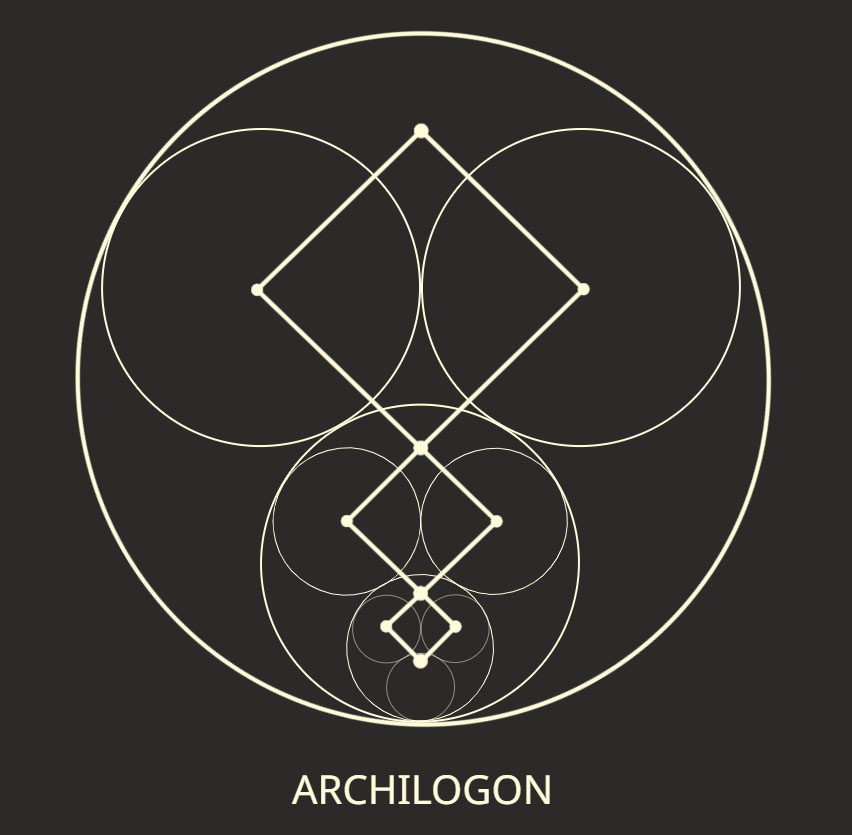
The difference is far from insignificant. Whereas Nature is a generic term, Cosmos does not simply mean “the order of the world”. It is the name given by the Pythagoreans to the archetypal diagram through which those initiated into Sophia imposed a mathematical and geometrical order upon Nature.
Through that diagram, Plato also learned Pythagoreanism and assimilated its logic. He would later describe it cryptically in the Psychogony of the Timaeus. He probably did not assimilate the entire system at once, and the Dialogues may reflect the successive stages of his gradual reconfiguration.
It therefore appears clear that Pythagoreanism and Platonism are inseparable in their logical foundations, even though they may diverge in certain conceptual developments. Different Concepts may be “grafted” onto the same Forms. Those Concepts, in turn, may be expressed through many different terms, multiplied further through translation into different languages and thereby rendering written testimony rather unreliable.
Language fluctuates across time and space. Forms, by contrast, are stable and eternal.
In the next video, we shall attempt to address the delicate problem of Plato’s so-called Unwritten Doctrine.
“To the Principle!”