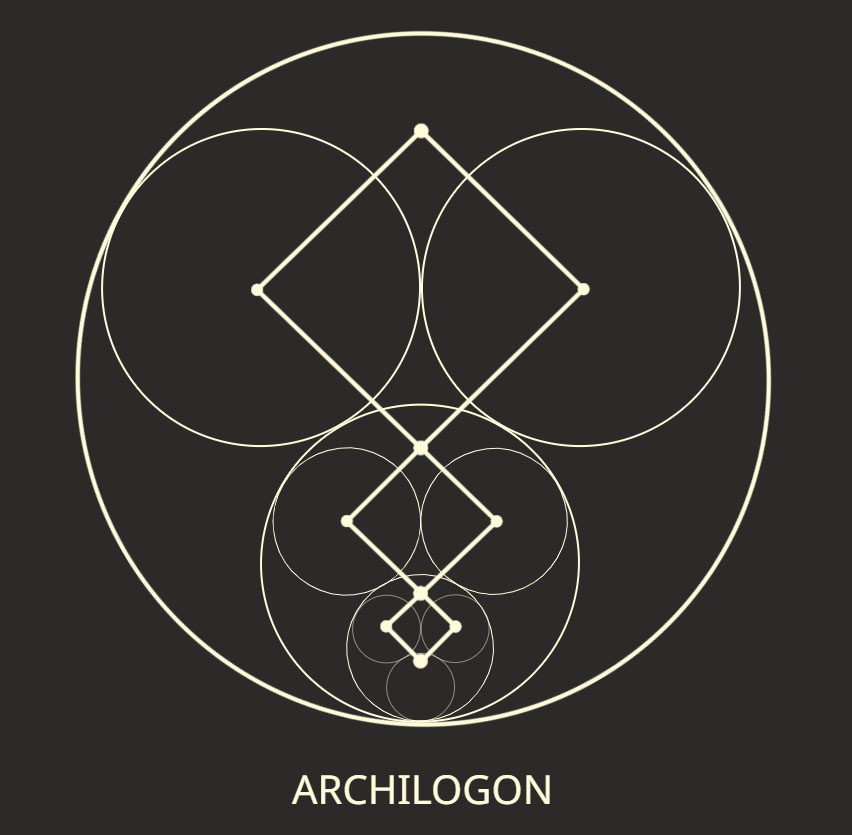
Archilogon 048 - 6. Academy - 7. The Critique of Language
In this video, Elias Artista addresses the problem of Plato’s so-called “Unwritten Doctrine”, accepting some of the conclusions of the Tübingen School while questioning the idea that orality constituted the privileged vehicle of Platonic doctrine. The criticism Plato entrusts to Socrates is directed not only at writing, but at Language understood as a flow of words, founded upon the fragile connection between Object, Concept, Sound, and Sign, and therefore exposed to ambiguity, deception, and relativism. Through the Phaedrus and, above all, the Cratylus, there emerges a contrast between the unstable and subjective human Logos and a “divine” Logos anchored in the Forms and therefore capable of grounding Episteme. The paradoxical etymologies of the Cratylus reveal what happens when the Sign loses every necessary relation to the Essence of the thing named: Objective Knowledge dissolves into Doxa. From this perspective, the need emerges to move beyond the traditional opposition between writing and orality by assigning a central role to a third instrument: the diagram. True Platonic knowledge would therefore be grounded not in words, but in the contemplation of the Formal Relations that structure the Intelligible World.
Archilogon – The key to Synthetic Logic. A project by Elias Artista.
Bibliography
Works Cited
- Plato, Phaedrus, 275c and 274e.
- Shane M. Ewegen, Plato’s Cratylus - The Comedy of Language, Indiana University Press, Bloomington & Indianapolis, 2014, p. 122.
- John Sallis, “The Flow of φύσις and the Beginning of Philosophy: On Plato’s Theaetetus”, in Proceedings of the Boston Area Colloquium in Ancient Philosophy, Vol. XX, eds. J. Cleary and G. Gurtler, Brill, Leiden, 2005.
- Plato, Cratylus, 415d-e and 439a.
Further Reading
- Thomas A. Szlezák, Platone e la scrittura della Filosofia, Vita e Pensiero, Milan, 1988.
- Konrad Gaiser, La Dottrina Non Scritta di Platone – Studi sulla fondazione sistematica e storica delle scienze nella Scuola Platonica, Vita e Pensiero, Milan, 1994.
Video transcription
With regard to the notorious “Unwritten Doctrine”, our position is broadly aligned with the conclusions of the Tübingen School. We are convinced, in other words, that Plato developed far more within the Academy than he committed to the Dialogues. Our interpretation nevertheless diverges, for example, from that of Thomas Szlezák, according to whom Plato entrusted the most precious achievements of his doctrine to oral discourse.
Four substantial reasons lead us to doubt that orality was his privileged instrument of teaching.
First. Oral discourse, no less than writing, is capable of concealing the truth and often performs a deconstructive function in the Dialogues. The character of Socrates, for example, devotes himself to verbally "dismantling" what has been verbally constructed elsewhere.
Second. For Plato, Dialectic is not a rhetorical instrument, but the driving force of his logic, as we shall see in the Parmenides.
Third. For Plato, it is sight, not hearing, that provides access to philosophical truth, as passage 47a of the Timaeus attests.
Fourth. Plato’s refusal to eternalise through Signs those things that are “truly important” conflicts with his intense striving towards Episteme: the pursuit of knowledge that is stable and eternal, embodied in the Ideas/Forms.
In essence, those who emphasise orality tend to undervalue the visual dimension, which is extraordinarily prominent in Plato. Since it would make little sense to teach orally a doctrine constructed upon geometrical entities, we argue for the centrality of a third element, situated between written and oral discourse. In our view, only Konrad Gaiser has adequately analysed the importance of this element: the diagram, which offers an alternative to the stark choice between writing and orality.
The thought that a philosopher might regard verbal discourse and writing as misleading, if not positively harmful, appears rather disconcerting to us moderns, "immersed" as we are in words. This is especially so when the criticism comes from someone who left behind so many written works.
To understand this problematic position, we must return to the words of Socrates in the Phaedrus:
"Anyone who believes that an art can be transmitted by entrusting it to the alphabet, and anyone who receives it in the belief that something precise and permanent can be derived from writing, must be truly naïve."
Through Socrates, Plato speaks here of the alphabet: discourse conveyed by words, signs arbitrarily associated with sounds. It is one thing to transmit precise and permanent knowledge, an activity that Plato undoubtedly regards as highly valuable. It is quite another to attempt to eternalise truth through a mere association of letters and sounds, that is, through the phonetic alphabet which, according to the legend recounted in the Phaedrus itself, was the worst of Thoth’s inventions. Thoth is the Egyptian archetype of the Greek Hermes:
"When the discussion turned to writing, Thoth said to Thamus: 'This invention, O King, will make the Egyptians wiser and improve their memory, for it is a remedy for memory and wisdom.' The King replied: 'Most ingenious Thoth, one person possesses the ability to invent, while another possesses the ability to judge what harm or benefit those who use an invention will derive from it. Now, because you are the father of writing, your affection for it has led you to say the opposite of its true effect. The invention of writing will produce forgetfulness in the souls of those who use it. Trusting in writing, they will grow accustomed to recalling signs written by others upon external supports, instead of rediscovering within themselves what is already present there. You have therefore provided not a remedy for memory, but merely for repetition. In this way, you will give your pupils the appearance of wisdom, not its truth. Because of you, they will become mere hearers of worthless notions and will believe that they know many things which, in reality, they do not comprehend. It will therefore be difficult to converse with them, because they will become ‘collectors of opinions’ rather than wise.'”
In this story within the story, Plato expresses a criticism of Language understood as “discourse”, as a flow of words. Because of the alphabet, human beings are destined to become not wiser, but merely more erudite: mere collectors of futile notions, or of notions they do not comprehend, mere accumulators of disconnected knowledge.
The purpose of the Platonic Academy is not to produce erudite scholars, but autonomous, thinking individuals. The words of others, when memorised and repeated mechanically, impede individual development. One must therefore free oneself from them as soon as possible, activating a personal process of Anamnesis in order to reach, within oneself, the roots of knowledge: the Ideas/Forms.
The limitations of Language understood as “discourse” erupt with full force in the Cratylus, where it becomes clear that words are inherently incapable of grounding Episteme, or Objective Knowledge.
The Hermes mentioned in the dialogue is an interpreter, a messenger, a thief, and a deceiver, and these qualities are transferred to one of his inventions. Like the hybrid figure of Hermes, Language possesses two aspects: a divine aspect, which conveys truth, and a human aspect, which is not always trustworthy. One must be capable of distinguishing between them, something that, according to Plato, only a true philosopher can do.
Those who fail to perceive the divine aspect remain confined to the human dimension of Language. They are consequently trapped in a state of flux, incapable of attaining true knowledge.
If Language possesses the power to deceive, our subjective interpretations cannot be considered reliable. In the Cratylus, Plato therefore stages his comedy of etymologies, which Socrates himself will describe as “a farce”.
Shane Ewegen writes:
"The comedy of etymologies reveals, in a tragic sense, the way in which human beings are bound to the human Logos. Although Socrates and Hermogenes attempt to discover the correct names of things, assuming that these coincide with the 'divine', and therefore real, names, the etymological game ultimately reveals that human beings are entirely immersed in “human names”: names created by human beings according to their all-too-human opinions. In other words, because Socrates and Hermogenes are bound to the human Logos, they are fundamentally incapable of reaching the divine names they seek, while remaining unaware of their own incapacity. Through a comic etymological performance, Socrates thus reveals the tragic character of human names and the pragmatic necessity from which they arose. The situation becomes tragic, however, only when the Logos remains merely human: when it is so pervaded by falsehood that it remains wholly severed from the true Logos of the Gods."
Through the Cratylus, as he had already done in the Theaetetus, Plato continues his campaign against the relativism of Protagoras. If every entity is something different for each person who perceives its appearance, Language loses its reliability. What one person calls “hot”, another will call “cold”, and so forth.
The consequence is that two people, each possessing a different level of comprehension, will never be able to meet upon common ground. As John Sallis observes, in this world of radical flux, nothing remains the same for long enough to allow the Logos to attach to it a single stable and true name. In such a world, true knowledge becomes impossible.
Taking this vision to its furthest consequences, Plato presents, in the etymological section of the Cratylus, a representation of what such relativism would entail. The delirious etymologies display the triumph of Doxa: a stream of words interpreted according to arbitrary criteria so questionable that they can even generate opposing etymologies.
All this belongs to Subjective Knowledge. If, according to Protagoras, “man is the measure of all things”, the Sign can no longer be applied stably to the entity it is intended to signify. Language disintegrates, reducing the essence of things to mere appearance.
Amid the vertigo of the etymologies, Socrates shows Hermogenes, and the reader, that the original act of naming may be reduced to a matter of preference, and may then be transmitted arbitrarily through the authority attributed to the first “name-givers”. Relativism therefore destroys Objectivity. With it, the distinction between truth and falsehood collapses.
This is why the power to give things their correct names should not be granted to everyone, but only to those capable of knowing the true characteristic of the thing being named: its Essence.
The creator of names should be a kind of “technician of Language”, capable of forging a name that captures the Essence of the thing named. Just as a tool is shaped according to its purpose, so the name must be guided by the function performed by the thing within the Whole of which it forms a Part.
The fanciful etymologies of the Cratylus refer to something that must have appeared incongruous and exaggerated to contemporary readers: a game that cannot be reproduced in modern translations. Plato seeks to make Relativism appear ridiculous, particularly in those passages where Socrates adds letters to words or removes them at will.
In his dialogue with Hermogenes, Socrates anticipates the reader’s possible objection with a knowing wink:
"You might now tell me that this is yet another case in which I am inventing something. But I would reply that, if what I previously said about the word “vice” is correct, then what I am now saying about the word “virtue” must also be correct."
In essence, once the arbitrary attribution accepted for contingent reasons is admitted as valid, anything becomes valid.
We must therefore ask ourselves whether there is any means of escaping the relativism of Language. Socrates suggests that Being may truly be known through something other than words:
"If it is true that things may be known both through their names and through their Essence, which form of knowledge should be preferred? Should we know the Essence through its name, assuming that the name faithfully represents the truth of which it is an image? Or should we know the truth of the Essence directly, and then apply to it a name that represents it adequately?"
As readers, we might expect Socrates to say something about the method by which this truth may be reached, yet we are disappointed. The interlocutors Plato has chosen for this dialogue are not yet capable of receiving such knowledge. Their role is merely to instil doubt in the reader.
Socrates delights in uprooting established opinions, leaving the interlocutor’s soul empty, yet prepared to rediscover a new truth “by itself”, provided that the interlocutor genuinely desires to seek it and does not merely use knowledge to obtain petty material advantages.
It is therefore evident that Plato does not reject Language in its entirety. He is searching instead for a language that cannot lie as the words of the Sophists can, a language not conveyed by discourse, that is, by sounds artfully fashioned to serve concealed purposes.
What he discovers is the “divine” aspect of Language: that which is anchored in the Forms. For the Intelligible World, as we should remember, is not made of words: it is made of Forms.
What Plato does not permit his Socrates to reveal is, in all probability, the outcome of Pythagorean diagrammatic speculation. He may have made this choice after discovering within the Academy how difficult it was for an empirical consciousness, such as Aristotle’s, to accept that a simple geometrical figure might be the key, capable of unlocking Noesis: the “comprehension of Reality”.
"To the Principle!"