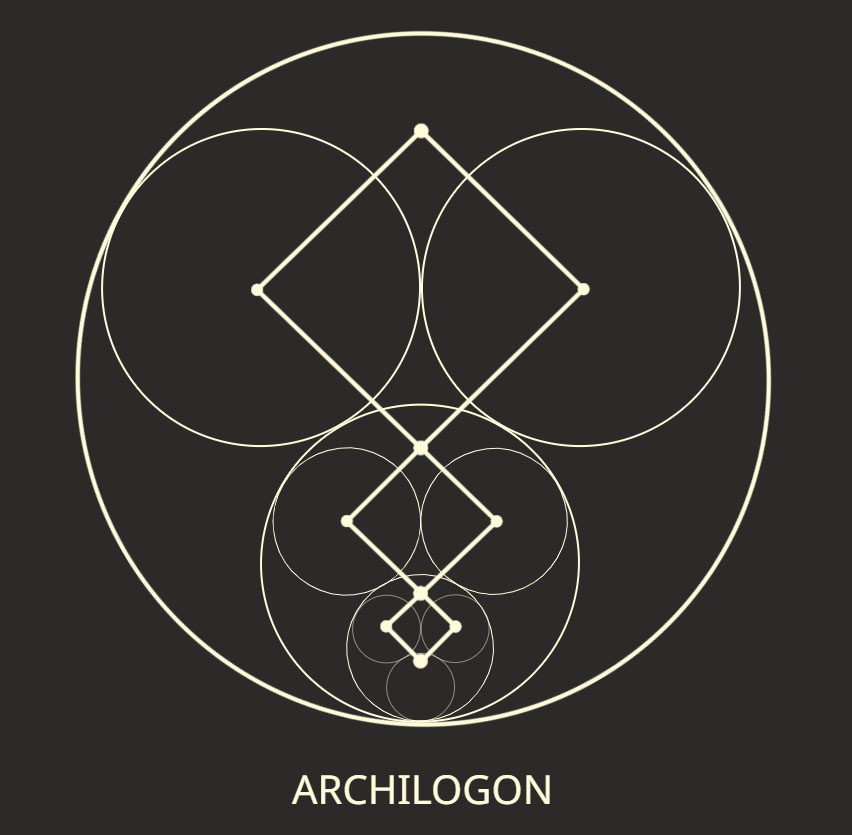
Archilogon 049 - 6. Academy - 8. Anamnesis and Synopsis
In this video, Elias Artista explores the function of Anamnesis in Platonic philosophy, interpreting it not as the mere recollection of already formulated knowledge, but as the rediscovery of logical Forms that consciousness can recognise even before it possesses the words with which to express them. Socratic dialogue performs a predominantly maieutic and deconstructive function: by dismantling the certainties constructed through language, it prompts the interlocutor to turn inwards. Anamnesis is followed by Synopsis, the synthetic act through which the individual Forms are apprehended simultaneously, each in the position it occupies within the archetypal diagram. Only through this comprehensive vision can the Ideas emerge as the conceptual correlates of the Forms. On this basis, Elias Artista advances a radical thesis: the core of Platonic knowledge resides not in words, whether written or spoken, but in the contemplation of a diagram. The comparison with Aristotle reveals a profound divide between two antithetical logics: the spatial and symbolic Synthetic Logic of Pythagoras and Plato, and the linguistic and decompositional Analytical Logic of Aristotle.
Archilogon – The key to Synthetic Logic. A project by Elias Artista.
Bibliography
Works Cited
- Plato, Theaetetus, 189a.
- Ludwig C. H. Chen, Acquiring knowledge of the Ideas: A Study of the methods in Plato's Phaedo, Symposium & Republic, Steiner, Stuttgart, 1991, p. 21.
- Asclepius of Tralles, In Aristotelis Metaphysicorum libros A–Z commentaria, ed. M. Hayduck, CAG VI.2, Berlin, Reimer, 1888, p. 34, lines 3 ff., and p. 40, lines 10 ff.
- Dario Antiseri, “Introduzione”, in Aristotele – De Interpretatione, ed. D. Antiseri, Minerva Italica, Bergamo, 1970, p. 37.
Further Reading
- Plato, Meno.
- Plato, Phaedo.
Video transcription
In the previous video, we rejected the idea that Plato entrusted the heart of his doctrine to oral teaching. From what emerges in the Dialogues, oral discourse appears to be a means of unsettling the interlocutor’s fragile certainties and, with the aid of expert guidance, awakening the desire to search within oneself for answers that lie deeper than words.
An example of this method of demolition and maieutic reconstruction can be found in the Theaetetus. During an extended enquiry into Knowledge, Socrates leads Theaetetus to recognise the inadequacy of the positions from which he began:
“We did not begin our discussion in order to discover what Knowledge is not, but what it is. Nevertheless, we have made some progress.”
“Quite so. And this, Socrates, if I have understood correctly, is what is called ‘an exchange of opinions’.”
“You have understood correctly, my friend. So now erase everything that has been said before. Having reached this point, begin again and try to discover something more. Tell me, then, once again: what is Knowledge?”
In the exchange of opinions, oral discourse thus performs a predominantly deconstructive function. This is not because dialogue lacks any positive value, but because truth cannot be conveyed through the words of the teacher: the interlocutor must attain it — or regain it — through a logical transformation.
By demolishing the “certainties” conveyed by natural language, and through the tabula rasa that Socratic scepticism produces with irony and determination, the interlocutor is led to turn his attention inwards. He is thereby placed in a position to bring to light those elementary Formal Relations which, from the Platonic perspective, the soul possesses prior to any experience.
Plato calls this process of introspection Anamnesis. Ludwig Chen writes:
“Anamnesis consists in the recollection of knowledge originally acquired before the incarnation of the soul in a human body, that is, before the birth of the individual. In the Meno, the theory of Anamnesis serves to establish the thesis of learning: the soul’s pre-incarnational possession of knowledge. In the Phaedo, by contrast, its principal function is to demonstrate the soul’s pre-incarnational existence.”
The most celebrated example of Anamnesis occurs in the Meno. Here, an uneducated young slave is invited by Socrates to solve a geometrical problem. At first, the boy answers incorrectly. He then recognises his mistakes and, through a succession of questions, eventually comes to understand the solution.
The slave in the Meno has never studied Geometry. It is therefore legitimate to ask where his ability to understand Formal Relations, proportions, equalities, and differences comes from, even before he possesses the technical language with which to name them. Plato thus demonstrates the existence of pure Intuition: the ability spontaneously to recognise certain Relations between Forms without having previously learnt them.
At this point, however, we must emphasise an essential distinction. Within what tradition encompasses under the terms eidos and idea, we must distinguish the Form from the Idea.
A Form is a pre-conceptual structure: a pure Spatial Relation that can be represented geometrically. An Idea, by contrast, is the conceptual correlate produced when the philosopher assigns a meaning to that Form within a specific structure.
From this perspective, Anamnesis does not lead immediately to already formulated Ideas. It first restores the Forms and their Relations to consciousness. The Ideas emerge only at a later stage, when those Forms are observed in their reciprocal positions, in their interplay of dialectical oppositions, and are interpreted conceptually.
Pure Form, in the specific sense adopted in the Archilogon, is a Relation rendered spatially intelligible by Geometry. Forms, however, do not appear in isolation, for in isolation they would carry no meaning. Throughout history, the masters of Sophia have arranged archetypal Forms within a complex and dynamic structure.
To understand how the Parts relate to one another within the Whole, it is therefore not enough to consider them separately: they must be viewed together. What is required, in other words, is a synoptic vision.
Synopsis is the synthetic cognitive act through which consciousness simultaneously contemplates the Forms and the Relations connecting them within the diagram. If Anamnesis brings to light the formal elements while they are still apprehended separately, Synopsis allows them to be understood within a complete and self-sufficient structure.
Through this comprehensive vision, the philosopher can arrive at the Ideas, understood as the conceptual correlates of the Forms. This is achieved by assigning to each form in the diagram — a point, a line, a circle — a Concept appropriate to the Relation expressed by its position, according to the particular field under consideration, whether humanistic, scientific, or theosophical.
This clarifies Plato’s mistrust of Language. If fundamental metaphysical knowledge consists in the contemplation of archetypal Formal Relations, then what is essential can, at least in principle, be expressed through a diagrammatic structure.
Our reconstruction of Synthetic Logic has therefore led us to formulate a radical thesis: the core of Platonic truth was not primarily contained in discourse, but in a structure of Relations capable of diagrammatic representation.
This is because the diagram possesses a force, stability, and truth that discourse lacks. Its internal Relations cannot be altered arbitrarily without destroying the completeness of the system.
Unlike Forms, words are sounds or Signs associated with Concepts. Their connection with what they are intended to express does not arise from mathematical necessity, but from linguistic conventions, historical transformations, and contingent usage. The same word may change its meaning as it passes through different cultures, losing some associations and acquiring others.
Language is plastic, and this very plasticity makes it a dangerous instrument of persuasion. The most skilful rhetorician wins over an audience through his talent for combining words and appealing to emotions, expectations, and convictions. This ability to separate the persuasive force of discourse from the necessity of truth makes Rhetoric dangerous and suspect in Plato’s eyes, and explains his long polemic against the Sophists.
The diagram does not persuade: it shows. It need not undergo translation from one language into another. Nor does it depend upon the historical meanings of words. Anyone who contemplates it can recognise within it a logical structure independent of the language in which it will subsequently be explained.
If the tradition concerning the inscription placed at the entrance to the Academy preserves at least a kernel of truth, then the requirement imposed upon those wishing to advance into Platonic enquiry was the ability to reason “geometrically”: to activate a “spatial” rather than a “linguistic” mode of understanding. This did not mean simply knowing Geometry as a technical discipline, but being capable of thinking through Spatial Relations.
This point becomes especially important when confronting the “Aristotle problem”. If different levels of access to teaching existed within the Academy, then Aristotle’s position in relation to this inner core must be reconsidered.
Aristotle was no Sophist, and we must acknowledge in him the intellectual integrity of a true scientist. Yet he misunderstood the Pythagoreans because he failed to recognise that they expressed themselves symbolically and spatially. Let us reconsider this testimony from Asclepius of Tralles:
“The Pythagoreans did not wish to make their knowledge accessible to everyone and, for this reason, transmitted their teachings in symbolic form. Those who confine themselves to the apparent meaning therefore risk misunderstanding them.
The Pythagoreans did not intend to claim that natural things are materially composed of Numbers. Numbers possess the property of determining and delimiting what is numbered; and the same function belongs to Forms, which determine and organise matter. Through Numbers, therefore, the Pythagoreans intended symbolically to indicate Forms, not matter.
Aristotle, by contrast, invariably demands that doctrines be expounded with precision. He consequently reproaches the Pythagoreans for expressing themselves symbolically instead of employing precisely defined terms, and ends by criticising them as though their assertions were incorrect. Our teacher Ammonius never shared this judgement.”
The testimony of Asclepius, who records and reworks the lectures delivered by Ammonius Hermiae on Aristotle’s Metaphysics, is of the greatest importance. Ammonius represents an ancient exegetical tradition that was conscious of a profound hermeneutic divide between Aristotle and Plato.
What emerges clearly is a profound difference in logic between two contrasting personalities. Plato regards words as provisional instruments whose meaning must be traced back to something more stable. Aristotle, by contrast, assigns Language a decisive role in the construction of knowledge and subjects terms, propositions, and inferences to meticulous analysis.
Dario Antiseri writes:
“Plato is not greatly concerned with the word, which is an organon, that is, an instrument: what interests him are things and Ideas, rather than the verbal instruments used to evoke them. Aristotle, for his part, is convinced that attention to language, in its function as the faithful messenger of ‘the passions of the soul’, is of decisive importance both in the construction of Science and in the formation of a well-ordered city. It is precisely on the terrain of language that one can defeat the scepticism which seeks to undermine both Science and the foundations of morality.”
Aristotelian Analytical Logic is founded upon the decomposition of discourse into its constituent elements, the differentiation of terms, the structure of propositions, and the conditions under which an inference can be valid.
Plato, by contrast, does not trust the stability of terms. Precisely because words can be associated, separated, and recombined in different ways, they remain ambiguous and potentially deceptive instruments.
If, then, Aristotle was unable to conform himself to the Pythagorean logic that Plato had assimilated, his role within the Academy must be reconsidered. Not in order to diminish his greatness, but to understand the position from which he observed and judged Plato.
“To the Principle!”