Archilogon 050 - 6. Academy - 9. The Paradox of Contemplation
In this video, Elias Artista calls into question one of the most celebrated yet least explained formulas in the Platonic tradition: the claim that the philosopher “contemplates” the Ideas. Replacing this verb with expressions such as “intuit”, “grasp intellectually”, or “see through the Nous” does not explain what operation is actually being performed, nor does it allow contemplation to be distinguished from subjective illusion. Drawing on the original meaning of theōria and the reconstruction proposed by the Archilogon, contemplation is interpreted as the synoptic vision of the archetypal diagram: a geometrical structure composed of points, lines, and circles, which renders visible the positions and invariant relations of the Forms. The video thus introduces Pythagoras’ Partition of the Whole, the dialectical passage from Unity to Multiplicity, and the method of Structural Deduction, showing how a single formal architecture could unify the different disciplines cultivated within the Old Academy.
Archilogon – The key to Synthetic Logic. A project by Elias Artista.
Bibliography
Works Cited
- Andrea Wilson Nightingale, Spectacles of Truth in Classical Greek Philosophy: Theoria in Its Cultural Context, Cambridge University Press, Cambridge, 2004, pp. 3–4.
Further Reading
- Konrad Gaiser, La Dottrina Non Scritta di Platone – Studi sulla fondazione sistematica e storica delle scienze nella Scuola Platonica, Vita e Pensiero, Milan, 1994.
- Eliane Christina Souza, “Contemplação das Formas e os limites do conhecimento no Fédon e no Banquete”, Philósophos, 19/2, 2014.
- Peter Pesic, “Seeing the Forms”, Plato Journal, 7, 2007.
Video transcription
For more than two millennia, one of the most familiar expressions in Platonic philosophy has been that the philosopher “contemplates” the Ideas. The formula has become so familiar that it now seems self-explanatory. Yet since our approach to Plato is wholly rational, we cannot evade a basic question: how is it possible to “contemplate” abstract entities such as the Ideas/Forms?
Terminology cannot solve the problem. Replacing “contemplate” with “intuit”, “grasp intellectually”, “see through the Nous”, or “experience a noetic vision” does not explain the process: it merely renames it. Andrea Wilson Nightingale writes:
“The highest form of wisdom is theōria, the ‘rational vision’ of metaphysical truths.”
The explanation has always formed a closed circle: the Ideas are known by the Nous because the Nous contemplates them; to contemplate them is to grasp them intellectually; to grasp them intellectually is to experience a noetic vision. Each expression points to another, yet none explains what operation is being performed, what its concrete object is, or what distinguishes it from mystical illusion.
Contemplation thus comes to function as a liturgical formula: it does not solve the problem of how the Ideas are known, but removes it from inquiry by cloaking the answer in an aura of sacredness.
Plato presents “contemplation” as the supreme act of philosophical knowledge. Tradition has transformed the act — theōria — into a conceptual operation, despite Plato’s persistent use of visual terms to describe it: theōreîn, theâsthai, horân, ideîn, katideîn, blépein.
As Nightingale explains, the Forms are at once alien and familiar to the person who contemplates them. On the one hand, they are superhuman and divine; on the other, they possess a kinship with the Psyché, which is able to recognise within the intelligible order a structure akin to its own. Nightingale speaks of singhèneia, that is, a relation of kinship.
In our view, however, this does not indicate a derivation of the human from the divine, but a structural affinity. The Psyché, when educated by Philosophy, becomes capable of recognising in the Intelligible World the logical structure of Reality. Contemplation is therefore not contact with something wholly alien, but the recognition of a single underlying matrix.
Following this contact with the Forms, the philosopher performs an operation rooted in the etymology of the term “Theory”. In traditional theōria, an individual known as a theōrós would leave his own city, travel to a sanctuary, oracle, or religious festival, witness a sacred spectacle, and then return to his community to give a public account of what he had seen.
The philosopher, then, is a theōrós who, after contemplating the Forms, returns and recounts what he has seen. In other words, he submits his account to the examination of others. To do so, he must necessarily translate the Forms into communicable content. He must transform the Form into a Concept, and then the Concept into a Sign.
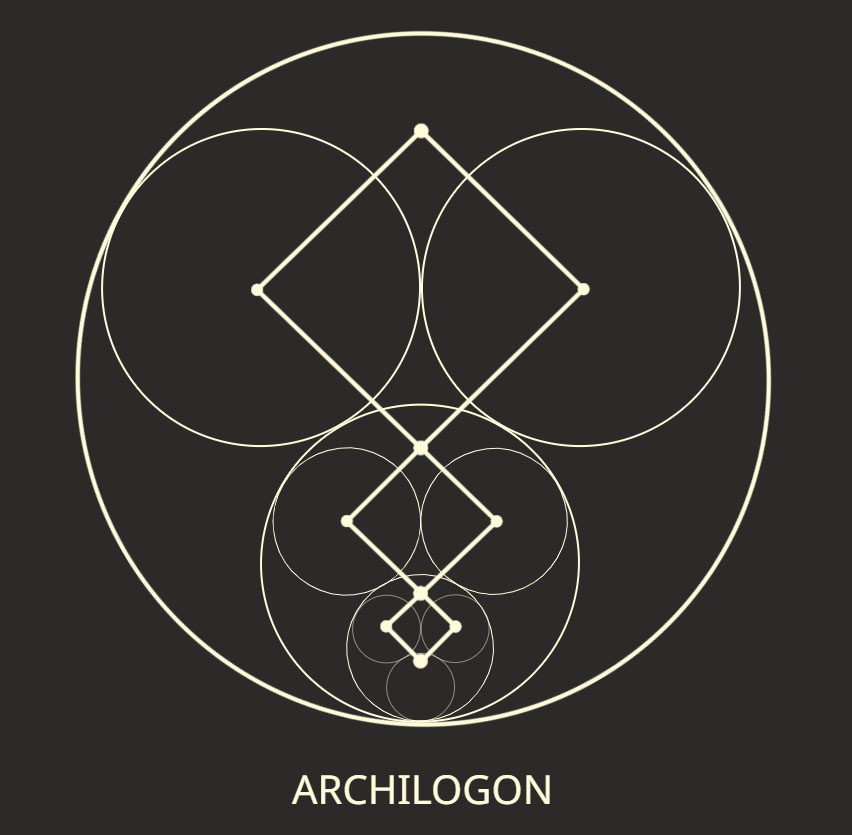
But what does the philosopher see? According to the reconstruction proposed by the Archilogon, he does not contemplate isolated intelligible objects, but a structure composed of points, lines, and circles: geometrical elements that render visible the positions and relations of the Forms.
In the Republic, the Divided Line distinguishes between different cognitive stages, yet the spatial character of this construction is mistakenly reduced to a mere teaching aid. The Line, by contrast, is a rigorously constructed schema in which the division of the segments follows the same proportional ratio.
Socrates states that Dialectic leads from Dianoia to Noesis, ascending from hypotheses towards the non-hypothetical principle. Yet he does not explain what operation enables the philosopher to contemplate the Forms and recognise their order. This omission is far from marginal: it is the void situated at the very centre of the system.
That void can be filled by returning to the logical roots of Pythagoreanism, as they emerge from the reconstruction of Synthetic Logic. The first answer is this:
To “contemplate” the Ideas means, first and foremost, to recognise the Forms within the archetypal diagram.
Yet even this is not enough. To understand why a diagram and a synoptic vision of its internal elements are necessary, we must return to an original problem posed by Pythagoreanism, which may be summarised in the following question:
Is it possible to “decompose” something that eludes our grasp — in this case, Reality conceived as a Whole — into the smallest number of Parts that are logically meaningful to the human mind, so that the intellect may grasp every stage of its process of transformation and assign a symbolic name to each Part?
The geometrical elements of the diagram — the Forms — arise from the need to determine the minimum number of articulations required for the Partition of the Whole to become thinkable and, subsequently, communicable through language, by means of words, symbols, or numbers.
The point of departure is therefore not experience, or the multiplicity of entities, but an ideal whole: the One, the All. The first decomposition of the Whole is dialectical: the fundamental opposition between Unity and Multiplicity. Multiplicity is not added to Unity from without; it is Unity viewed under another aspect and situated within itself. This is the greatest difficulty involved in understanding Synthetic Logic.
This decomposition proceeds through further oppositions and distinguishes thirty-two articulations, while preserving the nexus that constitutes them as moments within a single process. Dialectic — the Logic of Oppositions — produces, within that continuity, a definite number of Forms without which the transformation could neither be conceived nor expressed.
The Form is the result of the logical decomposition of the Whole, both in the outward process from Unity to Multiplicity and in the return from Multiplicity to Unity. The Essence of the Form — that is, its function within Reality — is not created by the human mind. Through the diagram, however, the human mind isolates it and renders it thinkable.
Within the diagram, the Form is simultaneously: a position within the Totality; a stage of the movement; a relation to what precedes and follows it; a polarity in relation to its Opposite, whether Contrary or Correlative; and an internal transformation of the Whole.
We can therefore formulate a precise definition:
“The Form is an invariant determination obtained through the Partition of the Whole, identifiable spatially as a position within the diagram and temporally as a stage within the cycle of transformation.”
The possible states of a continuous transformation are theoretically infinite, but not all of them possess a distinguishable function. The diagram isolates only the structurally necessary stages: those that the human mind can recognise because they occupy a determinate position within the cycle and maintain invariant relations with the others.
The archetypal diagram is therefore not a mystical object. It is an instrument of determination that allows the structurally necessary moments of a cyclical process of transformation to be isolated.
We shall return to the Partition of the Whole at length in the chapter devoted to Pythagoras. For now, these brief indications are sufficient to understand the work undertaken by the members of the inner circle of the Old Academy.
Each Form within the diagram can be isolated analytically and assigned a definition. This definition arises from the function the Form performs within the structure. Yet the process does not produce a definitive and univocal vocabulary, because the Forms acquire their names according to the field of inquiry to which they are applied. Moreover, different languages and cultures may assign different names to the same Forms. Hence the need to identify them through symbols or numbers.
If the logical structure expressed by the diagram is archetypal, it does not belong exclusively to any single domain of Reality. By Analogy, the same formal oppositions can be reflected at different levels and produce different conceptual correlates within each discipline.
This also allows us to understand the diversity of expertise represented within the Academy: mathematicians, astronomers, musicologists, legislators, naturalists, and theosophists would all have reasoned through a common logical structure, isolating in each case the polarities and determinations relevant to their own field.
The academic community was therefore unified not by an encyclopaedia of shared content, but by a common instrument of Structural Deduction. Each Academic contemplated the same formal architecture and derived from it Ideas capable of establishing a fundamental structure for every discipline practised within the Academy.
The archetypal polarity between Unity and Multiplicity could manifest itself, analogically, as “Limit” and “Unlimited” on the mathematical plane; “Identity” and “Difference” on the logical plane; “Rest” and “Motion” in natural philosophy; and “Consonance” and “Dissonance” in harmonics.
This is the transdisciplinary ambition of Pythagoreanism: to begin with an archetypal opposition expressed by the diagram, recognise its function at a particular level of Reality, and arrive at the definition of objects that are not directly given to sensible perception.
The archetypal structure therefore functions as a generative matrix. It constrains the way in which concepts can be formed and brought into relation. From this follows a fundamental logical unity of human knowledge.
For the Archilogon, then, “contemplation” is the synoptic vision of the archetypal diagram that enables the philosopher to assign an Idea to each Form on the basis of the relations woven within the structure.
At this point, however, we cannot evade a historiographical question: how could the archetypal diagram have remained at the margins of Platonic exegesis for so long?
One possible answer is that, after Xenocrates, the diagram ceased to be transmitted in its organic form and survived only through fragmentary doctrines, isolated figures, and conceptual formulations that had become detached from the original structure.
A devotee of Platonism may be content to know that the philosopher “contemplates” the Ideas. The critical philosopher, however, must ask what this means, how it occurs, and by what criterion this act may be distinguished from a subjective illusion.
The task of the Archilogon begins precisely where the liturgical formula loses its hypnotic power and — once again — becomes a basic question.
“To the Principle!”