Archilogon 052 – 6. Academy – 11. One Reality, Two Logics
In this video, Elias Artista addresses one of the central problems of ancient exegesis: can Plato and Aristotle be reconciled? Through an analogy with Grammatical Analysis and Logical Analysis, the video interprets the two philosophers as representatives of distinct yet complementary approaches to Reality. Aristotle classifies Phenomena according to their Properties; Plato, by contrast, investigates Formal Relations and the functions performed by the Parts within the Whole. This distinction makes it possible to address the difficult relationship between the Sensible and Intelligible Worlds posed by Plotinus: their heterogeneity does not prevent their correlation, but constitutes its dialectical condition. The video thus clarifies the difference between the “existential” judgement of Science and the “spiritual” judgement of Philosophy, showing why Scientists and Theosophists could coexist within the Platonic Academy without contradiction. The subsequent separation of these two approaches would give rise to the great paradigms of Aristotelian Ontology and Platonic Henology.
Archilogon – The key to Synthetic Logic. A project by Elias Artista.
Bibliography
Works Cited
- Plato, Phaedrus, 270c–d.
- Aristotle, On the Soul, 402b, 26.
- William James, The varieties of religious experience – A study in human nature (Centenary Edition), Routledge, London/New York, 2002, pp. 9–10.
- Plotinus, Enneads, VI, 3, 1.
- Riccardo Chiaradonna, Sostanza, Movimento, Analogia – Plotino critico di Aristotele, Bibliopolis, Naples, 2002, pp. 308–309.
Further Reading
- Plato, Phaedo.
- Iamblichus, On the Mysteries, I, 3–5 and I, 8.
Video transcription
Plato has no interest in the investigation of Phenomena, as the biographical remarks in the Phaedo make clear. Aristotle, for his part, regards Plato’s Pythagoreanism as empty and inconsistent. The world cannot be known, he argues, by turning one’s gaze inwards. We must observe the things before our eyes and formulate correct judgements about them.
Can Plato’s vision be reconciled with Aristotle’s? This is one of the great questions debated by ancient exegetes. As our account proceeds, we shall examine some of the positions historically adopted. We shall begin, however, from our own perspective: that the two doctrines address different objects and represent complementary approaches to the study of Reality, just as Philosophy and Science are complementary.
To clarify this claim, we shall propose an analogy that illuminates, from an idealist perspective, the distinctive epistemological role of Philosophy. The opposition between Analytical Logic, which seeks to describe the Sensible World, and Synthetic Logic, which seeks to describe the Intelligible World, can be clarified through a linguistic parallel: the distinction between Grammatical Analysis and Logical Analysis, two complementary approaches to the understanding of Language.
Grammatical Analysis concentrates on the individual words within a sentence, classifying them according to grammatical category: Noun, Verb, Adjective, and so forth. Logical Analysis, by contrast, concerns the Relations that words, as Parts, establish within the sentence as a Whole, focusing upon the meaning and logical coherence of the statement. This second form of analysis shows how elements belonging to the same grammatical categories may perform different functions within the structure of a statement, and thereby contribute to the formation of its meaning.
With his empirical approach, Aristotle may be regarded as a precursor of Grammatical Analysis. His doctrine rests upon the division of Phenomena into classes according to sensible or evident Properties. Plato, by contrast, may be regarded as a precursor of Logical Analysis, because, for him, the meaning of words emerges from the Relation established by grammatical elements within the sentence as a whole.
Platonic analysis seeks to grasp these Formal Relations, which cannot be found within the individual words themselves, that is, within the Phenomena. The archetypal Formal Relation at the heart of idealist thought is the dialectical Relation between Unity and Multiplicity, or between Subject and Object.
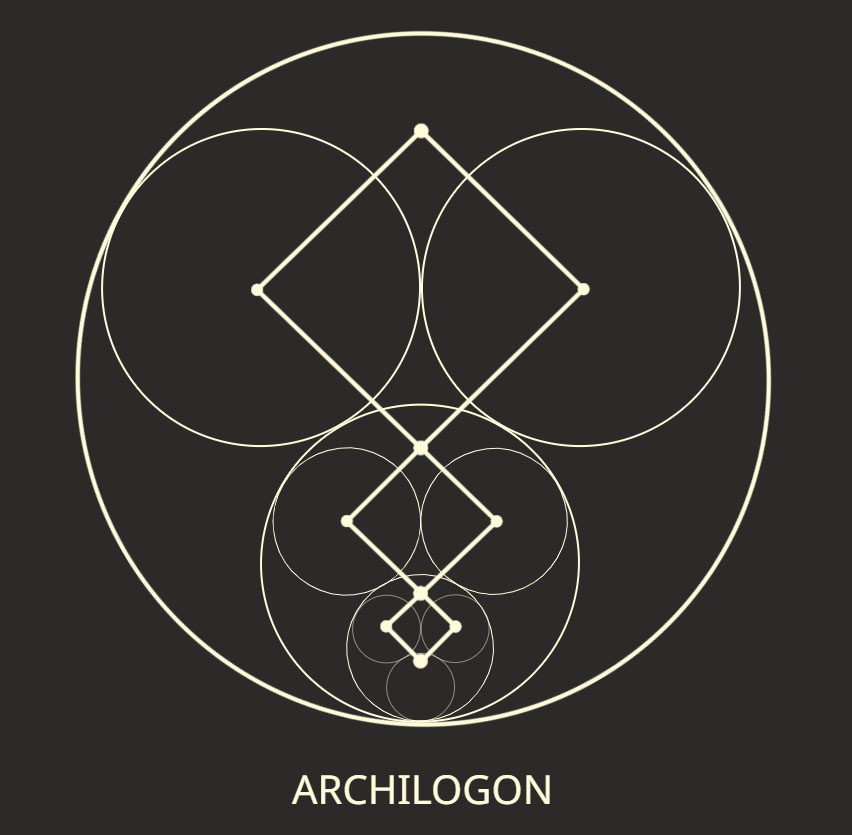
These archilogical diagrams illustrate our proportional analogy. On the basis of the archetypal dialectical opposition, Logical Analysis stands to Grammatical Analysis as Subject stands to Object.
Here is an illuminating passage from the Phaedrus, in which Plato has Socrates briefly summarise the mechanism of Dialectic:
“Remember what Hippocrates says about authentic logic, and about the method in which we ourselves wish to become proficient and to make others proficient. In every field, we must first distinguish the Whole and its Parts. Secondly, within the Whole, we must examine their functions, determining what may serve as Subject and what as Object. Then, after dividing them into further Parts, we must consider each Part as a unity and determine what may serve as its Subject and what as its Object.”
We have deliberately transposed this passage from Plato into the vocabulary of the Archilogon, because classical translations, failing to discern the outlines of Synthetic Logic and its archetypal dialectical mechanism, do not allow the true nature of the message to emerge.
In essence, dialectical decomposition is a progressive binary decomposition of the Whole, in this case into a unitary Subject and a multiple Object. The two, however, cannot be kept apart by the Principles of Identity and Non-Contradiction, since each refers to the other, and they are correlated according to the Principles of Reciprocal Implication and Relativity.
The problem is this: Grammatical Analysis and Logical Analysis are both necessary to understand Language, yet they constitute two approaches that cannot be hybridised. Individual words may be replaced while the overall meaning remains unchanged. Meaning is independent of the Properties of Phenomena because it rests upon their Relations.
The Parts, the objects of Heraclitean fluidity, are interchangeable; the Whole, the subject of Parmenidean immutability, is not. Yet words, despite being fluid and interchangeable, are absolutely necessary to the sentence. This is the meaning of Plato’s objection to Parmenidean monism: the Whole cannot render “unreal” the Parts through which it is articulated.
For Aristotle, who adopts a “philological” approach, only words are Substance. As an empiricist, he begins from the fact that they exist and can be perceived objectively by everyone, as a passage from On the Soul makes clear:
“The starting point of every demonstration is the ‘what it is’ of the thing. Hence all definitions that neither enable us to know its properties nor make them easy to conjecture have plainly been formulated in a dialectical and empty manner.”
Plato, by contrast, adopts a “hermeneutic” approach and seeks to identify the Eidos, that is, the function performed by words — Subject, Object, Complements — because the Parts acquire meaning only in relation to the Whole.
William James helps us to understand the nature of these two approaches:
“Two orders of inquiry must be distinguished with regard to anything whatsoever. First: ‘What is its nature? How did it come into existence? What are its constitution, origin, and history?’ And second: ‘What is its importance, meaning, or significance, now that it exists?’ The answer to the first question is given in an ‘existential’ judgement or proposition. The answer to the second is a proposition of value, what the Germans call a Werthurtheil, which we may, if we wish, call a ‘spiritual’ judgement. Neither judgement can be immediately deduced from the other. They arise from different intellectual concerns, and the mind combines them by first separating them and then adding them together. Existential facts alone are insufficient to determine value; the finest representatives of advanced criticism therefore never confuse the ‘existential’ question with the ‘spiritual’ one.”
Whereas Aristotle asks, “What is it?”, thereby formulating an existential question, Plato asks, “What does it mean?”, thereby formulating a spiritual one. It is precisely this demand for meaning that distinguishes Philosophy from Science.
The fundamental elements of the two systems — Categories-Predicaments and Ideas-Forms — thus emerge as epistemological instruments of classification that are entirely distinct from one another. We shall discuss this extensively in the chapter devoted to Methexis, but we may already introduce a difficulty that would come to characterise Neoplatonism.
Plotinus maintains, on the one hand, that the Sensible World depends upon Intelligible Reality and cannot be properly understood in isolation from its causality. On the other hand, he maintains that the two Worlds are heterogeneous and that the Categories used to classify corporeal realities cannot be transferred to intelligible ones.
His position emerges with particular clarity in the treatise On the Genera of Being, where he explicitly compares the analysis of the Sensible World to the grammatical classification of speech:
“Since we must speak of sensible things, and since we know that they are all contained within this world, we must first examine this world, divide it according to the nature of the beings that compose it, and distribute them into genera, just as we would if we were analysing speech and reducing its infinite variety to a determinate number of classes. In the Sensible World, we must seek genera different from those of the Intelligible, for this World differs from that one: it is its reflection.”
Riccardo Chiaradonna identifies a serious interpretative problem here:
“According to Plotinus, it is impossible to give an adequate account of the Sensible World without demonstrating its dependence upon Intelligible Reality and its causality. The Intelligible World must, in turn, be conceived according to its own appropriate principles, without unduly transferring to it, even by analogy, the Categories we employ in discussing extended and corporeal realities. This thesis is not free from serious difficulties. In particular, it is difficult to maintain simultaneously that: A) the Sensible World depends upon the Intelligible and cannot be known except in reference to it; and B) the Sensible and Intelligible Worlds are heterogeneous, so that the Categories employed in discussing one must under no circumstances be transferred to, or employed in discussing the other.”
From the standpoint of Analytical Logic, the difficulty identified by Chiaradonna appears insurmountable, because two elements can be brought into relation only by identifying a Property they share. Synthetic Logic, however, proceeds differently. It does not correlate elements on the basis of their similarity, but according to the differential function each performs within the Whole.
This is the essence of Dialectic: the Logic of Oppositions. Subject and Object are not correlated “despite” their heterogeneity, but precisely by virtue of it. In the same way, the Intelligible and Sensible Worlds may refer reciprocally to one another without sharing the same categories. Their dependence is founded not upon the identity of their Parts, but upon the unity of their Correlation.
The difficulty identified by Chiaradonna is therefore real within Analytical Logic, but disappears when the relation is interpreted within the framework of Synthetic Logic. Dependence does not require homogeneity, because it is founded not upon shared Properties, but upon a Formal Relation between different functions. Heterogeneity does not prevent correlation: it is its very condition.
Any attempt to harmonise these two approaches without recognising their radical difference consequently leads to interpretative chaos. This is the problem that emerges from Iamblichus’ criticism of Porphyry in On the Mysteries: intelligible entities cannot be investigated by transferring to them definitions, categories, and discursive procedures proper to sensible realities. The two systems can be coordinated only if their respective fields of application remain distinct.
This is all the more important because, following the loss of the Pythagorean key, the “existential judgement” concerning supersensible entities would become entirely meaningless, making it impossible to express the “spiritual” judgement correctly. It is meaningless to ask, “What is Zeus?”, as though this name designated an entity endowed with Properties. It is, however, perfectly rational to ask: “What does Zeus represent? What function does Zeus perform within the Whole that we call Reality?”
This explains how Theosophists and Scientists could coexist within the Platonic Academy without contradiction. Their coexistence would appear contradictory only after Philosophy and Science came to be conceived as mutually exclusive explanations.
Within the Academy, Scientists studied the parts, properties, and regularities of Phenomena. Theosophists studied relations, archetypal functions, and the meaning of the Whole. One might ask what the stars were composed of, and how they moved; the other, what function they performed within the ordered structure of Reality, that is, within the Cosmos. Their answers did not exclude one another, because they answered different questions.
Mathematics, Astronomy, Dialectic, and Theosophy belonged to a single path of knowledge. They were not disciplines assembled without any governing principle: they constituted progressive levels in the interpretation of the same Synthetic Logic.
The rupture would occur when the “spiritual” judgement was transformed into an “existential” one. Zeus would then become a supposed “supersensible being” capable of violating the laws of nature, and Science would rightly reject such explanations with force. Yet what it rejected was not original Theosophy, but Theology: the attempt to assert an Ontology of the Divine.
As the two complementary approaches of Plato and Aristotle diverged over the course of History, they would give rise to two great epistemological paradigms: Henology, the doctrine of non-existent Unity, and Ontology, the doctrine of existent Multiplicity, of Phenomena, of Being — that is, of everything situated within Space and Time.
We have restricted the domain of Metaphysics to Platonic Henology because the Aristotelian investigation of entities, insofar as it concerns what possesses knowable and predicable determinations, has progressively found its most rigorous method in Science. The intrusion of Philosophy into this domain would be both inappropriate and redundant, as is historically demonstrated by the progressive contraction of the discipline’s influence in inverse proportion to the advance of Science.
Through the analogy with the two forms of linguistic analysis, established dialectically and illustrated by the archilogical diagram, the relation of interdependence between the Intelligible and Sensible Worlds can be understood from within. It thereby offers an important clue to the nature of Platonic Methexis, which we shall examine in a separate chapter.
Above all, however, this analogy sheds light upon the authentic and irreplaceable spiritual role of Philosophy: a role that Science, bound by its constitutive existential principles, is unable to fulfil.
To the Principle!