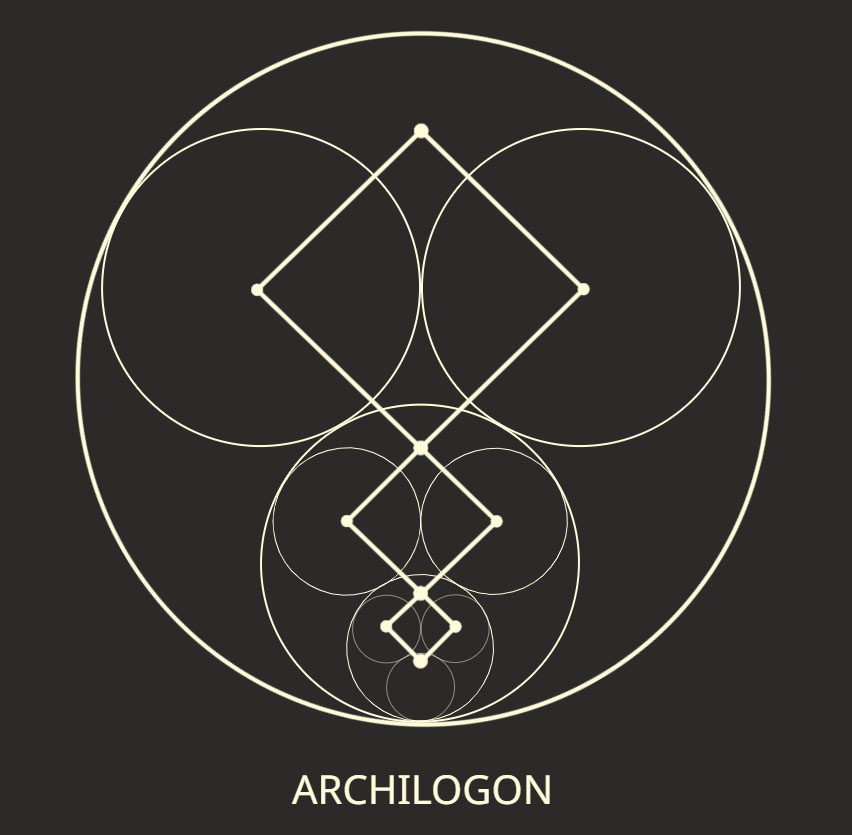
In this video, Elias Artista addresses an apparent paradox in the history of the Old Academy. Judged by the standards of the exact sciences, the early Academics do not appear to have achieved any significant results. The picture changes, however, if their true object is understood to have been not Mathematics in the modern sense, but «Mathesis»: the search, across different disciplines, for the same logical and formal structure expressed by the geometrical Forms of the Archetypal Diagram. Plato may then be understood as the «Architect of the Sciences», that is, as the coordinator of this project within the Academy. After his death, his successors pursue different paths according to their individual inclinations: Speusippus seeks the common root underlying every discipline through Numbers and Forms; Xenocrates arranges Ideas and Gods within the same architecture, placing it at the service of Theosophy. Against the background of the Archetypal Diagram’s gradual disappearance, the celebrated Pythagorean «Polymathia» thus reveals its original meaning: not the accumulation of separate bodies of knowledge, but the recognition, through Analogy, of the same formal structure across different domains of knowledge.
Archilogon – The key to Synthetic Logic. A project by Elias Artista.
Bibliography
Works Cited
- Proclus, Commentary on Euclid’s Elements, 67–68.
- Leonid Zhmud, “Plato as Architect of Science”, in Phronesis, Vol. 43, No. 3, Brill, Leiden, 1998, p. 237.
- Diogenes Laertius, Lives of Eminent Philosophers, IV, 2.
- Harold Cherniss, The Riddle of the Early Academy, Russell & Russell, New York, 1962, p. 42.
- Philodemus, Storia dei filosofi. Platone e l’Accademia (PHerc. 1021 e 164), ed. T. Dorandi, Naples, Bibliopolis, 1991, PHerc. 1021, col. Y, ll. 1–7; pp. 126–127.
- Theology of Arithmetic, chapter “On the Decad”.
- Stobaeus, Eclogae physicae et ethicae, I, p. 62, ll. 18–30 Wachsmuth.
- Hans Joachim Krämer, Der Ursprung der Geistmetaphysik: Untersuchungen zur Geschichte des Platonismus zwischen Platon und Plotin, Schippers, Amsterdam, 1964, in the chapter “Die theologischen Fragmente des Xenokrates”.
- Eduard Schwartz, “Apomnemoneumata”, in Paulys Realencyclopädie der classischen Altertumswissenschaft, Vol. II.1, Stuttgart, 1895, cols. 170–171.
Further Reading
- David T. Runia, Philo of Alexandria and the Timaeus of Plato, Brill, Leiden, 1986.
- Leonardo Tarán, Speusippus of Athens, Brill, Leiden, 1981.
- Margherita Isnardi Parente, Senocrate, Ermodoro – Frammenti, Bibliopolis, Naples, 1982.
Video transcription
A recurring historical question about the Academy is whether its activities fostered the development of the exact sciences in antiquity or, on the contrary, held it back. We shall examine the birth of formal mathematics in the chapter entitled Geometry. For now, however, we can anticipate a few points.
Although Plato made no discoveries in the strictly scientific sense, scholars generally agree that he played an important role both in organising research and in shaping its methods. According to Zhmud, the Old Academy resembled a research institution, where the leading mathematicians and astronomers of the time worked under Plato’s supervision.
Philodemus calls Plato the “Architect of the Sciences”. But what exactly does this expression mean? Our reconstruction of Synthetic Logic suggests that Plato directed Academic research according to the Forms of the archetypal diagram. This would have been regarded as a task of the highest Mathesis. We use this term to designate Ideal Mathematics, which differs profoundly from Mathematics as we understand it today.
Plato begins with the Forms produced by the Partition of the Whole, then seeks traces of the same logical division within each discipline, so as to define its internal elements. Such a project could only be coordinated by someone capable of viewing the sciences as a unified whole. It is in this sense that Plato may be called an “Architect of the Sciences”.
A particularly illuminating passage appears in the Catalogue of Geometers contained in Proclus’ Commentary on Euclid’s Elements:
“All these Geometers lived together in the Academy and conducted their research jointly. Philip of Mende, a pupil of Plato who had been initiated by him into Mathematics, pursued his investigations under Plato’s guidance. He also examined every question that he believed might contribute to the development of Platonic Philosophy.”
The evidence points to a common project. Plato supplied its philosophical direction, while the results achieved in each field helped, in turn, to refine particular aspects of Platonic philosophy. Everything begins with Philosophy, and with Logic in particular.
When Socrates explains the Divided Line and its fourfold structure to Glaucon in the Republic, he does not pause to explain the principles governing its construction. He simply takes them for granted. If our hypothesis is correct, and the Diagram already existed in its complete form in the books of Philolaus, the Academics would not have been primarily concerned with the metaphysical Forms — the geometrical structure developed by the Pythagoreans. Their work would instead have focused on the Ideas determined by those Forms: their analogical counterparts at the conceptual level.
Together with Plato, the Academics probably sought to assign an analogical content to each Form, each scholar working within his own field of research. In doing so, they would have expanded the list of dialectical oppositions attested by Aristotle. The project concerning the Forms appears to have been fully defined and completed in the Diagram of Pythagoras. The project concerning the Ideas, by contrast, may have remained in a state of continual development.
The interests reflected in Plato’s Dialogues led his own research into Language, proto-Psychology, Politics, Pedagogy, and Theosophy. His aim was to arrive at clear and systematic conceptual definitions of Ideas such as Justice, Beauty, and the Good. These, as we should remember, are at once Ideas, Gods, and forms of our psyche.
We can now return to our initial question. The Academy understood Science in a markedly different sense from our own. Some scientific discoveries made within the Academic milieu would pass into the later mathematical tradition. Yet the synthetic project that traced them back to their common Pythagorean foundations would exert no comparable influence upon modernity. Above all, Ideal Mathematics would gradually become unintelligible.
Zhmud writes:
“Speusippus wrote On Mathematics and On Pythagorean Numbers; Hermodorus wrote On Mathematics; Xenocrates wrote On Mathematics in six books, On Geometry in five books, On Arithmetic, On the Theory of Numbers, On Astrology in six books, and On Geometry in two books. Yet, despite their prolific work in Philosophy, and perhaps in the History of Mathematics, none of them left any mark upon the exact sciences. Judging from the fragments of their works, such as the long fragment from Speusippus’ On Pythagorean Numbers, the material that interested them was far removed from the actual problems of contemporary Mathematics, and their approach could in no sense be described as ‘professional’. The reason is very simple: they studied Mathematics for the sake of Philosophy rather than for the sake of Mathematics itself.”
The reasoning is sound, but it presupposes a different definition of the object under investigation. Zhmud assesses these works from the perspective of Mathematics understood as an exact science. They should instead be read as expressions of Mathesis: the Pythagorean Ideal Mathematics that constitutes a pure Philosophy founded upon Geometry.
After Plato’s death, the precious diagram contained in the books purchased through Dion of Syracuse probably passed to Speusippus, together with his uncle’s library. From this point onwards, its transmission becomes increasingly difficult to trace. The diagram appears gradually to dissolve into partial reconstructions and fragmentary accounts. A dramatic period of decline in the history of Philosophy thus begins.
The Academy itself, however, did not close: its activities continued. Echoes of Plato can still be heard in the works of the new scholarchs, Speusippus and Xenocrates, although only a few fragments survive. Both appear to preserve the underlying logic, but each explores a different path according to his own inclinations.
Speusippus, who succeeded his uncle as head of the Academy, appears to embody the authentic spirit of Mathesis. Unfortunately, most of what we know about him comes from Aristotle and the anonymous author of the Theology of Arithmetic.
According to Aristotle, Speusippus did not develop Plato’s insights because he regarded them as an unnecessary and artificial complication of Pythagorean doctrine. Speusippus seems to have accepted the Forms while rejecting the Ideas developed from them. The contemplation of the Diagram may have led him to conclusions that differed from those reached by the other Academics. Aristotle would later use this disagreement to reinforce his criticism of the obscurity of Pythagorean doctrines.
Diogenes Laertius, citing Diodorus, credits Speusippus with seeking a common foundation for the different fields of knowledge:
“Speusippus was the first to see what the various disciplines had in common and, as far as possible, to demonstrate their mutual affinity.”
We cannot be certain which “Diodorus” Diogenes had in mind. Eduard Schwartz identifies him with the opponent of Phanias, who is generally identified in turn as Diodorus Cronus. He was active between the late fourth and early third centuries BC, and therefore still relatively close to the first generations of the Academy. If this identification is correct, the testimony may derive from a tradition not far removed from Speusippus himself.
The Greek verb used here is significant: theaomai, meaning “to look at” or “to observe”, but also “to contemplate”. The particular form employed, etheásato, therefore describes an activity originally connected with sight. We do not know whether Diogenes is reproducing Diodorus’ exact words. He may, however, have preserved an ancient formulation whose concrete referent was no longer recognisable within the context of his account.
If so, Speusippus did not merely postulate an abstract principle shared by the different disciplines. He may have derived the relationship among them from the contemplation of the archetypal diagram.
Harold Cherniss describes the structure of his thought in these terms:
“For Speusippus, the essential nature of each thing is identical with the complex of all its relations to other things, so that the content of existence is nothing other than the entire network of those relations, traced within a universal diairetic scheme. Different entities are simply different focal points within a single system of relations.”
In our reconstruction, this is precisely the purpose of Pythagoreanism. Speusippus investigates the analogical root of the different disciplines and seeks to relate them formally and geometrically, beginning with the Forms of the Archetypal Diagram. Diodorus may therefore still have been referring to the literal “contemplation” of the diagram. In the text of Diogenes, only the final verbal echo of that practice may have survived. In his logical premises, then, Speusippus appears to be an authentic Pythagorean.
The anonymous author of the Theology tells us that he inherited his uncle’s library and, above all, the writings of Philolaus:
“On the basis of the Pythagorean teachings, which were then held in high esteem, and particularly the writings of Philolaus, Speusippus composed a subtle little book.”
That little book, now lost, was entitled On Pythagorean Numbers. The Theology preserves several passages from it, but the Pythagorean Diagram does not appear in any of them. We do not know whether Speusippus included a drawing of it or omitted it altogether. In either case, the author of the Theology does not reproduce it and is therefore unable to describe it in detail.
Speusippus’ successor, Xenocrates, sought to preserve the master’s thought as conveyed through the Dialogues. Through careful exegesis, he attempted to make it internally coherent and, as far as possible, systematic. Xenocrates seems to have applied the structure of the diagram chiefly to Theosophy, as the following passage from Stobaeus suggests:
“Xenocrates, son of Agathenor, of Chalcedon, establishes the Monad and the Dyad as Gods. The former occupies the rank of male and father, ruling in heaven, and he also calls it Zeus, Odd, and Nous; for him, this is the first God. The latter he calls Dike, female and mother of the Gods, presiding over the portion below heaven; for him, she is the soul of the universe.”
This is Theosophy founded upon Dialectic: the Gods are deduced from their position within the archetypal structure. The passage from Stobaeus also shows that the placement of the Ideas or Gods in relation to the Forms and Numbers still allowed for a degree of interpretation.
According to Krämer, Xenocrates developed an original doctrine. Yet to speak of “originality” here seems excessive. Working from an already formalised Pythagorean structure, Xenocrates was more probably attempting to organise a coherent pantheon within the Pythagorean Cosmos. This central concern with the Ideas or Gods anticipates the efforts of later Platonists to establish Paganism as an official religion in opposition to Christianity. We shall examine this at length in the chapter entitled Pantheon.
Speusippus therefore seeks the common root of the disciplines through the study of Numbers and Forms. Xenocrates places that same architecture at the service of Theosophy. Their investigations differ in content, but both remain consistent with the Pythagorean project.
We do not know what became of the books of Philolaus after they passed into the hands of Speusippus. Xenocrates probably acquired them later, even though he was not among Plato’s heirs. What we do know is that their contents were regarded as exceptionally precious.
Diogenes Laertius writes:
“Speusippus was the first to divulge what Isocrates called ‘the secrets of his art’, as Caeneus attests.”
This account shows that Speusippus was already associated in antiquity with the disclosure of “reserved” teachings. In this climate of secrecy, guarded communication, and fragmentary information, disagreements over the interpretation of the Psyché would emerge very early.
One example is the “Lambda-shaped” arrangement of the seven numbers mentioned in the Timaeus, which Plutarch attributes to Crantor of Soli. Nothing in the dialogue itself reveals this arrangement. This is therefore strong evidence that Crantor was among the last to see the Diagram, through his teacher Xenocrates.
If we connect the centres of the six lateral circles of the Archilogon to the lower midpoint, a “V” appears: an inverted Lambda. The two numerical progressions can certainly be derived from the text of the Timaeus; the dialogue, however, never explains how they should be arranged geometrically. Their configuration becomes apparent only from the complete underlying figure, where the two lines diverge as the circles progressively increase in size.
The most coherent explanation, therefore, is that Crantor saw the diagram through Xenocrates and subsequently transmitted the famous divergence “orally”.
We can now give a fuller answer to our opening question: within the Pythagorean circle of the Academy, every line of inquiry arising from reflection upon the archetypal Forms — physical, mathematical, logical, and theosophical — was almost certainly pursued in parallel, with each supporting the others. The greatest obstacle to understanding the aims and methods of the Old Academy lies precisely in this movement across different planes, all governed by the same logical and formal structure.
The celebrated Pythagorean Polymathy was not the accumulation of many separate branches of knowledge. It was the ability to recognise, through Analogy, the same formal structure across different domains. This was not encyclopaedism, but “structural transversality”.
The Pythagorean studied many things because he did not regard them as truly “separate”. Arithmetic, Geometry, Harmonics, Language and Psychology became different expressions of the same system of relations. The diagram made it possible to reconstruct the underlying architecture of each discipline.
This synthetic vision is what distinguishes the Philosopher from the erudite scholar. The erudite scholar knows many things but cannot connect them within an organic whole. The Philosopher not only knows them, but also understands their role and meaning, because they are Parts of a functional Whole. Indeed, their position within the structure of that Whole is precisely what “defines” them.
For Plato, what matters is not how much one knows, but whether one can organise that knowledge into a unified, synoptic vision. Knowledge becomes useful only when it compels the mind to move beyond the apparent separation of the disciplines and grasp the principle they share.
The project of the Platonic Academy therefore stands in direct opposition to modernity’s prevailing tendency towards the progressive analytical fragmentation of disciplines. Such specialisation has undoubtedly made the extraordinary development of Science possible. Yet it is difficult to imagine Plato approving of the same fragmentation within Philosophy, which arose precisely as the Science of Unity.
“To the Principle!”