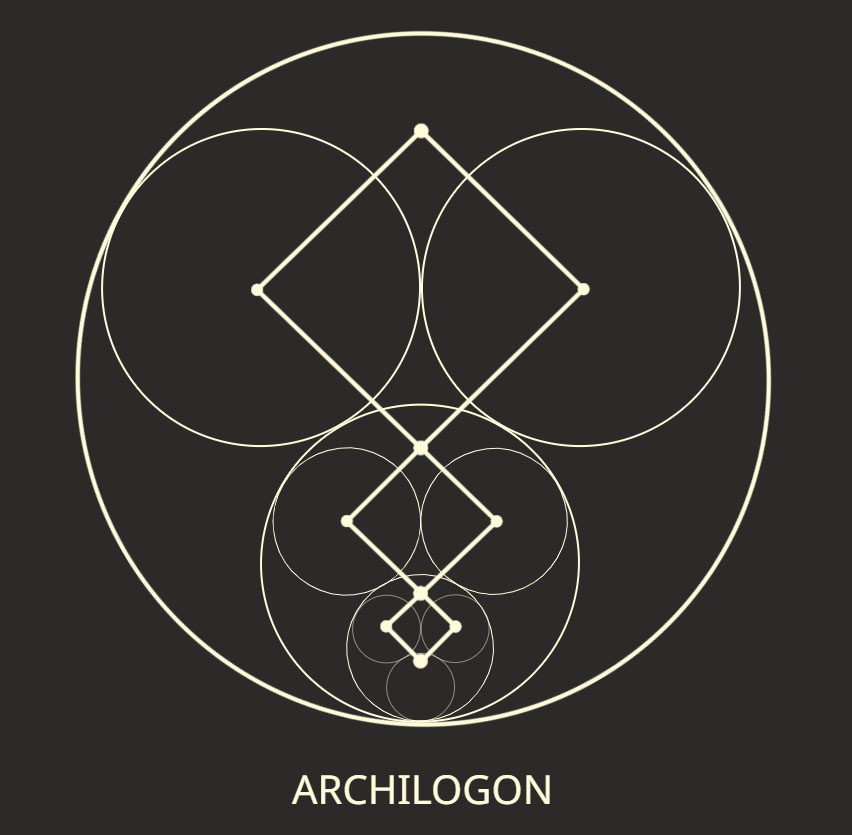
In this video, Elias Artista interprets the dogma of Platonism as the residue of a deduction whose underlying process has been lost. In his Dialogues, Plato does not transmit truths founded upon authority, but omits the long pedagogical path and the diagrammatic key through which they could be reached. When that key disappears, the conclusion survives as an unsupported claim, and what once constituted the end point of a demonstration becomes the starting point of a belief. The decisive historical transition occurs when the Archetypal Diagram, which displayed simultaneously the Parts, the oppositions, and the Relations that structured the Whole, is replaced by fragmentary testimony. Once the figure has been lost, what can no longer be shown must be recounted; what can no longer be deduced must be guaranteed by authority. This is the “fall into Pistis”: from Comprehension, or Noesis, which restores a given content to its intelligible foundation, to Faith, or Pistis, which accepts that content without tracing it back to the rationale that produced it. Here, then, lies the role of the “moderate Scepticism” that permeates the Archilogon’s reconstructive project: an attitude capable of testing fragmentary and incongruous testimony without excluding the possibility that an underlying truth may lie concealed behind the inexplicable.
Archilogon – The key to Synthetic Logic. A project by Elias Artista.
Bibliography
Works Cited
- Immanuel Kant, Prolegomena to Any Future Metaphysics, Preface, AA 4:260.
- Calcidius, Commentary on Plato’s Timaeus, ch. 127.
- William James, The Varieties of Religious Experience: A Study in Human Nature (Centenary Edition), Routledge, London/New York, 2002, pp. 9–10, 29.
- Pseudo-Dionysius the Areopagite, The Celestial Hierarchy, VI, 1, 200C.
- Arnold I. Davidson, “Introduzione”, in L’insegnamento degli antichi, l’insegnamento dei moderni, Edizioni ETS, Pisa, 2012, p. 15.
- Gospel of John, 20:29.
- Valentina Izmirlieva, All the Names of the Lord: Lists, Mysticism, and Magic, University of Chicago Press, Chicago/London, 2008, p. 5.
Further Reading
- Johann Gottlieb Fichte, Foundations of the Entire Science of Knowledge.
Video transcription
Welcome, wanderer, to the seventh stage of the Archilogon project. In the previous stage, we proposed a reconstruction of how Plato’s Academy may have operated: as a community of scholars, in which different disciplines were united by reflection upon the same diagrammatic structure. Transmitted by the Pythagorean tradition through the work of Philolaus of Croton, this figure made it possible, through a process of analogy, to identify the same formal Relations across widely different fields of inquiry.
The question that defines our seventh stage is this: What happens when the Archetypal Diagram disappears, and only the propositions originally deduced from it survive? What happens when the very key that once made it possible to understand the logical foundations of a doctrine is lost?
When we first approach an ancient philosophical work with a clear and rational mind, we cannot help wondering where the “certainty” surrounding its claims about the supersensible comes from. Any Philosophy that investigates Reality without first receiving a dose of the "Socratic vaccine" now appears unbearably dogmatic. Even Plato, the supreme rationalist, cannot entirely escape the charge of dogmatism, despite the strength with which that very "vaccine" runs through his veins.
Yet Plato did not transmit dogmas. Rather, in the Dialogues, he “omitted” the process leading to some of his claims. He left the conclusions visible, but did not reveal the method by which they had been reached. Dogma would arise later, when his later interpreters, no longer able to reconstruct that process, transformed the conclusion of a lost deduction into a truth to be accepted on authority.
In his Commentary on the Psychogony of the Timaeus, written seven centuries after Plato’s death, Calcidius encounters passages whose rationale he cannot fully reconstruct, and writes:
“Plato, relying more upon authority than upon compelling and persuasive arguments, shows that faith must precede all the sciences, especially when such claims come not from ordinary individuals, but from great and, in a certain sense, ‘divine’ men. It is not by chance that people say of Pythagoras: ‘Ipse Dixit, and there is no need to inquire any further.’ This tells us that we need not constantly resort to proofs and compelling arguments when dealing with what has been handed down to us by the ancients, men endowed with an almost divine wisdom.”
Through his work, Calcidius attempts to carry into Latin culture a system of thought formulated in a language and within a conceptual horizon that had long since become remote. Wherever he can reconstruct an argument, he presents it. Wherever its underlying rationale escapes him, he has no recourse but to invoke the authority of the ancients.
The initial trust required by Plato amounts to a form of pedagogical epoché. The aspirant is not asked to believe, but temporarily to suspend both assent and rejection. He is asked not to dismiss what his present logic cannot yet comprehend, so that he may loosen the constraints of his habitual logic and enter into a different one. His judgement is not abolished, but deferred until he is able to reconstruct the reasons for the claim by himself.
Calcidius, by contrast, ultimately turns this provisional suspension into a potentially unlimited trust, extended to every claim that initially appears incomprehensible. His Commentary on the Timaeus, now severed from the pedagogical work performed upon the living consciousness of the aspirant, must entrust the transmission of a remote body of thought to writing alone. Yet once the diagrammatic key has also been lost, writing can preserve the fragments of the system, but cannot reproduce the long discipline through which they were reassembled within the Whole, and thereby comprehended. The reader is left with no alternative but to accept the word of one who is presumed to know. It is precisely at this point that methodological trust becomes dogmatic faith.
What was originally the conclusion of a demonstration thus becomes the starting point of a belief. The proposition is preserved, but can no longer be deduced, because the inferential mechanism that produced it is no longer available: certain key elements are missing. Its truth must therefore be guaranteed by external factors: the antiquity of the tradition, the authority of the master, the sacred status of the text, or the divine origin of the teaching.
In confronting this dramatic shift, a “moderate” scepticism performs an indispensable function. Scepticism is a valuable ally of Reason, provided that it does not become compulsive. Almost any intellectual construction can be razed to the ground, and the sceptic who turns doubt into a permanent habit, eventually becomes arid and tiresome. Yet even tiresome scepticism can have a fruitful effect, for it compels the sceptic’s opponent to defend his position by digging more deeply in search of firmer foundations.
One might say that the thesis “Hume” generated the antithesis “Kant”, and that Hume is therefore a "metaphysically necessary entity". Kant himself writes:
“I freely admit that it was the warning of David Hume which, many years ago, first interrupted my dogmatic slumber and gave my investigations in the field of Speculative Philosophy an entirely different direction.”
The scepticism underpinning the Archilogon project is moderate because it does not destroy the deep conviction that ancient doctrine may contain an underlying truth, despite the language through which it was transmitted. The truth lying at the heart of dogma may plausibly have been handed down in an incomplete form, and progressively misunderstood.
This attitude allows us to distinguish Pythagorean Metaphysics sharply from any body of teaching founded upon Revelation. Pythagorean doctrine is not “sacred” in the sense of proclaiming itself to be the “divine Word”. It was regarded as “sacred” by those who understood its value and saw it as one of the most sublime achievements of human Reason.
As a preliminary step, it is worth distinguishing a "community" from a "sect". The ancient Pythagorean communities may certainly have possessed rules, rituals, and forms of secrecy. Their philosophical core, however, did not consist in obedience to a “revealed” truth, but in a truth to be attained and shared through a transformation of the aspirant’s psychic structure. That transformation was necessary if the aspirant was to comprehend — literally, to “contain” — a logic broader and more complex than the one with which he had begun. Pythagorean aspirants trained themselves to “transcend” the Logic of the Part, with which each person is endowed at birth, and to conform themselves to the Logic of the Whole.
The difference between a philosophical community and a sect lies not in the presence of rituals, symbols, or reserved teachings, but in their relationship to the questions they raise. A philosophical community submits every answer to an inquiry into its rationale, whereas a sect protects the answer from the question that might endanger it. A sect defends itself and seeks to preserve its own existence indefinitely. A philosophical community is an instrument directed towards an end higher than the survival of the group itself.
Every community is founded upon a reference text declared inviolable. William James invites us to investigate the concrete conditions under which texts regarded as “sacred” were produced. He asks: under what precise biographical conditions did their authors contribute to these dogmatic texts? And what exactly did each of them, as an individual, have in mind when communicating his revelations?
James cautiously observes that answering these historical questions does not determine what spiritual value such texts may possess for any one of us. To reconstruct the psychological origin of a belief is not to refute its content. Yet the converse is also true: to attribute a divine origin to a belief is not to demonstrate its truth.
Religious experience can give rise to inner phenomena of extraordinary depth. An individual may be inwardly convinced that he has come into contact with the divine. He may interpret a vision, an intuition, or a transformation of consciousness as a "revelation". Psychology may investigate the origin, structure, and effects of that experience. Whether it warrants true claims about the divine, however, is a philosophical question. Our principal concern here is what happens when a private experience claims the status of universal knowledge.
From a philosophical standpoint, the problem emerges at the moment of transmission. An inner experience, precisely because it is private, cannot be reproduced in the listener. It can only be recounted. The listener does not personally relive what the witness claims to have experienced: he must take the witness at his word.
As the reputation of a revelation becomes established, the later links in the chain of transmission no longer claim any direct experience. They present themselves instead as guardians of a wisdom codified in an archaic and now inaccessible age. They mythologise its origins and its founders — Hermes, Abraham, Thoth, Pythagoras, even Plato himself — in the conviction that these men, rendered indistinct by temporal distance, possessed faculties denied to present humanity.
Pseudo-Dionysius the Areopagite, for example, openly declares the principle governing this form of transmission:
“We cannot know the mysteries of the celestial intelligences and their most sacred perfections except through what the Divinity has chosen to reveal to us concerning them. We shall therefore say nothing on our own initiative. So far as we are able, we shall set forth the visions of the angelic world as the sacred authors contemplated them and transmitted them to us.”
Here the chain of transmission appears in its complete form: the sacred authors contemplated; the text recounts what they are said to have contemplated; the commentator expounds what the text recounts; and the believer must accept the testimony. The original vision, assuming that there ever was one, becomes progressively inaccessible. Only the word remains.
In the Gospel of John, Jesus says to Thomas:
“Because you have seen me, you have believed; blessed are those who have not seen and yet have believed.”
Valentina Izmirlieva interprets this passage as follows:
“The Christianity of the future will consist of those who believe not because they witnessed the events, but because they heard the message. The episode of Thomas thus represents a crucial transformation of the Christian community, from a society of direct disciples, or eyewitnesses, into the universal community of a verbal tradition. Henceforth, the ear rather than the eye becomes the organ of faith, while the focus of Christian experience shifts from the revelatory event, the Incarnation, to the text that proclaims it, the New Testament. These changes have at least two important consequences: they bring the invisible to the forefront of the Christian imagination and make its verbal representation — the rhetoric of the invisible — crucial to the social reproduction of Christian identity.”
Every tradition destined to outlive its founders must necessarily undergo this passage from witness to testimony. In the Pythagorean-Platonic tradition, however, the shift takes a very particular form. It is not merely a passage from experience to its narration. It is a passage from the presence of a concrete object — the Archetypal Diagram — to the transmission of evocative words whose connection to their original rationale has been lost together with the object itself.
The Diagram made the Parts, their oppositions, and the Relations that united them within the Whole, visible all at once. Language, by contrast, is forced to name each element in succession. Once the figure is lost, individual propositions begin to survive in isolation from the very structure that gave them meaning. What could once be shown must now be recounted. What can no longer be justified must be guaranteed by authority.
This is the transition we define as the “fall” from Noesis into Pistis. In the Divided Line, Plato does not use the term ‘Pistis’ in the Christian sense of “religious faith”. He uses it to indicate a form of belief that stops at what appears to be given and fails to reach the intelligible principle upon which it rests. We fall into Pistis whenever thought stops before a received content and abandons the attempt to trace it back to its original grounds.
There may be many reasons for this surrender. One may be inwardly convinced that no rationale exists. One may give up after acknowledging one’s inability to understand. Or, out of intellectual pride, one may encounter something that is not immediately comprehensible and declare it "inaccessible to everyone". An appeal to the sacred then becomes an astute and often successful manoeuvre: a way of disguising gaps beneath a solemn tone capable of intimidating less resolute sceptics. Anyone who presents himself as a “master” cannot afford to reveal points of vulnerability, for his credibility would be at stake.
Arnold Davidson writes:
“Philosophers dislike unfamiliarity because it entails a moment of incomprehension, often a painful one. Philosophers are assumed to understand everything, as though their intelligence had no limits. To acknowledge one’s inability to understand requires a certain maturity, a virtue more spiritual than intellectual.”
Anyone who aspires to authentic Philosophy must possess intellectual honesty above all else. To acknowledge the existence of limits is the first step towards overcoming them. Secondly, he must never lay down his arms without a struggle. If he is a true philosopher, his instinct will always lead him back before Reason, in whose presence he knows himself to be entirely naked.
If the struggle seems too arduous, or if the need for security and belonging prevails over the pursuit of truth, he may halt his ascent along the Divided Line and decide that Pistis is his final destination. There is nothing morally contemptible in this choice, provided that 'faith' is not mistaken for 'comprehension'. The priest, as priest, preserves and transmits a received truth. The philosopher, as philosopher, cannot exempt any claim, however solemn, from the examination of his own Reason. The same individual may fulfil both roles, but he cannot appeal to the authority of the first while claiming to speak in the name of the second. Dogma begins when a proposition ceases to be the conclusion of a demonstration and becomes the first article of a faith.
This distinction is not an attack upon Religion or Mysticism, whose consolation we ourselves have sought more than once in difficult times. It means recognising that they answer different needs. Religion can offer consolation, belonging, moral guidance, and hope. Philosophy, by contrast, arises from a relentless question that refuses to be silenced by an incongruous answer. The philosopher cannot contemplate the surrender of thought before the unknown, even if the battle is already lost. To surrender before fighting would turn defeat into a self-fulfilling prophecy.
This seventh stage of our journey has been conceived as an interlude between two historical chapters, allowing us to examine more deeply the delicate transition from Plato to Platonism. Before continuing our journey, we must pause to understand the historical, sociological, and psychological mechanism that transformed rational content into dogma.
In the centuries following Plato, as the expansion of Christianity created a new religious urgency, Pagan philosophers increasingly concentrated their efforts upon defining the divine. The Platonic Psyché and its Ideas-Forms supplied the elements from which a system could be reconstructed, both within Paganism and within the revealed religions. From the end of the Old Academy onwards, the obscurity of a crucial dialogue such as the Timaeus, together with the loss of the Pythagorean key, brought about the dramatic shift from Noesis — what is 'comprehended' — to Pistis — what is 'accepted on faith'. It marks nothing less than the dissolution of Philosophy in its original form.
“To the Principle!”