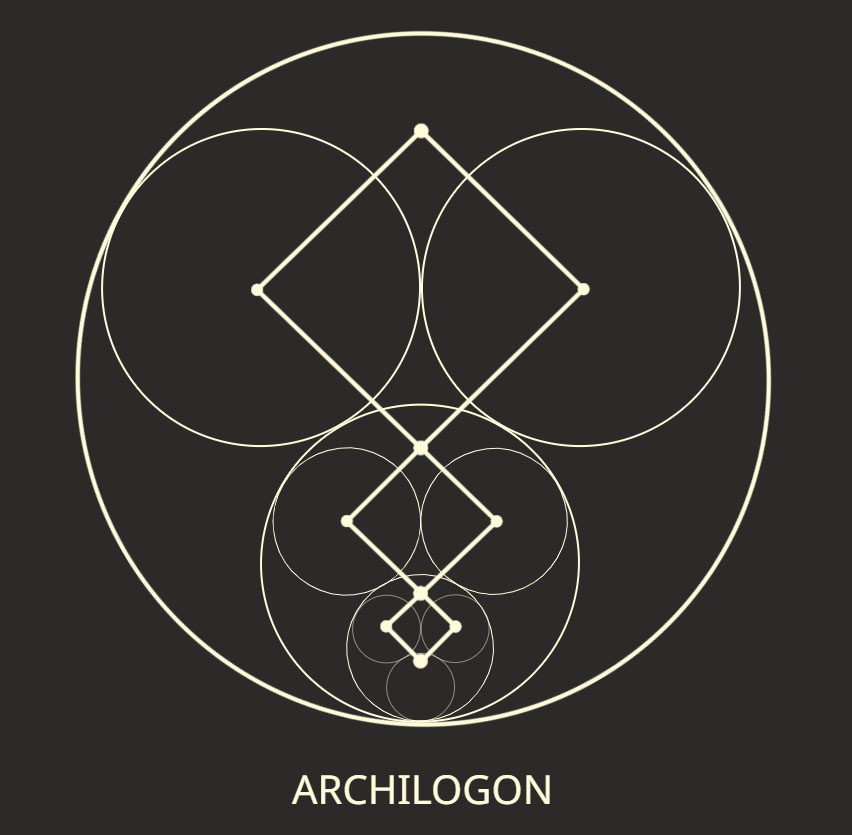
In this video, Elias Artista traces the transformation of Platonism in late antiquity, as the pagan world confronts the spread of Christianity. He begins with Plato’s Timaeus: its powerful mythical imagery captivates readers, while the logic beneath the account and the Pythagorean figure described in the Psychogony recede from view. With the loss of the diagrammatic key, Plato’s successors inherit the conclusions without the deductive process that produced them. This crisis is compounded by the entanglement of Platonic and Aristotelian logic and the growing subordination of philosophical enquiry to truths established by religious authority. Faced with the spread of Christianity, some Neoplatonists seek to preserve ancient wisdom through authoritative texts, rituals and a succession of masters. The Chaldean Oracles, Iamblichus, Julian’s political project and the work of Proclus mark different stages in this endeavour. Yet in trying to save a philosophy founded on individual understanding, they come to transmit its conclusions as a tradition to be accepted and defended on faith. Julian’s project comes to a premature end, and Paganism fades as a public religion. Fragments of ancient Sophia, however, continue to survive within the esoteric tradition.
Archilogon – The key to Synthetic Logic. A project by Elias Artista.
Bibliography
Works Cited
- Anders Nygren, Agape and Eros, The Westminster Press, Philadelphia, 1953, p. 166.
- André-Jean Festugière, L’Astrologia e le Scienze Occulte, edited by M. Neri, Mimesis Edizioni, Milan/Udine, 2019, p. 23.
- Philo of Alexandria, Allegorical Interpretation II.3.
- Vera Calchi, The Theology of the Epinomis, Routledge, London/New York, 2023, pp. 3–4.
- Lucius Apuleius, De Deo Socratis, 1907 ed., p. 353.
- Emilie Kutash, The Ten Gifts of the Demiurge: Proclus on Plato’s Timaeus, Bloomsbury, London/New York, 2011.
- Julian, Hymn to King Helios, dedicated to Sallust, 44.
Further Reading
- Plato, Timaeus.
- Plato, Epinomis.
- Alfred Edward Taylor, Plato and the Authorship of the ‘Epinomis’, H. Milford, London, 1930.
- Polymnia Athanassiadi, ‘The Chaldaean Oracles’, in P. Athanassiadi and M. Frede (eds), Pagan Monotheism in Late Antiquity, Oxford University Press, Oxford, 1999.
- Polymnia Athanassiadi, Damascius: The Philosophical History, Apamea Cultural Association, Athens, 1999.
- H. D. Saffrey, ‘Les Néoplatoniciens et les Oracles Chaldaïques’, Revue des Études Augustiniennes 27 (1981): 224–225.
Video transcription
As the Hellenistic age draws to a close and the Roman Empire emerges, a cultural shift begins that will have profound consequences for philosophy. In the early centuries of the Empire, the critical and enquiring spirit of Greek culture encounters religious traditions grounded in Revelation. This encounter does not come out of nowhere: religious and philosophical ideas from many sources had already entered the thought of the educated classes.
Anders Nygren writes:
"It was an event of immense importance in human history when Plato, in his Doctrine of Ideas, brought about a synthesis of Greek rationalism and Eastern mysticism. Unless both these sources of Plato's vision are taken into account, its deeper significance cannot really be understood. Its dual character is apparent even at a glance: the dialectical arguments of the Dialogues are interrupted here and there by passages of myth, drawn chiefly from the religious ideas of the time."
Nygren brings into focus a question that has long troubled Plato's interpreters: how does rational enquiry relate to religious belief in his work? The Timaeus makes that question especially pressing. After reading the Dialogues in which Socratic scepticism takes centre stage, one might come away from the Timaeus with the impression that Plato has abandoned critical enquiry and invested his claims with a sacred aura.
In the Timaeus, Plato describes the formation of the physical universe by a mysterious Demiurge. He begins with a description of the Pythagorean Cosmos: an archetypal diagram devised to give matter an intelligible order through numbers, lines, circles and proportions. The question is whether the Demiurge is a god who exists in his own right, or an artistic embodiment of Reason.
When readers struggle to grasp this distinction, and above all to reconstruct the figure described in the Psychogony, their attention shifts towards the mythical images of the story. They admire the power of the description without fully grasping its underlying logic. Successive generations of interpreters become increasingly fascinated by the mystery, and less attentive to the formal relations concealed within the account.
Festugière sees this change in interpretation as a sign of the times:
"Little by little, the ancient Greek rationalism which, from the earliest Ionian thinkers onwards, had freed scientific thought from the encrustations of myth and apocalypse, gave way to a very different disposition. Reason was distrusted, while confidence was placed in ways of knowing foreign to Reason. Neither development caused the other; together, they expressed the same abdication of the mind."
We should not imagine that Religion replaced Philosophy overnight. In the history we are examining, Philosophy begins as an individual pursuit, while Religion seeks social cohesion. The two therefore always coexist. Yet when a philosophical doctrine becomes a tool in the hands of religious authorities, it loses its proper point of reference: the authority of Reason.
From our perspective, the crisis of the philosophical project pursued by Pythagoras and Plato has three aspects, which emerge at different historical moments.
First: the loss of the diagrammatic key. The Doctrine of the Partition of the Whole, generated through Structural Deduction, uses a diagram to express the possible logical and formal relations through which Reality can manifest itself. Once the diagram and its logic are lost, Plato's successors retain the conclusions but lose the deductive process that produced them. Passed down as "truth" exempt from demonstration, those conclusions become dogmas.
Second: the gradual entanglement of Platonic and Aristotelian logic. Platonism and Aristotelianism begin with different questions. An attempt to fuse the foundations of the two systems risks making both incoherent. This issue will become particularly important in the Middle Ages. Porphyry's conciliatory thought, for example, will become an unavoidable point of reference. Meanwhile, the Liber de Causis, an Arabic reworking of material drawn from Proclus, will circulate in Latin under Aristotle's name. These are different episodes, but both reveal the incongruous results of this blending, as we shall see in later chapters.
Third: the subordination of philosophical enquiry to revealed truth. When philosophical texts are interpreted to meet the demands of doctrine, some questions can no longer be pursued freely. Metaphysics is then called upon to support a scriptural canon instead of testing its own principles. It would be wrong to say that every theologian ceases to enquire. The problem is the constraint placed upon enquiry when religious authority has settled the conclusion in advance.
Philo of Alexandria, for example, reinterprets Greek Philosophy in the light of the Hebrew Scriptures:
"God exists, then, in accordance with Unity and Uniqueness; or rather, we should say that Unity exists by virtue of the one God. For every number is more recent than the world, as is Time. God, however, is older than the world, and is its Creator."
Here the theosophical process is reversed and becomes theological. God is no longer deduced from the Form of Unity: Unity depends upon God. Human Reason must bow before the power of the Creator. This reversal allows mystery to transcend Reason and, consequently, allows claims made in its name to escape critical examination.
As we noted in the chapter on the Academy, Pythagorean and Platonic Theosophy arises from an attempt to apply the Doctrine of the Partition of the Whole to the transcendent realm. Its aim is to isolate and define the fundamental forces of Reality - the Ideas, or Gods - through a logical and geometrical structure. The Epinomis, a dialogue preserved within the Platonic corpus and attributed by several scholars to Philip of Opus, bears witness to the theosophical project as it developed within the Academy.
Vera Calchi writes:
"The Epinomis offers a means of developing the Platonic roots of Cosmology as the indispensable background to Ethics, in keeping with the later Hellenistic conception of the human being as a citizen of the universe. Without entirely stripping religious worship of its civic character, Philip of Opus seeks to purify official theology. He takes to its furthest point the attempt to reconcile civic religion with astral, cosmic religion, whose separation Plato had already noted. As well as representing the culmination and natural development of the theological arguments of Plato's later work, the theology of the Epinomis anticipates the Hellenistic idea of a cosmic religion that transcends the traditional limits of civic cults."
Later, the emergence and growing pressure of Christianity will change both the aims and the urgency with which post-Platonic thinkers pursue the theosophical project. Philosophy is undergoing a transformation. Once an instrument for the individual development of consciousness, driven by the aspirant's own inner impulse, it is becoming a theoretical foundation for Religion, placed at the service of a scriptural canon.
Adherence to a cult, of course, does not ensure that its followers understand the metaphysical reasoning on which its doctrine rests. Apuleius offers an example of this gap in understanding. Describing himself as a "Platonic philosopher", he sharply criticises worship without reason in De Deo Socratis:
"The multitude of the ignorant, strangers to Philosophy, lacking true devotion, sound reason, religious understanding, and the ability to grasp the truth, neglect the Gods both through excessively scrupulous worship and through insolent contempt. Some are fearful through superstition; others are arrogant through disdain. Many worship the Gods who dwell in the sublime heights of heaven, far from human corruption, but they do not worship them as they should. All fear them without knowing them, while some impiously deny that they exist. Plato held that the Gods were incorporeal, living natures, without beginning or end, eternal in past and future, distinct by nature from material bodies and possessed of an essence of their own."
Apuleius' judgement is valuable because it exposes a fundamental divide: people can practise a cult without understanding the order to which it refers. Outward participation does not guarantee Noesis. It is hard to imagine anything further from Philosophy.
In this respect, Christianity introduces a powerful new force. Its message addresses everyone, regardless of social background or education. To reach such a varied public, its teaching must take a form that can be communicated even to those who have never followed a philosophical path.
Pagan Theosophy consequently takes on new meanings and new aims. Through authoritative texts, a succession of masters and disciples, and institutions capable of protecting it, it too seeks to establish a pagan canon in response to the spread of Christian Theology. Neoplatonic works do not all serve the same purpose, and it would be misleading to reduce Plotinus, Porphyry and Iamblichus to a single programme. But in late antiquity, Philosophy needs a broader communal life if it is to survive. It seeks to show that it preserves a wisdom older than Christianity.
It is in this setting that the Chaldean Oracles gain authority. Composed in the second century, the Oracles are received by some Neoplatonists as testimony to a remote wisdom. Their prestige lends weight to the image of an unbroken succession of masters, while their testimony lends religious authority to a philosophical system distinct from the Christian one. The Oracles were not composed in response to Christianity. What matters to us is the role they came to play, at this particular historical moment, in the construction of a pagan tradition.
Emilie Kutash writes:
"The Chaldean Oracles have been called 'the Bible of the Neoplatonists', and their canonical status dates back to Iamblichus' extensive commentary on the work. The Amelius whom Proclus cites in his commentary documents a direct connection between the Chaldean Oracles and some of the earlier figures mentioned by Proclus who gathered at Apamea, where Iamblichus brought together students from across the Mediterranean world."
Thanks above all to the work of Iamblichus, Apamea becomes one of the places where this ancient tradition is studied and transmitted. Proclus, too, will later invoke its succession of masters.
With the conversion of the emperor Constantine and the growing favour shown to Christianity, the conflict enters a new phase. The Empire's elites do not all share the same faith, and the old pagan culture survives the emperor's decision. When Julian comes to power in 361, he therefore attempts to restore traditional cults to a central place in public life.
Julian - later called "the Apostate", or "the Renouncer", by Christians - pursues an ambitious and desperate project: to uphold learned Paganism as an alternative to the Christian religion. Educated in a Neoplatonic milieu and initiated into the Eleusinian Mysteries, he looks to Iamblichus as an intellectual guide. In his Hymn to King Helios, Julian writes:
"Sallustius, if you wish to consult fuller and more inspired works on these subjects, you will find in the treatises of the divine Iamblichus the perfection of human wisdom."
A public religion requires recognisable teachings, rites, celebrations and people entrusted with transmitting them. What for Pythagoras and Plato had been the outcome of an individual journey towards Noesis thus becomes the canon of a "counter-theology": something to accept and defend even without having undergone the process needed to understand it. In the effort to save a teaching founded on individual understanding, it is transformed into a tradition founded on faith.
In the Seventh Letter, attributed to Plato, we read:
"There is no way to set down in writing what I am concerned with."
The highest questions cannot be fully entrusted to a treatise; understanding matures through long practice undertaken together. A canon alone is of no use.
Yet the centres of late antique Platonism begin producing extensive commentaries and ordering doctrines in an effort to reconcile different authorities. Writing commentaries is not itself the problem. The problem arises when preserving a tradition takes precedence over retracing and questioning its reasons.
The Intelligible Monad is, after all, a difficult principle to grasp for someone seeking a being to whom prayers can be addressed. Divine hierarchies, cosmic images and ritual practices offer a way in even to those who have not followed the deductive path.
Julian dies in 363, bringing his political attempt to an end. In the final decades of the fourth century, particularly under the laws issued during the 390s under Theodosius, traditional cults face increasingly severe restrictions.
In the following century, Proclus continues to study Plato, Pythagoras, the Orphic traditions and the Chaldean Oracles. His Commentary on the Timaeus bears witness both to remarkable philosophical activity and to an effort to unite these different voices within a single ancient wisdom.
Paganism nevertheless fades as a public religion, although its philosophical inheritance continues to circulate, even among Christian authors. What is missing is the key that could lead its doctrines back to their rational and deductive origin. Without that key, the Philosophy that does not submit to Revealed Theology will continue to survive through the esoteric tradition, which will claim the fragments of ancient Sophia as its own.
"To the Principle!"