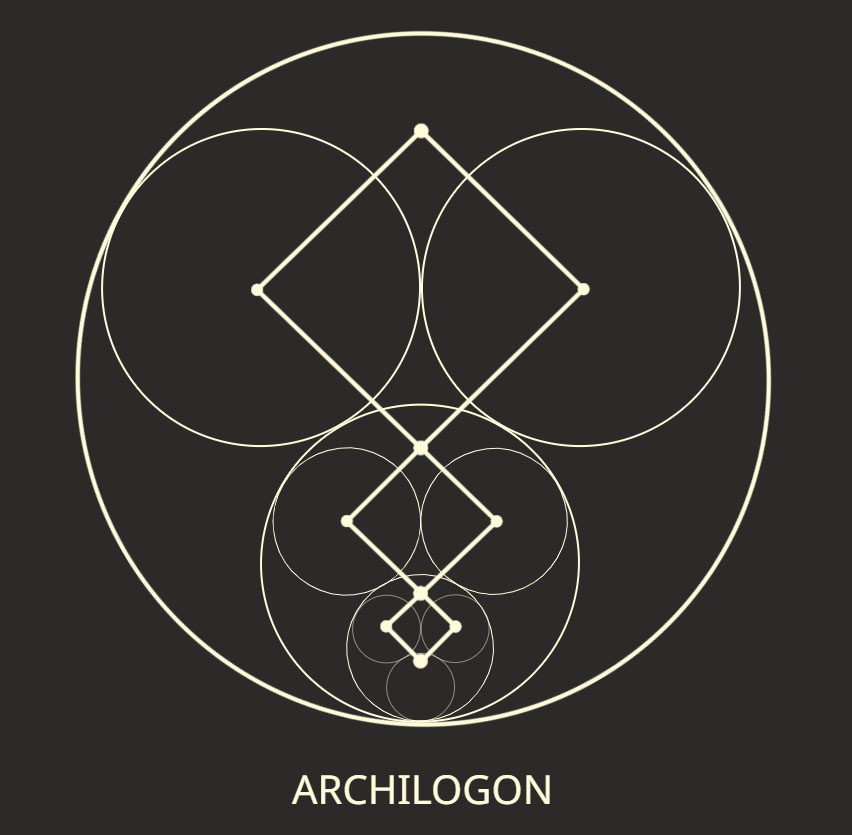
In this video, Elias Artista examines the distinction between Theosophy and Theology by clarifying the role of the divine within human knowledge. The Archilogon’s interpretation reveals a decisive reversal: Theology subordinates Reason to Faith; Theosophy subordinates Faith to Reason. Pythagorean and Platonic Theosophy seeks to deduce the functions of the Gods through the Partition of the Whole, whereas Theology grounds its reflection in a truth revealed by the divinity itself. Beginning with the origins of the two terms and their retrospective application, the discussion then examines the relationship between the Gods as mythical representations, Ideas and Forms. Plato’s Philebus illustrates the transition from divine personification to an inquiry into its intelligible content. Drawing on the writings of Plutarch, John Philoponus and Festugière, the video explores how myth contributes to knowledge, the meaning of Sophia, and the transformation of consciousness that leads from Doxa to Episteme.
Archilogon – The key to Synthetic Logic. A project by Elias Artista.
Bibliography
Works Cited
- Plato, Philebus, 12b–c.
- Plutarch, Isis and Osiris, 58.
- John Philoponus, Commentary on Nicomachus’ Introduction to Arithmetic, I, 1, 45–49. In Giovanna R. Giardina, Giovanni Filopono matematico tra neopitagorismo e neoplatonismo. Commentario alla Introduzione aritmetica di Nicomaco di Gerasa, Catania, CUECM, 1999, pp. 250 ff.
- André-Jean Festugière, Il Dio Cosmico, ed. M. Neri, Mimesis Edizioni, Milan/Udine, 2020, vol. II, pp. 722–723.
Further Reading
- Porphyry, La Filosofia rivelata dagli Oracoli - Con tutti i frammenti di Magia, Stregoneria, Teosofia e Teurgia, eds. G. Girgenti and G. Muscolino, Bompiani, Milan, 2011.
- Werner Jaeger, La Teologia dei primi pensatori greci, Florence, La Nuova Italia, 1961.
- Pierre Hadot, Esercizi spirituali e Filosofia antica, new expanded edition, Turin, Einaudi, 2005.
- Eric R. Dodds, Pagani e cristiani in un’epoca di angoscia - Aspetti dell’esperienza religiosa da Marco Aurelio a Costantino, Florence, La Nuova Italia, 1970.
Video transcription
The distinction between Theosophy and Theology introduced in the previous video concerns the place of the “divine” within human knowledge. To clarify this distinction, we use “Theosophy” here to mean the philosophical investigation of transcendent Forms, and “Theology” to mean reflection grounded in a revealed truth.
The term “Theology” means “discourse on the divine”. Its earliest known occurrence is in Plato’s 'Republic', in the fourth century BC, where Socrates discusses how poets should represent the Gods. The term thus already belongs to pagan culture. Christian authors will later adopt it and develop its meaning in relation to Revelation.
“Theosophy”, by contrast, means “wisdom concerning divine things”. The noun is attested in the third century, both in a Christian context, in Origen’s 'Commentary on the Psalms', and in a Neoplatonic context, in Porphyry. Its meaning is elusive and varies from one author to another. For some, including Porphyry, the “opponent of Christianity”, the entirely dogmatic content of Theosophy amounts to nothing less than a "counter-Revelation".
The term “Theosophy” therefore postdates Plato. When we apply it to Pythagorean and Platonic inquiry, we use it retrospectively to mark a fundamental difference between two approaches.
“Theosophy” contains the word “Sophia”. If Sophia is the body of teaching that comprises the doctrine of the Partition of the Whole, then the Gods deduced through this method emerge as functions established through “theosophical” inquiry.
Our distinction is intended to bring out a clear reversal in the approach to the divine: Theology subordinates Reason to Faith, whereas Theosophy subordinates Faith to Reason. In Theology, the divine is a premise accepted on authority. In Theosophy, as we have just defined it, the divine is a conclusion reached through Structural Deduction.
In Pythagorean and Platonic Theosophy, the divine Pantheon can be understood as the anthropomorphic and mythical representation of a system of Ideas and Forms. The Idea is the conceptual correlate of the Form, while the God personifies it in the language of myth. The outcome of this theosophical inquiry departs from popular religion.
A telling example appears in the 'Philebus', where Plato examines the Idea of Pleasure:
“Let us begin our inquiry with the very deity whom Philebus calls ‘Aphrodite’, although ‘Pleasure’ would be the more appropriate name.”
“Quite right.”
“My reverence for the names of the Gods, Protarchus, is beyond anything you can imagine, and goes far beyond mere fear. I shall therefore call Aphrodite by the name that is dear to her. As for Pleasure, however, what I know is that it appears in many different forms. That is where we must begin our inquiry into its nature.”
Philebus’ identification of 'Aphrodite' with 'Pleasure' suggests an analogical correspondence between the anthropomorphic name of the Goddess and the Idea she embodies. Socrates takes up this association but sets the name aside. His concern is to investigate the nature of the Idea of Pleasure, its Essence, so as to distinguish its various manifestations and determine their relations to the Idea of the Good.
The name 'Aphrodite', a product of art and popular tradition, thus gives way to a rational examination of the Idea, and therefore of the Form beneath that anthropomorphic mask. This transition shows how the philosopher seeks, through Eidetic Intuition, to move from the representation to its intelligible content.
Yet setting aside the God’s popular name does not mean that Plato adopts a secular position. Refusing to remain attached to the anthropomorphic mask does not amount to declaring the Gods “unreal”. To understand this, we must return to the distinction between 'Reality' and 'Being' established earlier in our journey. Forms do not “exist”; they “subsist”. Plato is firmly and utterly convinced that the Gods subsist as eternal and recurrent Forms and Ideas.
The philosopher, understood specifically as someone who aspires to Sophia, draws a clear distinction between anthropomorphic figures and what they represent. Rather than deriving a God’s properties from its assumed existence or from the tradition that names it, the philosopher apprehends the Form through its manifestations. The logical Partition of the Whole then provides the basis for determining its position and function.
Popular tradition intuits a function of reality, and the artist gives it an image. The philosopher’s task is to understand its role within Reality. Accepting the artistic personification without recognising its underlying intelligible content leaves us at the level of representation, and therefore of popular faith. The philosophical path, instead, requires us to move from the perception of the manifestation to the eternal Form that expresses the same function.
Plutarch, a scholar and priest at Delphi, writes in his 'Isis and Osiris':
“We should not treat myths as though they were history. Instead, we should take the essence of each myth and bring it into accordance with what is plausible.”
Myth can contribute to knowledge, provided that the metaphor it conveys is correctly interpreted. This is why Plato accuses Homer of misrepresenting the Gods: for the purposes of his narratives, Homer portrays them as superhuman creatures. The poetic power of myth can direct consciousness towards the Intelligible, but philosophical understanding requires us to grasp what the image conceals.
The “Theology of Revelation” proceeds differently. It begins with something accepted as an expression of divine will and transmitted through Holy Scripture. Theological reflection develops from this indispensable foundation, using rational arguments that never call the initial principle itself into question.
The purpose of Religion is to shape a community. The Theology that supports it provides a theoretical foundation through intellectual reflection. Theology thus serves Religion by conveying a truth, bringing new believers into the community and strengthening their commitment.
This purpose need not be deceptive; it may rest on a deeply sincere conviction. Indeed, the more certain theologians are of the truth of their faith and its power to bring salvation, the more determined they will be to spread it.
To reach people whose education and experience differ, religious teaching must use representations that are readily accessible. Believers can then address a deity conceived in human terms: benevolent and tolerant, or stern and punitive; capable of rewarding, taking offence or forgiving.
The theologian may develop more subtle arguments. Scriptures associated with Revelation can be subjected to exegesis, historical study and critical discussion, even within the religious community. Their contexts, literary genres and the meanings of their words can all be examined. Yet if their authority rests on their status as Revelation, that status remains a boundary the inquiry cannot cross.
This boundary becomes apparent when the question concerns the foundation itself. If the ultimate answer depends on faith, rational inquiry encounters a premise it cannot justify by its own means. When preserving this certainty becomes essential to the community’s integrity, criticism may be perceived as a threat. In fundamentalist settings, doubt then triggers the immune response of an organism seeking to protect itself and survive.
Philosophy, in the sense in which we use the term here, does not seek converts indiscriminately. It addresses those who aspire to follow a path that transforms their consciousness. Its outcome is Comprehension, 'Noesis': knowledge of the supersensible order. Theosophy, as a branch of Philosophy, follows a course of education directed towards knowledge of the divine order.
John Philoponus, a Christian author educated in the Alexandrian philosophical tradition, bears witness to this ideal. In his 'Commentary on Nicomachus’ Introduction to Arithmetic', he writes:
“Those who lived before Pythagoras used the term ‘Sophia’ indiscriminately in every context. Pythagoras was the first to restrict its use, reserving the name ‘Sophia’ for the science of eternal things alone, while calling the love of this knowledge ‘Philosophy’. For the ultimate aim of Sophia is knowledge of divine things, whereas, according to Plato and Plotinus, the science of mathematical entities is what leads to Sophia.”
Plato therefore honours the Gods, but his inquiry does not take a text founded on a “divine word” as its starting point. Moving from the status of “believer” to that of “aspirant to Sophia” requires a change in how one relates to what is asserted. Aspirants must reconstruct the reasons for these assertions through the exercise of their own Reason, leaving Doxa behind to attain Episteme.
Plato’s spirituality consists in the search for the intelligible order of Reality and its transcendent constraints, rather than adherence to a particular faith. Festugière writes on this subject:
“Plato was led to the Doctrine of Ideas by the need to attain certain knowledge, rather than by religious considerations. The Intelligible alone is recognised as true Being and as the sole object of certain knowledge: it does not change, whereas everything sensible is constantly changing.
The task, then, is to construct this world of intelligible realities. Although these realities are many, each constitutes a single essence, and together they form a unified Whole. The task is therefore to apprehend their mutual relations and the way they are ordered under the concept of the One.
Intuition of the One-Good demands long and difficult preparation, both moral and scientific. It requires a combination of natural gifts that is rather rare, followed by years of mathematical and dialectical work. Even after these disciplines have been mastered, there is no certainty that the reward will follow.
There was only one Plato. Perhaps his experience occurred only once more, many centuries later, in Plotinus. From the very first generation after Plato, what might be called the ‘mysticism of Ideas’ was no longer practised.”
Festugière’s final judgement is too categorical. As our account unfolds, we shall encounter several thinkers engaged in this same inquiry into the Intelligible World. Their tools, methods and results differ, yet they share Plato’s disposition towards Synthetic Logic.
We shall return to them in the four chapters devoted to Mathesis Universalis: “Pantheon”, “Kabbalah”, “Mathesis” and “Idea”.
"To the Principle!"